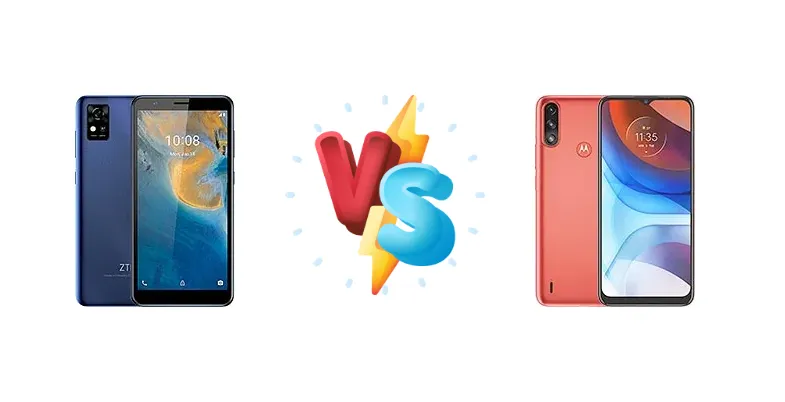
The ZTE Blade A31 and Motorola Moto E7i Power represent the absolute entry point into smartphone ownership. Both devices target users prioritizing affordability and essential functionality. This comparison dissects their similarities and subtle differences to determine which offers the best value for those on a tight budget.
🏆 Quick Verdict
For the average user seeking a basic, reliable smartphone, the Motorola Moto E7i Power edges out the ZTE Blade A31. The inclusion of 10W charging, while slow, provides a tangible benefit over the A31's unspecified charging speed, addressing a key pain point for budget phone users.
| Network |
|---|
| 2G bands | GSM 850 / 900 / 1800 / 1900 | GSM 850 / 900 / 1800 / 1900 |
| 3G bands | HSDPA 850 / 900 / 2100 | HSDPA 850 / 900 / 1700(AWS) / 1900 / 2100 |
| 4G bands | 1, 2, 3, 5, 7, 8, 20, 28, 38 | LTE |
| Speed | HSPA, LTE | HSPA, LTE |
| Technology | GSM / HSPA / LTE | GSM / HSPA / LTE |
| Launch |
|---|
| Announced | 2021, July 13 | 2021, February 23 |
| Status | Available. Released 2021, July 13 | Available. Released 2021, March 15 |
| Body |
|---|
| Build | - | Glass front, plastic back, plastic frame |
| Dimensions | 140 x 71 x 8.9 mm (5.51 x 2.80 x 0.35 in) | 165.1 x 75.9 x 9.2 mm (6.5 x 2.99 x 0.36 in) |
| SIM | Nano-SIM + Nano-SIM | Nano-SIM + Nano-SIM |
| Weight | 166 g (5.86 oz) | 200 g (7.05 oz) |
| | - | Water-repellent design |
| Display |
|---|
| Resolution | 720 x 1440 pixels, 18:9 ratio (~295 ppi density) | 720 x 1600 pixels, 20:9 ratio (~270 ppi density) |
| Size | 5.45 inches, 76.7 cm2 (~77.1% screen-to-body ratio) | 6.51 inches, 102.3 cm2 (~81.7% screen-to-body ratio) |
| Type | IPS LCD | IPS LCD, 380 nits (typ) |
| Platform |
|---|
| CPU | Octa-core (4x1.6 GHz Cortex-A55 & 4x1.2 GHz Cortex-A55) | Octa-core (4x1.6 GHz Cortex-A55 & 4x1.2 GHz Cortex-A55) |
| Chipset | Unisoc SC9863A (28 nm) | Unisoc SC9863A (28 nm) |
| GPU | IMG8322 | IMG8322 |
| OS | Android 11 (Go edition) | Android 10 (Go edition) |
| Memory |
|---|
| Card slot | microSDXC | microSDXC (uses shared SIM slot) |
| Internal | 32GB 2GB RAM | 32GB 2GB RAM |
| | - | eMMC 5.1 |
| Main Camera |
|---|
| Dual | - | 13 MP, f/2.0, 26mm (wide), 1/3.1", 1.12µm, PDAF
2 MP (macro) |
| Features | LED flash, HDR | LED flash, HDR, panorama |
| Single | 8 MP | - |
| Video | 720p@30fps | 1080p@30fps |
| Selfie camera |
|---|
| Features | - | HDR |
| Single | 2 MP (up-scaled to 5 MP) | 5 MP, f/2.2, 27mm (wide), 1.12µm |
| Video | - | 1080p@30fps |
| Sound |
|---|
| 3.5mm jack | Yes | Yes |
| 35mm jack | Yes | Yes |
| Loudspeaker | Yes | Yes |
| Comms |
|---|
| Bluetooth | 4.2, A2DP, LE | 4.2, A2DP |
| NFC | Yes (market/region dependent) | No |
| Positioning | GPS, GLONASS | GPS, GLONASS, GALILEO |
| Radio | FM radio | Unspecified |
| USB | microUSB 2.0 | USB Type-C 2.0 |
| WLAN | Wi-Fi 802.11 b/g/n | Wi-Fi 802.11 b/g/n |
| Features |
|---|
| Sensors | Accelerometer | Fingerprint (rear-mounted), accelerometer, proximity |
| Battery |
|---|
| Charging | - | 10W wired |
| Type | Li-Ion 3000 mAh, removable | Li-Ion 5000 mAh |
| Misc |
|---|
| Colors | Blue, Gray | Tahiti Blue, Coral Red |
| Models | - | XT2097-13 |
| Price | - | About 120 EUR |
ZTE Blade A31
- Potentially lower initial purchase price.
- Compact and lightweight design (likely).
- Simple and straightforward user experience.
- Unknown charging speed – potentially very slow.
- Limited performance for demanding tasks.
- Basic camera capabilities.
Motorola Moto E7i Power
- 10W wired charging for basic convenience.
- Recognizable Motorola brand and software support.
- Similar performance to the ZTE Blade A31.
- Slow charging speed compared to modern standards.
- Limited performance for demanding tasks.
- Basic camera capabilities.
Display Comparison
Both the ZTE Blade A31 and Motorola Moto E7i Power likely feature LCD panels, typical for this price segment. Specifics like resolution and brightness are not provided, but we can assume they are optimized for power efficiency rather than visual fidelity. Bezels are expected to be substantial on both devices, maximizing screen real estate within a compact form factor. Color accuracy will likely be standard for budget displays, prioritizing natural tones over vibrant, color-accurate reproduction.
Camera Comparison
Camera performance is expected to be basic on both devices. Details are scarce, but it's safe to assume both feature a primary camera and potentially a secondary depth sensor. The image processing will likely focus on simplicity, prioritizing quick capture over advanced features. Any secondary cameras (often 2MP macro lenses) are unlikely to offer significant image quality improvements and should be considered a marketing feature rather than a practical benefit. Without sensor size or aperture information, a direct comparison is impossible, but expectations should be tempered.
Performance
Both devices are powered by the Unisoc SC9863A chipset, a 28nm octa-core processor. The CPU configuration is identical – four cores clocked at 1.6 GHz (Cortex-A55) and four at 1.2 GHz (Cortex-A55). This means performance will be virtually indistinguishable in day-to-day tasks like browsing, social media, and light messaging. The 28nm manufacturing process, however, indicates limited thermal headroom, potentially leading to slight throttling under sustained load. Neither device is suited for demanding gaming or intensive multitasking.
Battery Life
Battery capacity is not specified for the ZTE Blade A31, while the Motorola Moto E7i Power includes 10W wired charging. This charging speed is slow by modern standards, taking several hours for a full charge, but it's a crucial advantage over the A31's unknown charging capabilities. The larger the battery capacity, the longer the device will last on a single charge, but the SC9863A's efficiency and the display's power draw will be the primary determinants of real-world battery life. The 10W charging on the Moto E7i Power provides a degree of convenience that the A31 likely lacks.
Buying Guide
Buy the ZTE Blade A31 if you prioritize a potentially lower initial cost and are comfortable with slower charging speeds. Buy the Motorola Moto E7i Power if you value the convenience of even basic wired charging and a slightly more recognizable brand reputation for software support, even within this price bracket.
Frequently Asked Questions
❓ Will the Unisoc SC9863A chipset struggle with popular apps like WhatsApp and Facebook?
No, the Unisoc SC9863A is sufficient for basic apps like WhatsApp and Facebook. These applications are not resource-intensive and will run smoothly on this chipset. However, expect longer loading times compared to more powerful processors.
❓ How long will it take to fully charge the Motorola Moto E7i Power with the 10W charger?
With the 10W charger, expect the Motorola Moto E7i Power to take approximately 3-4 hours to fully charge from 0%. While slow, this is a standard charging speed for ultra-budget smartphones and provides a usable charging solution.
❓ Can either of these phones run PUBG Mobile?
While technically possible to *install* PUBG Mobile, performance will be extremely limited and likely unplayable. The Unisoc SC9863A lacks the graphical power to run the game at acceptable frame rates, even on the lowest settings.
❓ Is the software on either phone heavily customized with bloatware?
Motorola generally offers a near-stock Android experience with minimal bloatware. ZTE's software experience can vary, and may include pre-installed apps. However, most of these can be uninstalled.