
ZTE Blade A31 vs Google Pixel 6a: A Clash of Titans (on a Budget)
| Phones Images | |||||
|---|---|---|---|---|---|
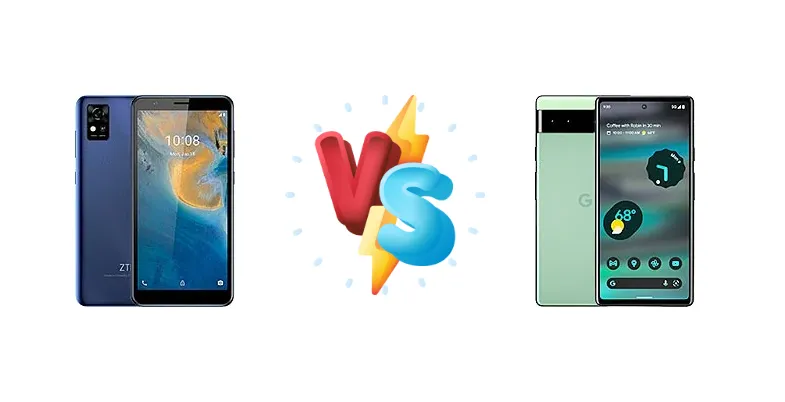
|
🏆 Quick Verdict
The Google Pixel 6a is the clear winner. While the ZTE Blade A31 offers affordability, the Pixel 6a's superior performance, camera, and software experience justify its higher price. It's a significant upgrade in almost every aspect.
| PHONES | ||
|---|---|---|
| Phone Names | ZTE Blade A31 | Google Pixel 6a |
| Network | ||
|---|---|---|
| 2G bands | GSM 850 / 900 / 1800 / 1900 | GSM 850 / 900 / 1800 / 1900 |
| 3G bands | HSDPA 850 / 900 / 2100 | HSDPA 800 / 850 / 900 / 1700(AWS) / 1900 / 2100 |
| 4G bands | 1, 2, 3, 5, 7, 8, 20, 28, 38 | 1, 2, 3, 4, 5, 7, 8, 12, 13, 14, 17, 18, 19, 20, 25, 26, 28, 29, 30, 38, 39, 40, 41, 42, 48, 66, 71 - GX7AS, GB62Z (USA/Canada) |
| 5G bands | - | 1, 2, 3, 5, 7, 8, 12, 20, 25, 28, 30, 38, 40, 41, 48, 66, 71, 77, 78 SA/NSA/Sub6 - GX7AS (USA/Canada) |
| Speed | HSPA, LTE | HSPA, LTE, 5G |
| Technology | GSM / HSPA / LTE | GSM / HSPA / LTE / 5G |
| - | 1, 2, 3, 5, 7, 8, 12, 20, 25, 28, 30, 40, 48, 66, 71, 77, 78 SA/NSA/Sub6 - G1AZG (International) | |
| Launch | ||
|---|---|---|
| Announced | 2021, July 13 | 2022, May 11 |
| Status | Available. Released 2021, July 13 | Available. Released 2022, July 21 |
| Body | ||
|---|---|---|
| Build | - | Glass front (Gorilla Glass 3), aluminum frame, plastic back |
| Dimensions | 140 x 71 x 8.9 mm (5.51 x 2.80 x 0.35 in) | 152.2 x 71.8 x 8.9 mm (5.99 x 2.83 x 0.35 in) |
| SIM | Nano-SIM + Nano-SIM | Nano-SIM + eSIM |
| Weight | 166 g (5.86 oz) | 178 g (6.28 oz) |
| - | IP67 dust/water resistant (up to 1m for 30 min) | |
| Display | ||
|---|---|---|
| Protection | - | Corning Gorilla Glass 3 |
| Resolution | 720 x 1440 pixels, 18:9 ratio (~295 ppi density) | 1080 x 2400 pixels, 20:9 ratio (~429 ppi density) |
| Size | 5.45 inches, 76.7 cm2 (~77.1% screen-to-body ratio) | 6.1 inches, 90.7 cm2 (~83.0% screen-to-body ratio) |
| Type | IPS LCD | OLED, HDR |
| - | Always-on display | |
| Platform | ||
|---|---|---|
| CPU | Octa-core (4x1.6 GHz Cortex-A55 & 4x1.2 GHz Cortex-A55) | Octa-core (2x2.80 GHz Cortex-X1 & 2x2.25 GHz Cortex-A76 & 4x1.80 GHz Cortex-A55) |
| Chipset | Unisoc SC9863A (28 nm) | Google Tensor (5 nm) |
| GPU | IMG8322 | Mali-G78 MP20 |
| OS | Android 11 (Go edition) | Android 12, upgradable to Android 15, up to 5 major Android upgrades |
| Memory | ||
|---|---|---|
| Card slot | microSDXC | No |
| Internal | 32GB 2GB RAM | 128GB 6GB RAM |
| - | UFS 3.1 | |
| Main Camera | ||
|---|---|---|
| Dual | - | 12.2 MP, f/1.7, 27mm, (wide), 1/2.55", 1.4µm, dual pixel PDAF, OIS 12 MP, f/2.2, 17mm, 114˚ (ultrawide), 1.25µm |
| Features | LED flash, HDR | Dual-LED flash, Pixel Shift, Auto-HDR, panorama |
| Single | 8 MP | 8 MP, f/2.0, 24mm (wide), 1.12µm |
| Video | 720p@30fps | 4K@30/60fps, 1080p@30/60/120/240fps; gyro-EIS, OIS |
| Selfie camera | ||
|---|---|---|
| Features | - | HDR, panorama |
| Single | 2 MP (up-scaled to 5 MP) | 8 MP, f/2.0, 24mm (wide), 1.12µm |
| Video | - | 1080p@30fps |
| Sound | ||
|---|---|---|
| 3.5mm jack | Yes | No |
| 35mm jack | Yes | No |
| Loudspeaker | Yes | Yes, with stereo speakers |
| Comms | ||
|---|---|---|
| Bluetooth | 4.2, A2DP, LE | 5.2, A2DP, LE |
| NFC | Yes (market/region dependent) | Yes |
| Positioning | GPS, GLONASS | GPS, GLONASS, GALILEO, QZSS |
| Radio | FM radio | No |
| USB | microUSB 2.0 | USB Type-C 3.1 |
| WLAN | Wi-Fi 802.11 b/g/n | Wi-Fi 802.11 a/b/g/n/ac/6e, dual-band, Wi-Fi Direct |
| Features | ||
|---|---|---|
| Sensors | Accelerometer | Fingerprint (under display, optical), accelerometer, gyro, proximity, compass, barometer |
| Battery | ||
|---|---|---|
| Charging | - | 18W wired, PD3.0 |
| Type | Li-Ion 3000 mAh, removable | Li-Po 4410 mAh |
| Misc | ||
|---|---|---|
| Colors | Blue, Gray | Chalk, Charcoal, Sage |
| Models | - | GX7AS, GB62Z, G1AZG, GB17L |
| Price | - | $ 138.99 / C$ 228.74 / ₹ 23,999 |
| Tests | ||
|---|---|---|
| Battery life | - | Endurance rating 94h |
| Display | - | Contrast ratio: Infinite (nominal) |
ZTE Blade A31
- Extremely affordable
- Decent battery life
- Lightweight design
- Weak performance
- Basic camera
- Low-resolution display
- Slow charging
Google Pixel 6a
- Excellent performance (Google Tensor)
- Outstanding camera
- Bright and vibrant display
- Clean Android experience
- Fast charging (PD3.0)
- Higher price than Blade A31
- Design can be polarizing
Display Comparison
The Pixel 6a boasts a significantly brighter display (876 nits) with an infinite contrast ratio, offering vibrant colors and excellent visibility even in direct sunlight. The Blade A31's display is likely adequate for basic use but lacks the Pixel's visual punch. The Pixel 6a's OLED technology also provides deeper blacks and better overall image quality.
Camera Comparison
Google's computational photography expertise shines in the Pixel 6a. It delivers exceptional image quality, even in challenging lighting conditions. The Blade A31's camera is adequate for casual snapshots, but lacks the Pixel's detail, dynamic range, and overall image processing capabilities. The Pixel 6a also offers features like Magic Eraser and Real Tone.
Performance
The Google Tensor chip in the Pixel 6a is a powerhouse compared to the Unisoc SC9863A in the Blade A31. Expect noticeably faster app loading, smoother multitasking, and a more responsive user experience on the Pixel 6a. The Blade A31 will handle basic tasks, but struggles with demanding apps and games.
Battery Life
Both phones offer impressive endurance ratings (94h), suggesting excellent battery life. However, the Pixel 6a's 18W wired charging with PD3.0 support provides faster charging speeds compared to the Blade A31, which likely has slower charging.
Buying Guide
Who should buy the ZTE Blade A31? Users prioritizing extreme affordability and basic functionality. Who should buy the Google Pixel 6a? Anyone seeking a premium experience, excellent camera, and smooth performance without breaking the bank.