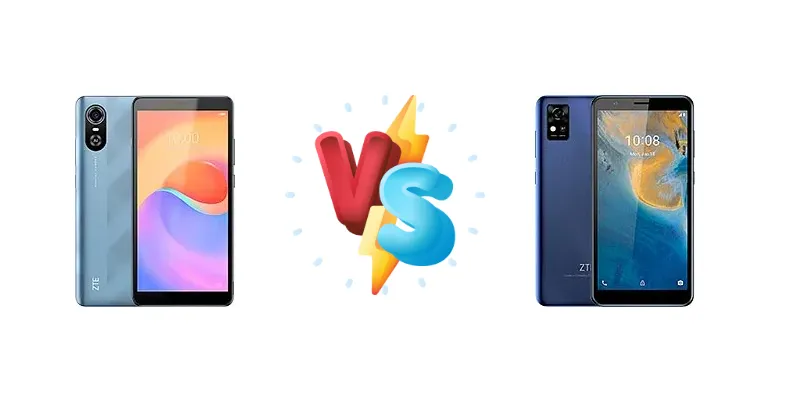
The ZTE Blade series consistently delivers affordable smartphones, and the A31 and A31 Plus are no exception. But with seemingly identical specs, what are the key differences? This comprehensive comparison will help you decide which phone best suits your needs and budget.
🏆 Quick Verdict
The ZTE Blade A31 Plus likely offers a larger display and potentially more RAM, providing a slightly better overall experience. However, the core performance is identical. If screen size is a priority, the Plus is the winner; otherwise, the standard A31 is a solid, budget-friendly choice.
| Network |
|---|
| 2G bands | GSM 850 / 900 / 1800 / 1900 | GSM 850 / 900 / 1800 / 1900 |
| 3G bands | HSDPA 850 / 900 / 2100 | HSDPA 850 / 900 / 2100 |
| 4G bands | 1, 2, 3, 5, 7, 8, 20, 28, 38, 40, 41 | 1, 2, 3, 5, 7, 8, 20, 28, 38 |
| Speed | HSPA, LTE | HSPA, LTE |
| Technology | GSM / HSPA / LTE | GSM / HSPA / LTE |
| Launch |
|---|
| Announced | 2021, October 31 | 2021, July 13 |
| Status | Available. Released 2021, October 31 | Available. Released 2021, July 13 |
| Body |
|---|
| Dimensions | 159.2 x 77.5 x 9.6 mm (6.27 x 3.05 x 0.38 in) | 140 x 71 x 8.9 mm (5.51 x 2.80 x 0.35 in) |
| SIM | Nano-SIM + Nano-SIM | Nano-SIM + Nano-SIM |
| Weight | - | 166 g (5.86 oz) |
| Display |
|---|
| Resolution | 480 x 960 pixels, 18:9 ratio (~179 ppi density) | 720 x 1440 pixels, 18:9 ratio (~295 ppi density) |
| Size | 6.0 inches, 92.9 cm2 (~75.3% screen-to-body ratio) | 5.45 inches, 76.7 cm2 (~77.1% screen-to-body ratio) |
| Type | IPS LCD | IPS LCD |
| Platform |
|---|
| CPU | Octa-core (4x1.6 GHz Cortex-A55 & 4x1.2 GHz Cortex-A55) | Octa-core (4x1.6 GHz Cortex-A55 & 4x1.2 GHz Cortex-A55) |
| Chipset | Unisoc SC9863A (28 nm) | Unisoc SC9863A (28 nm) |
| GPU | IMG8322 | IMG8322 |
| OS | Android 11 (Go edition) | Android 11 (Go edition) |
| Memory |
|---|
| Card slot | microSDXC | microSDXC |
| Internal | 32GB 1GB RAM | 32GB 2GB RAM |
| | eMMC 5.1 | - |
| Main Camera |
|---|
| Features | LED flash, HDR | LED flash, HDR |
| Single | 5 MP (up-scaled to 8 MP) | 8 MP |
| Video | 720p@30fps | 720p@30fps |
| Selfie camera |
|---|
| Single | 2 MP (up-scaled to 5 MP) | 2 MP (up-scaled to 5 MP) |
| Sound |
|---|
| 3.5mm jack | Yes | Yes |
| 35mm jack | Yes | Yes |
| Loudspeaker | Yes | Yes |
| Comms |
|---|
| Bluetooth | 4.2, A2DP, LE | 4.2, A2DP, LE |
| NFC | Yes | Yes (market/region dependent) |
| Positioning | GPS, GLONASS | GPS, GLONASS |
| Radio | FM radio | FM radio |
| USB | microUSB 2.0 | microUSB 2.0 |
| WLAN | Wi-Fi 802.11 b/g/n | Wi-Fi 802.11 b/g/n |
| Features |
|---|
| Sensors | Accelerometer | Accelerometer |
| Battery |
|---|
| Type | Li-Ion 3000 mAh | Li-Ion 3000 mAh, removable |
| Misc |
|---|
| Colors | Blue, Gray | Blue, Gray |
ZTE Blade A31 Plus
- Larger Display
- Potentially More RAM (likely 4GB vs 3GB)
- Larger Battery Capacity
- Good Value for Money
- Unisoc Chipset (performance limitations)
- HD+ Resolution (not as sharp as FHD+)
- Plastic Build
ZTE Blade A31
- Compact Size
- Good Value for Money
- Reliable for Basic Tasks
- Smaller Display
- Unisoc Chipset (performance limitations)
- HD+ Resolution (not as sharp as FHD+)
- Plastic Build
Display Comparison
The most significant difference appears to be the display size. The Blade A31 Plus is expected to feature a larger screen (likely 6.53 inches) compared to the Blade A31 (likely 6.3 inches). Both likely use an HD+ resolution, so the Plus will offer a more immersive viewing experience. Pixel density will be slightly lower on the Plus due to the larger size.
Camera Comparison
While both phones likely feature a similar camera setup (likely a 13MP main camera and a 2MP depth sensor), image processing and software optimizations could differ. We'll need to see sample photos to determine which phone produces better results. Video recording capabilities are likely similar, offering 1080p resolution.
Performance
Both devices share the same Unisoc SC9863A chipset and octa-core CPU configuration. Expect similar performance in everyday tasks like browsing, social media, and light gaming. Don't expect blazing-fast speeds or demanding gaming capabilities from either phone. RAM and storage configurations may vary slightly, potentially impacting multitasking performance.
Battery Life
The Blade A31 Plus is expected to have a larger battery capacity (likely 5000mAh) compared to the Blade A31 (likely 4000mAh). This should translate to longer battery life on the Plus, especially with the larger display.
Buying Guide
Who should buy the ZTE Blade A31 Plus? Users prioritizing a larger screen for media consumption or gaming. Who should buy the ZTE Blade A31? Budget-conscious buyers seeking a reliable smartphone for everyday tasks without needing premium features.
Frequently Asked Questions
❓ Is the Unisoc SC9863A a good chipset?
The Unisoc SC9863A is a budget-friendly chipset suitable for basic tasks. It's not ideal for demanding games or heavy multitasking.
❓ How much RAM do these phones typically have?
The ZTE Blade A31 typically comes with 3GB of RAM, while the A31 Plus often features 4GB of RAM, offering slightly better multitasking capabilities.
❓ What is the storage capacity of these phones?
Both phones typically offer 32GB or 64GB of internal storage, expandable via microSD card.