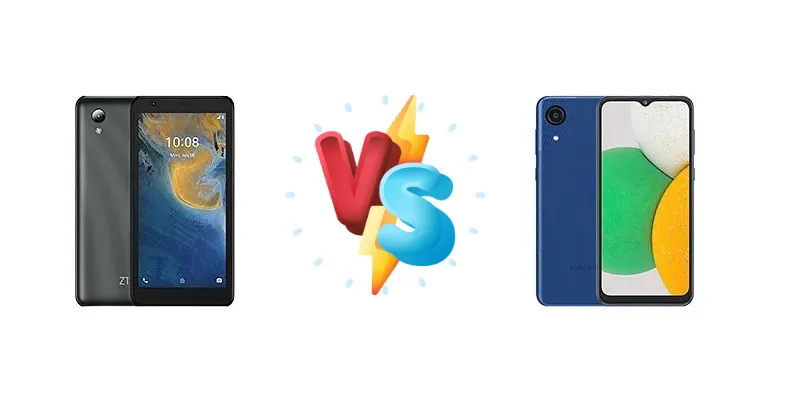
Both the ZTE Blade A31 Lite and the Samsung Galaxy A03 Core target the ultra-budget smartphone market, but they take different approaches to delivering value. The A31 Lite prioritizes simplicity with a quad-core processor, while the A03 Core opts for an octa-core configuration. This comparison dissects the implications of these choices, examining performance, battery life, and overall usability to determine which device offers the best experience for the price.
🏆 Quick Verdict
For most users, the Samsung Galaxy A03 Core is the better choice. Its Unisoc SC9863A chipset, featuring an octa-core CPU, provides a significantly smoother multitasking experience and improved app loading times compared to the ZTE Blade A31 Lite’s quad-core Unisoc SC9832E. While both phones are entry-level, the A03 Core offers a more future-proofed and responsive user experience.
| Network |
|---|
| 2G bands | GSM 850 / 900 / 1800 / 1900 | GSM 850 / 900 / 1800 / 1900 |
| 3G bands | HSDPA 850 / 900 / 2100 | HSDPA 850 / 900 / 2100 |
| 4G bands | LTE | 1, 3, 5, 7, 8, 20, 28, 38, 40, 41 |
| Speed | HSPA, LTE | HSPA 21.1/5.76 Mbps, LTE |
| Technology | GSM / HSPA / LTE | GSM / HSPA / LTE |
| Launch |
|---|
| Announced | 2021, June | 2021, November 15 |
| Status | Available. Released 2021, June | Available. Released 2021, December 06 |
| Body |
|---|
| Build | Plastic frame, plastic back | Plastic back, plastic frame |
| Dimensions | 137.3 x 67.5 x 10.5 mm (5.41 x 2.66 x 0.41 in) | 164.2 x 75.9 x 9.1 mm (6.46 x 2.99 x 0.36 in) |
| SIM | Nano-SIM + Nano-SIM | · Nano-SIM· Nano-SIM + Nano-SIM |
| Weight | 143 g (5.04 oz) | 211 g (7.44 oz) |
| Display |
|---|
| Resolution | 480 x 960 pixels, 18:9 ratio (~215 ppi density) | 720 x 1600 pixels, 20:9 ratio (~270 ppi density) |
| Size | 5.0 inches, 64.5 cm2 (~69.6% screen-to-body ratio) | 6.5 inches, 102.0 cm2 (~81.8% screen-to-body ratio) |
| Type | TFT LCD | PLS LCD |
| Platform |
|---|
| CPU | Quad-core 1.4 GHz | Octa-core (4x1.6 GHz Cortex-A55 & 4x1.2 GHz Cortex-A55) |
| Chipset | Unisoc SC9832E (28 nm) | Unisoc SC9863A (28 nm) |
| GPU | Mali-T820 MP1 | IMG8322 |
| OS | Android 11 (Go edition) | Android 11 (Go edition) |
| Memory |
|---|
| Card slot | microSDXC | microSDXC (dedicated slot) |
| Internal | 32GB 1GB RAM | 32GB 2GB RAM |
| | eMMC 5.1 | eMMC 5.1 |
| Main Camera |
|---|
| Features | LED flash | LED flash |
| Single | 5 MP | 8 MP, f/2.0, AF |
| Video | 720p@30fps | 1080p@30fps |
| Selfie camera |
|---|
| Single | 2 MP | 5 MP, f/2.2 |
| Sound |
|---|
| 3.5mm jack | Yes | Yes |
| 35mm jack | Yes | Yes |
| Loudspeaker | Yes | Yes |
| Comms |
|---|
| Bluetooth | 4.2, A2DP, LE | 4.2, A2DP |
| NFC | No | No |
| Positioning | GPS | GPS, GLONASS |
| Radio | Unspecified | Unspecified |
| USB | microUSB 2.0 | microUSB 2.0, OTG |
| WLAN | Wi-Fi 802.11 b/g/n | Wi-Fi 802.11 b/g/n, Wi-Fi Direct |
| Features |
|---|
| Sensors | Accelerometer | Accelerometer, proximity |
| Battery |
|---|
| Type | Li-Ion 2000 mAh | Li-Ion 5000 mAh |
| Misc |
|---|
| Colors | Gray, Blue | Black, Blue |
| Models | - | SM-A032F, SM-A032F/DS, SM-A032M |
| Price | About 80 EUR | £ 74.99 |
| SAR | - | 0.30 W/kg (head) |
| SAR EU | - | 0.24 W/kg (head) 1.39 W/kg (body) |
ZTE Blade A31 Lite
- Potentially lower price point
- Simpler user experience
- May have longer standby time due to less active cores
- Significantly slower performance
- Struggles with multitasking
- Less responsive user interface
Samsung Galaxy A03 Core
- Faster and smoother performance
- Better multitasking capabilities
- More responsive user interface
- Potentially higher price
- Octa-core processor may consume slightly more power under load
- May not be significantly better in camera performance
Display Comparison
Neither device boasts a standout display. Both utilize 28nm chipsets, suggesting similar power constraints impacting display capabilities. While specific display specs (resolution, brightness) are unavailable, the focus here is on processing power to drive the UI. The A03 Core’s more powerful processor *could* translate to slightly smoother scrolling and animations, even with a similar panel.
Camera Comparison
Without detailed camera specifications, a direct comparison is difficult. However, both phones likely feature basic camera setups geared towards casual photography. Given the price point, image quality will be heavily reliant on software processing. The A03 Core’s more powerful processor *could* enable slightly faster image processing and potentially better low-light performance, but this is speculative. It's reasonable to assume both phones will struggle with detailed shots in challenging lighting conditions.
Performance
The core difference lies in the chipset. The Samsung Galaxy A03 Core’s Unisoc SC9863A features an octa-core CPU comprised of four 1.6 GHz Cortex-A55 cores and four 1.2 GHz Cortex-A55 cores. This contrasts sharply with the ZTE Blade A31 Lite’s Unisoc SC9832E, which has a quad-core CPU clocked at 1.4 GHz. The A03 Core’s octa-core design allows for more efficient multitasking and handling of demanding applications. The Cortex-A55 architecture, while entry-level, is more efficient than older architectures, and having eight cores provides a significant advantage in parallel processing tasks. Users will notice this difference when switching between apps or loading more complex web pages.
Battery Life
Battery capacity is not specified for either device. However, the 28nm fabrication process of both chipsets suggests similar power consumption characteristics. The A03 Core’s octa-core processor *could* draw slightly more power under heavy load, but its efficiency gains might offset this. Without knowing the battery sizes, it’s difficult to definitively say which phone offers better battery life. Charging wattage is also unknown, making it impossible to compare charging speeds.
Buying Guide
Buy the ZTE Blade A31 Lite if you need a basic, extremely affordable phone primarily for calls, texts, and light web browsing, and are comfortable with potentially slower performance. Buy the Samsung Galaxy A03 Core if you prioritize smoother multitasking, faster app loading, and a more responsive overall experience, even if it means spending a bit more. The A03 Core is better suited for users who occasionally use social media, streaming services, or light gaming.
Frequently Asked Questions
❓ Will the Samsung Galaxy A03 Core handle popular social media apps like Facebook and Instagram smoothly?
Yes, the octa-core processor in the A03 Core provides enough processing power to run social media apps smoothly, even with multiple apps open in the background. The ZTE Blade A31 Lite may experience noticeable lag when switching between these apps.
❓ Is the difference in processing power between the two phones noticeable for everyday tasks like calling and texting?
For basic tasks like calling and texting, the difference is minimal. However, the A03 Core’s faster processor will be more noticeable when opening apps, browsing the web, or performing any task that requires more processing power. The A31 Lite may feel sluggish in these scenarios.
❓ Can the Samsung Galaxy A03 Core handle light gaming?
The A03 Core can handle some light gaming, but don't expect high frame rates or demanding graphics settings. The Unisoc SC9863A is an entry-level chipset, and its GPU is not designed for intensive gaming. The ZTE Blade A31 Lite will likely struggle even more with gaming.
❓ Does either phone support expandable storage via microSD card?
This information is not provided in the context data. However, given the target market, it's highly probable that both phones support microSD card expansion, allowing users to increase storage capacity.