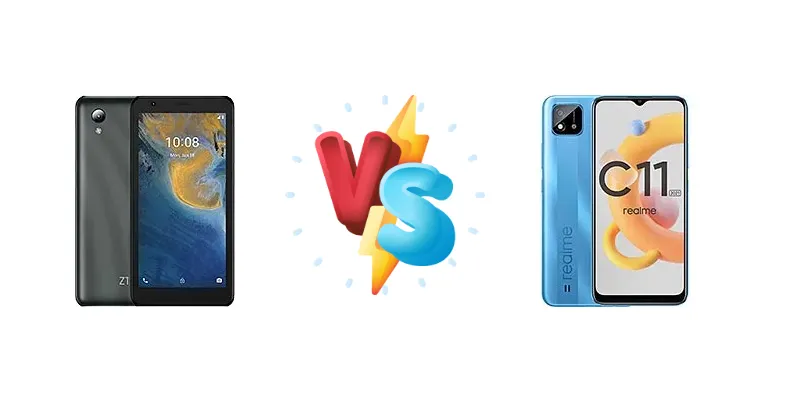
The sub-$150 smartphone market is fiercely competitive. Both the ZTE Blade A31 Lite and the Realme C11 (2021) aim to deliver essential smartphone functionality at an incredibly low price point. However, significant differences in their core hardware, particularly the chipset, dictate which phone will provide a smoother and more responsive user experience.
🏆 Quick Verdict
For most users, the Realme C11 (2021) is the better choice. Its Unisoc SC9863A chipset, featuring an octa-core CPU, offers a substantial performance advantage over the ZTE Blade A31 Lite’s quad-core SC9832E. While both phones are limited in features, the Realme provides a more fluid daily experience.
| Network |
|---|
| 2G bands | GSM 850 / 900 / 1800 / 1900 | GSM 850 / 900 / 1800 / 1900 |
| 3G bands | HSDPA 850 / 900 / 2100 | HSDPA 850 / 900 / 1900 / 2100 |
| 4G bands | LTE | 1, 3, 5, 8, 38, 40, 41 |
| Speed | HSPA, LTE | HSPA, LTE |
| Technology | GSM / HSPA / LTE | GSM / HSPA / LTE |
| Launch |
|---|
| Announced | 2021, June | 2021, June 28 |
| Status | Available. Released 2021, June | Available. Released 2021, June 28 |
| Body |
|---|
| Build | Plastic frame, plastic back | Glass front, plastic frame, plastic back |
| Dimensions | 137.3 x 67.5 x 10.5 mm (5.41 x 2.66 x 0.41 in) | 165.2 x 76.4 x 8.9 mm (6.50 x 3.01 x 0.35 in) |
| SIM | Nano-SIM + Nano-SIM | Nano-SIM + Nano-SIM |
| Weight | 143 g (5.04 oz) | 190 g (6.70 oz) |
| | - | Splash resistant design |
| Display |
|---|
| Resolution | 480 x 960 pixels, 18:9 ratio (~215 ppi density) | 720 x 1600 pixels, 20:9 ratio (~269 ppi density) |
| Size | 5.0 inches, 64.5 cm2 (~69.6% screen-to-body ratio) | 6.52 inches, 102.6 cm2 (~81.3% screen-to-body ratio) |
| Type | TFT LCD | IPS LCD, 400 nits (typ) |
| Platform |
|---|
| CPU | Quad-core 1.4 GHz | Octa-core (4x1.6 GHz Cortex-A55 & 4x1.2 GHz Cortex-A55) |
| Chipset | Unisoc SC9832E (28 nm) | Unisoc SC9863A (28 nm) |
| GPU | Mali-T820 MP1 | IMG8322 |
| OS | Android 11 (Go edition) | Android 11, Realme Go UI |
| Memory |
|---|
| Card slot | microSDXC | microSDXC (dedicated slot) |
| Internal | 32GB 1GB RAM | 32GB 2GB RAM, 64GB 4GB RAM |
| | eMMC 5.1 | eMMC 5.1 |
| Main Camera |
|---|
| Features | LED flash | LED flash, HDR, panorama |
| Single | 5 MP | 8 MP, f/2.0, (wide), AF |
| Video | 720p@30fps | 1080p@30fps |
| Selfie camera |
|---|
| Features | - | HDR, panorama |
| Single | 2 MP | 5 MP, f/2.2, (wide) |
| Video | - | 1080p@30fps |
| Sound |
|---|
| 3.5mm jack | Yes | Yes |
| 35mm jack | Yes | Yes |
| Loudspeaker | Yes | Yes |
| Comms |
|---|
| Bluetooth | 4.2, A2DP, LE | 4.2, A2DP |
| NFC | No | No |
| Positioning | GPS | GPS, GLONASS, GALILEO, BDS |
| Radio | Unspecified | Unspecified |
| USB | microUSB 2.0 | microUSB 2.0, OTG |
| WLAN | Wi-Fi 802.11 b/g/n | Wi-Fi 802.11 b/g/n |
| Features |
|---|
| Sensors | Accelerometer | Accelerometer, gyro, proximity, compass |
| Battery |
|---|
| Charging | - | 10W wired
Reverse wired |
| Type | Li-Ion 2000 mAh | 5000 mAh |
| Misc |
|---|
| Colors | Gray, Blue | Cool Blue, Cool Grey |
| Models | - | RMX3231 |
| Price | About 80 EUR | About 80 EUR |
ZTE Blade A31 Lite
- Potentially lower price point
- Basic functionality for essential tasks
- Simple and straightforward user experience
- Significantly slower performance due to quad-core processor
- Lacks features like reverse charging
- Likely limited software support
Realme C11 (2021)
- Faster octa-core processor for smoother performance
- 10W charging with reverse wired charging
- Potentially better software support from Realme
- May be slightly more expensive
- Still limited by budget hardware
- 10W charging is relatively slow
Display Comparison
Neither device boasts a standout display. Both utilize panels likely based on IPS LCD technology, given their price bracket. Specifics like resolution and brightness are not provided, but we can assume they are adequate for basic viewing. The lack of higher refresh rates or advanced features like PWM dimming control is expected. The Realme C11 (2021) likely benefits from Realme’s image processing, potentially offering slightly more vibrant colors, but this is speculative without direct comparison.
Camera Comparison
Camera performance on both devices will be limited. Details on sensor size and aperture are unavailable, but given the price point, expectations should be tempered. Both phones likely feature a primary camera alongside basic auxiliary lenses (potentially a depth or macro sensor). The Realme C11 (2021) may benefit from Realme’s software optimizations, but the underlying hardware limitations will be a significant constraint. Focusing on the primary sensor’s megapixel count is misleading; image quality is more dependent on sensor size and image processing.
Performance
The core difference lies in the chipsets. The Realme C11 (2021) utilizes the Unisoc SC9863A, an octa-core processor with a combination of 1.6 GHz and 1.2 GHz Cortex-A55 cores. This configuration provides a significant advantage over the ZTE Blade A31 Lite’s Unisoc SC9832E, a quad-core processor clocked at 1.4 GHz. The extra cores in the Realme allow for better multitasking and smoother performance in apps. While both are built on a 28nm process, the architectural advantage of the octa-core design is substantial. The Realme will handle more demanding apps and light gaming with less stuttering.
Battery Life
Battery capacity is not specified for either device. However, both are likely equipped with batteries in the 4000-5000 mAh range, typical for this segment. The Realme C11 (2021) includes 10W wired charging and reverse wired charging, a feature absent on the ZTE Blade A31 Lite. While 10W charging isn’t fast, the reverse charging capability allows the Realme to act as a power bank for smaller accessories, offering added utility.
Buying Guide
Buy the ZTE Blade A31 Lite if your primary need is a basic, functional phone for calls, texts, and extremely light app usage, and you prioritize absolute minimum cost. Buy the Realme C11 (2021) if you want a more responsive device capable of handling social media, basic gaming, and multitasking without significant lag, even if it means spending a little more.
Frequently Asked Questions
❓ Will the Realme C11 (2021) be able to run popular social media apps like TikTok and Instagram smoothly?
Yes, the Unisoc SC9863A’s octa-core processor in the Realme C11 (2021) is significantly better equipped to handle the demands of social media apps compared to the ZTE Blade A31 Lite’s quad-core processor. You should experience smoother scrolling and faster loading times.
❓ Is the reverse charging feature on the Realme C11 (2021) useful for everyday use?
The 10W reverse wired charging on the Realme C11 (2021) is primarily useful for topping up smaller accessories like Bluetooth earbuds or a smartwatch in a pinch. It won’t rapidly charge a phone, but it provides a convenient way to share power when an outlet isn’t available.
❓ Can I expect to play demanding games like PUBG Mobile on either of these phones?
While both phones *can* technically run PUBG Mobile, the experience will be far from ideal. The ZTE Blade A31 Lite will struggle significantly, even on the lowest settings. The Realme C11 (2021) will offer a slightly better experience, but you’ll still need to lower the graphics settings and expect frame rate drops.