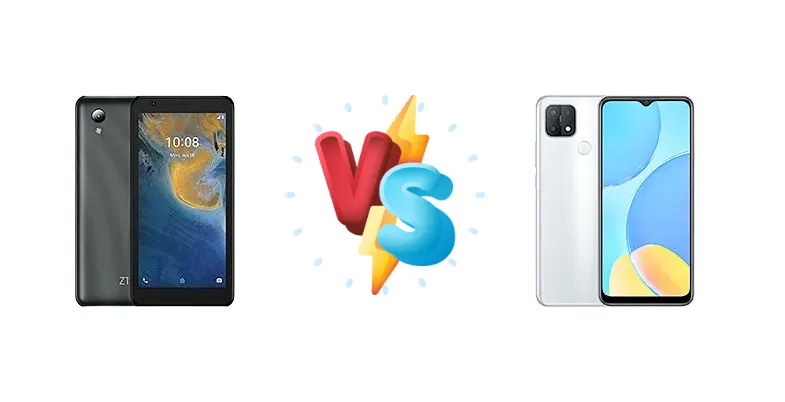
The Oppo A15s and ZTE Blade A31 Lite represent the extreme end of the budget smartphone market. Both aim to deliver essential smartphone functionality at the lowest possible price point, but they take drastically different approaches to achieving this. This comparison dissects their core components to determine which device offers the best value for users prioritizing performance versus absolute affordability.
🏆 Quick Verdict
For the average user, the Oppo A15s is the clear winner. Its Mediatek Helio P35 chipset, with its octa-core configuration, provides a significantly smoother and more responsive experience than the ZTE Blade A31 Lite’s quad-core Unisoc SC9832E. While the A31 Lite may be cheaper, the performance deficit is substantial.
| Network |
|---|
| 2G bands | GSM 850 / 900 / 1800 / 1900 | GSM 850 / 900 / 1800 / 1900 |
| 3G bands | HSDPA 850 / 900 / 2100 | HSDPA 850 / 900 / 2100 |
| 4G bands | LTE | 1, 3, 5, 8, 38, 40, 41 |
| Speed | HSPA, LTE | HSPA, LTE |
| Technology | GSM / HSPA / LTE | GSM / HSPA / LTE |
| Launch |
|---|
| Announced | 2021, June | 2020, December 18. Released 2020, December 18 |
| Status | Available. Released 2021, June | Discontinued |
| Body |
|---|
| Build | Plastic frame, plastic back | Glass front, plastic back, plastic frame |
| Dimensions | 137.3 x 67.5 x 10.5 mm (5.41 x 2.66 x 0.41 in) | 164 x 75.4 x 7.9 mm (6.46 x 2.97 x 0.31 in) |
| SIM | Nano-SIM + Nano-SIM | Nano-SIM + Nano-SIM |
| Weight | 143 g (5.04 oz) | 177 g (6.24 oz) |
| Display |
|---|
| Resolution | 480 x 960 pixels, 18:9 ratio (~215 ppi density) | 720 x 1600 pixels, 20:9 ratio (~269 ppi density) |
| Size | 5.0 inches, 64.5 cm2 (~69.6% screen-to-body ratio) | 6.52 inches, 102.6 cm2 (~83.0% screen-to-body ratio) |
| Type | TFT LCD | IPS LCD, 480 nits (typ) |
| Platform |
|---|
| CPU | Quad-core 1.4 GHz | Octa-core (4x2.35 GHz Cortex-A53 & 4x1.8 GHz Cortex-A53) |
| Chipset | Unisoc SC9832E (28 nm) | Mediatek MT6765 Helio P35 (12 nm) |
| GPU | Mali-T820 MP1 | PowerVR GE8320 |
| OS | Android 11 (Go edition) | Android 10, ColorOS 7.2 |
| Memory |
|---|
| Card slot | microSDXC | microSDXC |
| Internal | 32GB 1GB RAM | 64GB 4GB RAM, 128GB 4GB RAM |
| | eMMC 5.1 | eMMC 5.1 |
| Main Camera |
|---|
| Features | LED flash | LED flash, HDR, panorama |
| Single | 5 MP | - |
| Triple | - | 13 MP, f/2.2, (wide), 1/3.1", 1.12µm, PDAF
2 MP (macro)
Auxiliary lens |
| Video | 720p@30fps | 1080p@30fps |
| Selfie camera |
|---|
| Features | - | HDR |
| Single | 2 MP | 8 MP, f/2.0, (wide) |
| Video | - | 1080p@30fps |
| Sound |
|---|
| 3.5mm jack | Yes | Yes |
| 35mm jack | Yes | Yes |
| Loudspeaker | Yes | Yes |
| Comms |
|---|
| Bluetooth | 4.2, A2DP, LE | 5.0, A2DP, LE, aptX |
| NFC | No | No |
| Positioning | GPS | GPS, GLONASS, GALILEO, BDS |
| Radio | Unspecified | FM radio |
| USB | microUSB 2.0 | microUSB 2.0, OTG |
| WLAN | Wi-Fi 802.11 b/g/n | Wi-Fi 802.11 b/g/n, Wi-Fi Direct |
| Features |
|---|
| Sensors | Accelerometer | Fingerprint (rear-mounted), accelerometer, proximity |
| Battery |
|---|
| Charging | - | 10W wired |
| Type | Li-Ion 2000 mAh | Li-Po 4230 mAh |
| Misc |
|---|
| Colors | Gray, Blue | Dynamic Black, Fancy White |
| Models | - | CPH2179 |
| Price | About 80 EUR | About 130 EUR |
ZTE Blade A31 Lite
- Potentially lower price point
- May offer slightly longer battery life under minimal use
- Simple and straightforward user experience
- Significantly weaker processor performance
- Larger 28nm process node leads to less efficiency
- Limited multitasking capabilities
Oppo A15s
- Faster and more responsive performance with Helio P35
- More efficient 12nm process node
- Octa-core CPU enables smoother multitasking
- 10W charging provides reasonable charging speeds
- Likely a slightly higher price than the ZTE Blade A31 Lite
- Basic camera system
- Display quality is likely average
Display Comparison
Neither device boasts a particularly impressive display. Specifications are unavailable for the ZTE Blade A31 Lite's display, suggesting a basic LCD panel. The Oppo A15s also utilizes an LCD, but details regarding its brightness and color accuracy are limited. Given the price point, expect both displays to be adequate for indoor use but struggle in direct sunlight. Bezels are likely to be substantial on both models, maximizing screen real estate within their respective budgets.
Camera Comparison
Camera performance on both devices is expected to be basic. Details regarding sensor sizes and lens apertures are scarce. It’s safe to assume both phones rely on low-resolution primary sensors, supplemented by auxiliary lenses of questionable utility. The Oppo A15s may have a slight edge due to Mediatek’s image signal processing capabilities, but don’t expect flagship-level image quality from either device. Focusing on the primary sensor is key; the 2MP macro lenses often found in this segment offer minimal practical benefit.
Performance
The performance gap is the most significant differentiator. The Oppo A15s’ Mediatek Helio P35, fabricated on a 12nm process, features an octa-core CPU comprised of four Cortex-A53 cores clocked at 2.35 GHz and another four at 1.8 GHz. This contrasts sharply with the ZTE Blade A31 Lite’s Unisoc SC9832E, a quad-core processor built on a larger 28nm node. The 12nm process of the Helio P35 is more efficient, leading to better thermal management and sustained performance. The octa-core configuration also allows for more efficient multitasking. The Unisoc SC9832E will likely struggle with demanding applications and even moderately heavy multitasking.
Battery Life
Battery capacity details are unavailable for the ZTE Blade A31 Lite. The Oppo A15s features 10W wired charging. While not fast by modern standards, it’s sufficient for overnight charging. The larger process node of the Unisoc SC9832E in the ZTE Blade A31 Lite *could* translate to slightly better battery life under light usage, but the performance difference will likely mean users spend less time actively using the device, indirectly extending battery endurance. The 10W charging on the Oppo A15s will take several hours for a full charge.
Buying Guide
Buy the ZTE Blade A31 Lite if you absolutely need the lowest possible upfront cost and your smartphone usage is limited to basic tasks like calls, texts, and light social media. Buy the Oppo A15s if you prioritize a more fluid user experience, enjoy occasional gaming, or frequently multitask between apps – the Helio P35 offers a noticeable improvement in responsiveness and overall performance.
Frequently Asked Questions
❓ Will the Helio P35 in the Oppo A15s struggle with popular games like PUBG Mobile?
While the Helio P35 can run PUBG Mobile, you’ll likely need to play at lower graphics settings and frame rates to maintain a stable experience. Expect some stuttering and frame drops during intense action. The ZTE Blade A31 Lite’s Unisoc SC9832E will likely have even more difficulty running the game smoothly.
❓ Is the difference in processor architecture (quad-core vs. octa-core) noticeable in everyday use?
Yes, the difference is quite noticeable. The Oppo A15s’ octa-core processor allows it to handle multiple apps running simultaneously without significant slowdown. Switching between apps will be faster and more responsive. The ZTE Blade A31 Lite’s quad-core processor will struggle with even moderate multitasking, leading to noticeable lag.
❓ How does the 28nm process of the Unisoc SC9832E affect battery life compared to the 12nm process of the Helio P35?
A larger process node (28nm) generally means less power efficiency. The Unisoc SC9832E will consume more power for the same tasks compared to the Helio P35. However, the slower performance of the ZTE Blade A31 Lite might mean users spend less time actively using the phone, potentially offsetting some of the efficiency disadvantage.