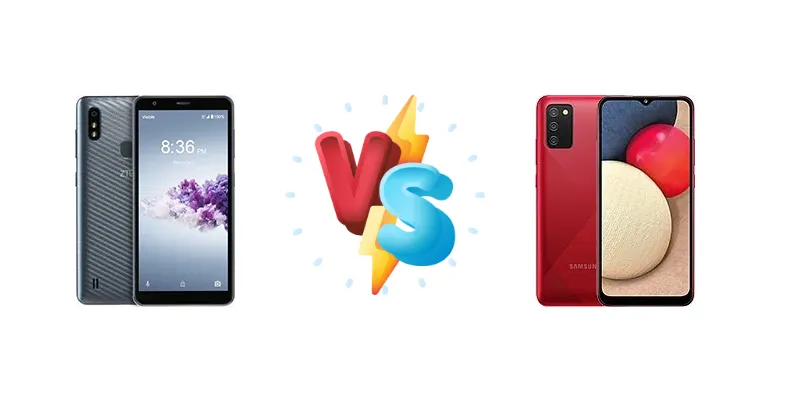
The ZTE Blade A3 Prime and Samsung Galaxy A02s represent the extreme end of the smartphone price spectrum. Both aim to deliver essential functionality at a minimal cost, but they take different approaches to achieving this. This comparison dissects their core components to determine which device offers the best value for users prioritizing affordability.
🏆 Quick Verdict
For most users, the Samsung Galaxy A02s emerges as the slightly better choice. Its octa-core Snapdragon 450 chipset provides a noticeable performance advantage over the ZTE’s quad-core Helio A22, making it more responsive for everyday tasks. While both offer similar battery endurance, the A02s’ 15W charging is a welcome addition.
| Network |
|---|
| 2G bands | GSM 850 / 900 / 1800 / 1900 | GSM 850 / 900 / 1800 / 1900 |
| 3G bands | HSDPA 850 / 900 / 1900 / 2100 | HSDPA 850 / 900 / 2100 |
| 4G bands | 2, 4, 5, 12, 13 | 1, 3, 5, 7, 8, 20, 28, 38, 40, 41 |
| Speed | HSPA, LTE | HSPA 42.2/5.76 Mbps, LTE Cat4 150/50 Mbps |
| Technology | GSM / HSPA / LTE | GSM / HSPA / LTE |
| Launch |
|---|
| Announced | 2020, June. Released 2020, June | 2020, November 24. Released 2021, January 04 |
| Status | Discontinued | Discontinued |
| Body |
|---|
| Build | - | Glass front, plastic back, plastic frame |
| Dimensions | 146 x 71 x 9.7 mm (5.75 x 2.80 x 0.38 in) | 164.2 x 75.9 x 9.1 mm (6.46 x 2.99 x 0.36 in) |
| SIM | Nano-SIM | · Nano-SIM· Nano-SIM + Nano-SIM |
| Weight | 163 g (5.75 oz) | 196 g (6.91 oz) |
| Display |
|---|
| Protection | - | Scratch-resistant glass |
| Resolution | 720 x 1440 pixels, 18:9 ratio (~295 ppi density) | 720 x 1600 pixels, 20:9 ratio (~270 ppi density) |
| Size | 5.45 inches, 76.7 cm2 (~73.9% screen-to-body ratio) | 6.5 inches, 102.0 cm2 (~81.8% screen-to-body ratio) |
| Type | IPS LCD | PLS LCD |
| Platform |
|---|
| CPU | Quad-core 2.0 GHz Cortex-A53 | Octa-core 1.8 GHz Cortex-A53 |
| Chipset | Mediatek MT6761 Helio A22 (12 nm) | Qualcomm SDM450 Snapdragon 450 (14 nm) |
| GPU | PowerVR GE8320 | Adreno 506 |
| OS | Android 10 | Android 10, upgradable to Android 12, One UI 4.1 |
| Memory |
|---|
| Card slot | microSDXC | microSDXC (dedicated slot) |
| Internal | 32GB 2GB RAM | 16GB 1GB RAM, 32GB 2GB RAM, 32GB 3GB RAM, 32GB 4GB RAM, 64GB 3GB RAM, 64GB 4GB RAM |
| | eMMC 5.1 | eMMC 5.1 |
| Main Camera |
|---|
| Features | Dual-LED flash | LED flash |
| Single | 8 MP, f/2.0, 1.12µm | 3.15 MP |
| Triple | - | 13 MP, f/2.2, (wide), AF
2 MP (macro)
Auxiliary lens |
| Video | 720p@30fps | 1080p@30fps |
| Selfie camera |
|---|
| Single | 5 MP, f/2.4, 1.12µm | 5 MP, f/2.2 |
| Sound |
|---|
| 3.5mm jack | Yes | Yes |
| 35mm jack | Yes | Yes |
| Loudspeaker | Yes | Yes |
| Comms |
|---|
| Bluetooth | 4.2, A2DP, LE | 4.2, A2DP |
| NFC | No | No |
| Positioning | GPS | GPS, GLONASS, GALILEO, BDS |
| Radio | No | Unspecified |
| USB | USB Type-C 2.0 | USB Type-C 2.0 |
| WLAN | Wi-Fi 802.11 a/b/g/n/ac, dual-band | Wi-Fi 802.11 b/g/n, Wi-Fi Direct |
| Features |
|---|
| Sensors | Fingerprint (rear-mounted), accelerometer | Accelerometer, proximity |
| Battery |
|---|
| Charging | - | 15W wired |
| Stand-by | - | Up to 530 h (2G) / Up to 530 h (3G) |
| Talk time | - | Up to 6 h 12 min (2G) / Up to 6 h 18 min (3G) |
| Type | Li-Ion 2660 mAh, removable | Li-Po 5000 mAh |
| Misc |
|---|
| Colors | Black | Black, White, Red, Blue |
| Models | Z5157V | SM-A025F, SM-A025F/DS, SM-A025G, SM-A025G/DS, SM-A025M, SM-A025M/DS, SM-A025U, SM-A025V, SM-A025A, SM-A025U1, SM-A025AZ, SM-S124DL |
| Price | About 50 EUR | About 110 EUR |
| SAR | - | 1.15 W/kg (head) 0.79 W/kg (body) |
| SAR EU | - | 0.40 W/kg (head) 1.37 W/kg (body) |
| Tests |
|---|
| Audio quality | - |
Noise -81.4dB / Crosstalk -80.5dB |
| Battery life | - |
Endurance rating 114h
|
| Camera | - |
Photo / Video |
| Display | - |
Contrast ratio: 1765:1 (nominal) |
| Loudspeaker | - |
-29.8 LUFS (Average)
|
| Performance | - |
AnTuTu: 90811 (v8)
GeekBench: 495 (v5.1)
GFXBench: 6.1fps (ES 3.1 onscreen) |
ZTE Blade A3 Prime
- Potentially lower price point
- May be more readily available in certain regions
- 12nm process *could* offer slightly better efficiency
- Quad-core processor limits performance
- Lack of detailed specifications
- Likely slower charging speeds
Samsung Galaxy A02s
- Octa-core Snapdragon 450 provides better performance
- 15W fast charging
- Brighter display with higher contrast
- May be slightly more expensive
- 14nm process is less efficient than 12nm (though offset by core count)
- Still a budget device with limitations
Display Comparison
The Samsung Galaxy A02s boasts a measured peak brightness of 406 nits and a 1765:1 contrast ratio, offering a more visually appealing experience than the ZTE Blade A3 Prime, for which display specifications are not provided. While the contrast ratio is nominally the same, the higher brightness of the A02s will translate to better visibility outdoors. The lack of detailed display information for the A3 Prime suggests a more basic panel, likely with lower color accuracy and viewing angles.
Camera Comparison
Both devices feature 'Photo / Video' capabilities, but lack specific details. Given their price point, image quality will be modest. The absence of sensor size or aperture information makes a direct comparison impossible. However, it’s reasonable to assume both rely on budget sensors, and image processing will be the primary differentiator. Expect limited low-light performance from both.
Performance
The core difference lies in the chipsets. The Samsung Galaxy A02s utilizes the Qualcomm Snapdragon 450, an octa-core processor built on a 14nm process. This contrasts with the ZTE Blade A3 Prime’s MediaTek Helio A22, a quad-core chip fabricated on a 12nm node. While the 12nm process *should* theoretically be more efficient, the Snapdragon 450’s eight cores provide a significant advantage in multi-tasking and app responsiveness. The A22 is sufficient for basic tasks, but the A02s will handle more demanding apps and light gaming with greater ease.
Battery Life
Both the ZTE Blade A3 Prime and Samsung Galaxy A02s achieve an endurance rating of 114 hours, indicating comparable battery life under similar usage conditions. However, the A02s supports 15W wired charging, while the A3 Prime’s charging speed is unspecified and likely slower. This means the A02s can replenish its battery more quickly, reducing downtime, even though the overall battery capacity is not stated for either device.
Buying Guide
Buy the ZTE Blade A3 Prime if you absolutely need the lowest possible price and your smartphone usage is limited to basic communication and very light app use. Buy the Samsung Galaxy A02s if you prioritize a smoother user experience, even with basic apps, and appreciate the convenience of faster charging, even if it's still relatively slow by modern standards.
Frequently Asked Questions
❓ Is the Snapdragon 450 in the Galaxy A02s powerful enough for basic social media apps like Facebook and Instagram?
Yes, the Snapdragon 450 is more than capable of handling basic social media apps without significant lag. Its octa-core architecture provides sufficient processing power for smooth scrolling and app switching, unlike the ZTE Blade A3 Prime's Helio A22 which may struggle with multiple apps open.
❓ How long does it realistically take to fully charge the Samsung Galaxy A02s with the 15W charger?
While 15W isn't 'fast charging' in the modern sense, it's significantly quicker than the likely charging speed of the ZTE Blade A3 Prime. Expect a full charge from 0% to 100% to take approximately 2.5 to 3 hours, depending on usage during charging.
❓ Can either of these phones handle popular mobile games like PUBG Mobile or Call of Duty Mobile?
Both phones will struggle with demanding games like PUBG Mobile or Call of Duty Mobile. While you might be able to run them at the lowest settings, expect significant frame rate drops and a generally poor gaming experience. The Snapdragon 450 in the A02s will offer a slightly better experience, but neither phone is designed for gaming.