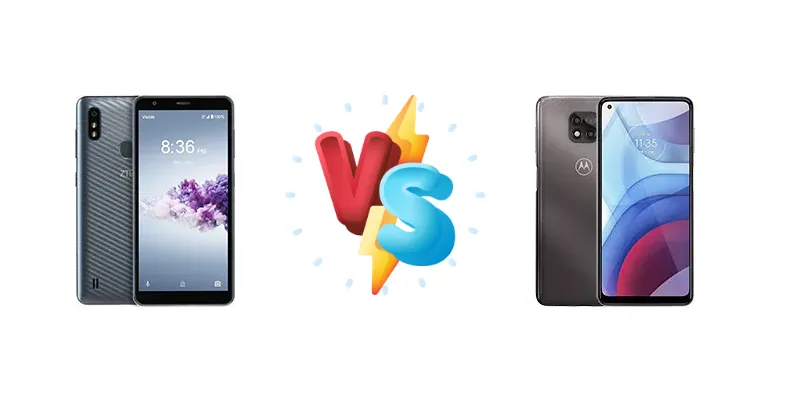
The ZTE Blade A3 Prime and Motorola Moto G Power (2021) represent distinct approaches to the budget smartphone market. The A3 Prime aims for ultimate affordability, while the Moto G Power prioritizes extended battery life and a more capable processor. This comparison dissects their core components to determine which device delivers the best experience for your needs.
🏆 Quick Verdict
For most users, the Motorola Moto G Power (2021) is the superior choice. Its Snapdragon 662 chipset provides a significantly smoother and more responsive experience than the ZTE Blade A3 Prime’s Helio A22, justifying the slight price premium. While the A3 Prime is cheaper, the performance gap is too large to ignore for all but the most basic users.
| Network |
|---|
| 2G bands | GSM 850 / 900 / 1800 / 1900 | GSM 850 / 900 / 1800 / 1900 |
| 3G bands | HSDPA 850 / 900 / 1900 / 2100 | HSDPA 850 / 900 / 1700(AWS) / 1900 / 2100 |
| 4G bands | 2, 4, 5, 12, 13 | 1, 2, 3, 4, 5, 7, 8, 12, 13, 14, 17, 25, 26, 29, 30, 38, 41, 66, 71 |
| Speed | HSPA, LTE | HSPA, LTE |
| Technology | GSM / HSPA / LTE | GSM / CDMA / HSPA / EVDO / LTE |
| | - | CDMA2000 1xEV-DO |
| Launch |
|---|
| Announced | 2020, June. Released 2020, June | 2021, January 08 |
| Status | Discontinued | Available. Released 2021, January 14 |
| Body |
|---|
| Build | - | Glass front, plastic back, plastic frame |
| Dimensions | 146 x 71 x 9.7 mm (5.75 x 2.80 x 0.38 in) | 165.3 x 75.9 x 9.5 mm (6.51 x 2.99 x 0.37 in) |
| SIM | Nano-SIM | Nano-SIM |
| Weight | 163 g (5.75 oz) | 206.5 g (7.30 oz) |
| | - | Water-repellent coating |
| Display |
|---|
| Resolution | 720 x 1440 pixels, 18:9 ratio (~295 ppi density) | 720 x 1600 pixels, 20:9 ratio (~266 ppi density) |
| Size | 5.45 inches, 76.7 cm2 (~73.9% screen-to-body ratio) | 6.6 inches, 105.2 cm2 (~83.8% screen-to-body ratio) |
| Type | IPS LCD | IPS LCD |
| Platform |
|---|
| CPU | Quad-core 2.0 GHz Cortex-A53 | Octa-core (4x2.0 GHz Kryo 260 Gold & 4x1.8 GHz Kryo 260 Silver) |
| Chipset | Mediatek MT6761 Helio A22 (12 nm) | Qualcomm SM6115 Snapdragon 662 (11 nm) |
| GPU | PowerVR GE8320 | Adreno 610 |
| OS | Android 10 | Android 10 |
| Memory |
|---|
| Card slot | microSDXC | microSDXC (dedicated slot) |
| Internal | 32GB 2GB RAM | 32GB 3GB RAM, 64GB 4GB RAM |
| | eMMC 5.1 | eMMC 5.1 |
| Main Camera |
|---|
| Features | Dual-LED flash | LED flash, HDR, panorama |
| Single | 8 MP, f/2.0, 1.12µm | - |
| Triple | - | 48 MP, f/1.7, (wide), 1/2.0", 0.8µm, PDAF
2 MP (macro)
Auxiliary lens |
| Video | 720p@30fps | 1080p@30/60fps, gyro-EIS |
| Selfie camera |
|---|
| Features | - | HDR |
| Single | 5 MP, f/2.4, 1.12µm | 8 MP, f/2.0, 1.12µm |
| Video | - | 1080p@30fps, gyro-EIS |
| Sound |
|---|
| 3.5mm jack | Yes | Yes |
| 35mm jack | Yes | Yes |
| Loudspeaker | Yes | Yes |
| Comms |
|---|
| Bluetooth | 4.2, A2DP, LE | 5.0, A2DP, LE |
| NFC | No | No |
| Positioning | GPS | GPS, GLONASS, GALILEO |
| Radio | No | FM radio |
| USB | USB Type-C 2.0 | USB Type-C 2.0 |
| WLAN | Wi-Fi 802.11 a/b/g/n/ac, dual-band | Wi-Fi 802.11 a/b/g/n/ac, dual-band, Wi-Fi Direct |
| Features |
|---|
| Sensors | Fingerprint (rear-mounted), accelerometer | Fingerprint (side-mounted), accelerometer, gyro, proximity, compass, barometer |
| Battery |
|---|
| Charging | - | 15W wired |
| Type | Li-Ion 2660 mAh, removable | Li-Po 5000 mAh |
| Misc |
|---|
| Colors | Black | Flash Gray, Polar Silver |
| Models | Z5157V | - |
| Price | About 50 EUR | About 60 EUR |
ZTE Blade A3 Prime
- Lowest possible price point
- Compact and lightweight design (likely)
- Acceptable for basic communication tasks
- Poor performance with demanding apps
- Limited multitasking capabilities
- Likely lower quality display
Motorola Moto G Power (2021)
- Significantly better performance
- Longer battery life
- Faster charging (15W)
- Slightly higher price
- Larger size may not suit all users
- Camera performance is still budget-level
Display Comparison
Neither device boasts a standout display. Both likely utilize LCD panels, common in this price bracket. However, the lack of detailed display specs for the A3 Prime makes direct comparison difficult. The Moto G Power’s focus is on size, offering a larger screen for media consumption. The A3 Prime’s display is likely smaller and lower resolution, impacting clarity. The absence of high refresh rates on either device is expected, but the Moto G Power’s larger canvas provides a more immersive viewing experience.
Camera Comparison
Camera performance is likely similar in real-world results, given both phones target the budget segment. Detailed camera specs are unavailable for the A3 Prime, but it’s safe to assume a basic sensor setup. The Moto G Power (2021) likely features a more refined image processing pipeline thanks to Qualcomm’s ISP. While neither phone will compete with flagship camera systems, the Moto G Power’s processor allows for faster image processing and potentially better low-light performance. The prevalence of 2MP macro lenses on both devices suggests limited utility; these sensors typically produce low-quality images.
Performance
The performance disparity is the most significant difference. The Motorola Moto G Power (2021) features the Qualcomm Snapdragon 662, an octa-core processor built on an 11nm process. This contrasts sharply with the ZTE Blade A3 Prime’s MediaTek Helio A22, a quad-core processor on a 12nm node. The Snapdragon 662’s eight cores (4x2.0 GHz Kryo 260 Gold & 4x1.8 GHz Kryo 260 Silver) provide a substantial advantage in multi-tasking and app responsiveness. The Helio A22 will struggle with demanding applications and even moderate multitasking. The Snapdragon 662’s architecture is also more efficient, leading to better thermal management and sustained performance. Users intending to play games or use resource-intensive apps will find the Moto G Power far more capable.
Battery Life
The Motorola Moto G Power (2021) prioritizes battery life, and its 15W wired charging is a welcome addition. While the exact battery capacity of the A3 Prime is unknown, the Moto G Power’s larger battery, combined with the more efficient Snapdragon 662, translates to significantly longer usage times. The 15W charging on the Moto G Power allows for a reasonable recharge time, while the A3 Prime likely charges at a slower rate, further extending the overall time to full capacity. Users who prioritize all-day battery life will strongly favor the Moto G Power.
Buying Guide
Buy the ZTE Blade A3 Prime if you absolutely need the lowest possible price and your smartphone usage is limited to calls, texts, and very light app usage. Buy the Motorola Moto G Power (2021) if you value a responsive user experience, enjoy occasional gaming, or need a phone that can reliably last through a full day of moderate to heavy use. The Moto G Power offers a better balance of performance and features for the average user.
Frequently Asked Questions
❓ Will the ZTE Blade A3 Prime struggle with popular social media apps like Facebook and Instagram?
The Helio A22 processor in the ZTE Blade A3 Prime is a low-end chipset. While it can run basic apps like Facebook and Instagram, you may experience noticeable lag and slowdowns, especially when scrolling through image-heavy feeds or using features like Stories. The Motorola Moto G Power (2021) with its Snapdragon 662 will provide a much smoother and more responsive experience.
❓ How much faster is the Motorola Moto G Power (2021) for gaming compared to the ZTE Blade A3 Prime?
The Motorola Moto G Power (2021) is significantly faster for gaming. The Snapdragon 662’s octa-core architecture and more powerful GPU allow it to handle most mobile games at medium settings without significant frame drops. The ZTE Blade A3 Prime’s Helio A22 will struggle with even less demanding games, resulting in low frame rates and a poor gaming experience. Expect to limit yourself to very simple 2D games on the A3 Prime.
❓ Does the Motorola Moto G Power (2021) support fast charging beyond the 15W specification?
While the Motorola Moto G Power (2021) supports 15W wired charging, it does not support faster charging protocols like Quick Charge or Power Delivery. Using a higher wattage charger will not result in faster charging speeds; the phone will only draw up to 15W.