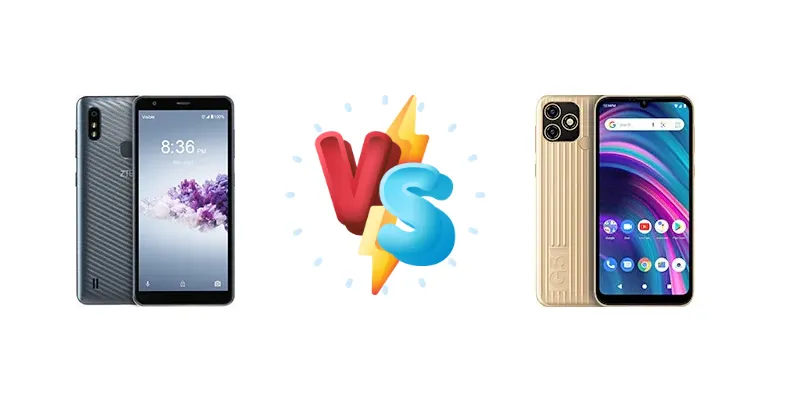
The ZTE Blade A3 Prime and BLU G51 represent the absolute bottom end of the smartphone price spectrum. Both devices target first-time smartphone buyers or those needing a reliable, ultra-affordable secondary device. With identical MediaTek Helio A22 chipsets, the differences lie in subtle design choices and potential software optimizations, making a direct comparison crucial for informed purchasing.
🏆 Quick Verdict
For the average user prioritizing simplicity and basic functionality, the BLU G51 edges out the ZTE Blade A3 Prime. While performance is identical, BLU’s slightly better brand recognition in the US market and potentially cleaner software experience offer a marginal advantage in this ultra-competitive segment.
| Network |
|---|
| 2G bands | GSM 850 / 900 / 1800 / 1900 | GSM 850 / 900 / 1800 / 1900 |
| 3G bands | HSDPA 850 / 900 / 1900 / 2100 | HSDPA 850 / 900 / 1700(AWS) / 1900 / 2100 |
| 4G bands | 2, 4, 5, 12, 13 | 2, 3, 4, 5, 7, 12, 17, 28, 66 |
| Speed | HSPA, LTE | HSPA, LTE |
| Technology | GSM / HSPA / LTE | GSM / HSPA / LTE |
| Launch |
|---|
| Announced | 2020, June. Released 2020, June | 2022, June 03 |
| Status | Discontinued | Available. Released 2022, June 03 |
| Body |
|---|
| Dimensions | 146 x 71 x 9.7 mm (5.75 x 2.80 x 0.38 in) | 155.3 x 73.5 x 9.5 mm (6.11 x 2.89 x 0.37 in) |
| SIM | Nano-SIM | Nano-SIM + Nano-SIM |
| Weight | 163 g (5.75 oz) | 166 g (5.86 oz) |
| Display |
|---|
| Resolution | 720 x 1440 pixels, 18:9 ratio (~295 ppi density) | 720 x 1520 pixels, 19:9 ratio (~276 ppi density) |
| Size | 5.45 inches, 76.7 cm2 (~73.9% screen-to-body ratio) | 6.1 inches, 92.9 cm2 (~81.4% screen-to-body ratio) |
| Type | IPS LCD | IPS LCD |
| Platform |
|---|
| CPU | Quad-core 2.0 GHz Cortex-A53 | Quad-core 2.0 GHz Cortex-A53 |
| Chipset | Mediatek MT6761 Helio A22 (12 nm) | Mediatek MT6761 Helio A22 (12 nm) |
| GPU | PowerVR GE8320 | PowerVR GE8320 |
| OS | Android 10 | Android 11 (Go edition) |
| Memory |
|---|
| Card slot | microSDXC | microSDXC |
| Internal | 32GB 2GB RAM | 32GB 2GB RAM |
| | eMMC 5.1 | eMMC 5.1 |
| Main Camera |
|---|
| Dual | - | 8 MP
Auxiliary lens |
| Features | Dual-LED flash | LED flash, HDR, panorama |
| Single | 8 MP, f/2.0, 1.12µm | 8 MP |
| Video | 720p@30fps | 1080p@30fps |
| Selfie camera |
|---|
| Single | 5 MP, f/2.4, 1.12µm | 8 MP |
| Video | - | 720p@30fps |
| Sound |
|---|
| 3.5mm jack | Yes | Yes |
| 35mm jack | Yes | Yes |
| Loudspeaker | Yes | Yes |
| Comms |
|---|
| Bluetooth | 4.2, A2DP, LE | 4.2, A2DP, LE |
| NFC | No | No |
| Positioning | GPS | GPS |
| Radio | No | FM radio |
| USB | USB Type-C 2.0 | microUSB 2.0 |
| WLAN | Wi-Fi 802.11 a/b/g/n/ac, dual-band | Wi-Fi 802.11 a/b/g/n, Wi-Fi Direct |
| Features |
|---|
| Sensors | Fingerprint (rear-mounted), accelerometer | Fingerprint (rear-mounted), accelerometer, proximity |
| Battery |
|---|
| Type | Li-Ion 2660 mAh, removable | Li-Po 3000 mAh |
| Misc |
|---|
| Colors | Black | Black, Blue, Green, Silver, Gold |
| Models | Z5157V | - |
| Price | About 50 EUR | - |
ZTE Blade A3 Prime
- Ultra-affordable price point
- Decent battery life due to efficient chipset
- Suitable for basic smartphone tasks
- Limited performance for demanding apps
- Potentially significant bloatware
BLU G51
- Ultra-affordable price point
- Decent battery life due to efficient chipset
- Potentially cleaner software experience
- Limited performance for demanding apps
- Basic camera capabilities
Display Comparison
Both the ZTE Blade A3 Prime and BLU G51 utilize displays that prioritize cost-effectiveness over premium features. Given the lack of specific display specs, we can assume both employ IPS LCD panels, common in this price bracket. Expect resolutions around 720p+, adequate for basic viewing but lacking sharpness compared to higher-resolution displays. Bezels are likely to be substantial on both devices, maximizing screen real estate within a compact form factor. Color accuracy and brightness will be limited, making outdoor visibility a challenge. The absence of features like high refresh rates or HDR support is expected at this price point.
Camera Comparison
Camera performance on both devices will be limited by the hardware and image processing capabilities. While specific sensor details are unavailable, it’s safe to assume both feature a primary camera around 8-13MP, likely paired with a basic secondary sensor for depth sensing. Expect limited dynamic range, soft details, and struggles in low-light conditions. The absence of Optical Image Stabilization (OIS) will exacerbate low-light issues. Any marketing around 'AI' camera features should be viewed skeptically, as the Helio A22's image signal processor (ISP) has limited capabilities. Focusing on capturing memories rather than high-quality photos is the realistic expectation here.
Performance
The heart of both the ZTE Blade A3 Prime and BLU G51 is the MediaTek MT6761 Helio A22, a quad-core processor clocked at 2.0 GHz. This chipset, built on a 12nm process, is designed for entry-level tasks like web browsing, social media, and light app usage. The Cortex-A53 cores are efficient but lack the performance headroom for demanding games or multitasking. RAM configurations are likely similar, impacting multitasking capabilities. Thermal management shouldn't be a concern given the low power draw of the Helio A22, meaning sustained performance won't be significantly hampered by throttling. The identical chipset guarantees virtually identical performance between the two devices.
Battery Life
Battery life is a key strength of both devices, thanks to the power efficiency of the Helio A22 chipset and likely battery capacities around 3000-4000 mAh. Expect all-day battery life with moderate usage, primarily consisting of calls, texts, and light browsing. Charging speeds will be slow, likely utilizing Micro-USB with 5W or 10W charging. A full 0-100% charge will likely take several hours. The focus here is on longevity rather than rapid replenishment, catering to users who prioritize minimizing charging frequency.
Buying Guide
Buy the ZTE Blade A3 Prime if you need a phone primarily for calls, texts, and very light app usage, and are comfortable with potentially more pre-installed bloatware. Buy the BLU G51 if you prefer a slightly more streamlined Android experience and value a brand with a stronger presence in the North American market, even if the core hardware is identical.
Frequently Asked Questions
❓ Will the Helio A22 chipset struggle with popular social media apps like Facebook and Instagram?
While the Helio A22 can run these apps, expect occasional lag and slowdowns, especially when multitasking or using features like video playback. These apps are optimized, but the chipset's limited processing power will be noticeable.
❓ Is the BLU G51 a good choice for someone upgrading from a feature phone?
Yes, the BLU G51 is an excellent entry point for first-time smartphone users. Its simplicity, affordability, and basic functionality make it easy to learn and use, providing a smooth transition from a traditional feature phone.
❓ Can I play games like PUBG Mobile on either of these phones?
While technically possible to *launch* PUBG Mobile, the experience will be severely limited. Expect extremely low frame rates, significant lag, and frequent crashes. These phones are not designed for gaming.
❓ What kind of storage options are available on these devices?
Both phones likely offer limited internal storage, around 16GB or 32GB. Thankfully, both support microSD card expansion, allowing you to add more storage for photos, videos, and apps.