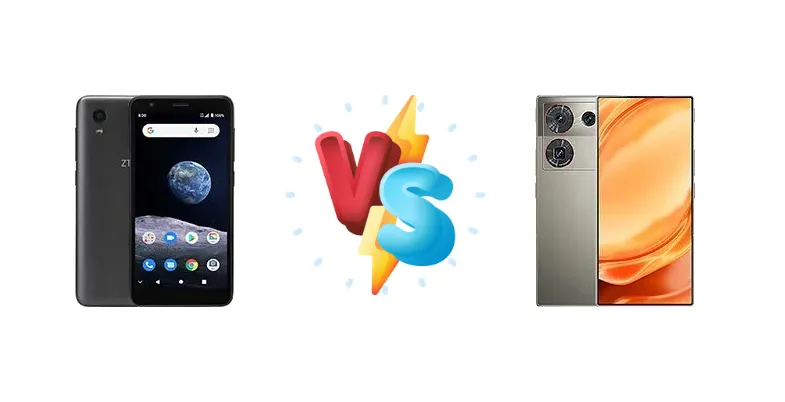
ZTE offers phones across a wide spectrum, from affordable entry-level devices to powerful flagships. Today, we're pitting two very different ZTE phones against each other: the budget-conscious Blade A3 Plus and the high-end nubia Z50 Ultra. This comparison will help you decide which phone best suits your needs and budget.
🏆 Quick Verdict
The nubia Z50 Ultra utterly dominates the ZTE Blade A3 Plus in almost every category. Its Snapdragon 8 Gen 2 chipset, stunning display, and advanced camera system make it a flagship powerhouse. The Blade A3 Plus is a basic, affordable option for those needing essential smartphone functionality.
| Network |
|---|
| 2G bands | GSM 850 / 1900 | GSM 850 / 900 / 1800 / 1900 |
| 3G bands | HSDPA 850 / 1700(AWS) / 1900 | HSDPA 850 / 900 / 1700(AWS) / 1900 / 2100 |
| 4G bands | 2, 4, 5, 7, 12, 13, 66 | LTE |
| 5G bands | - | SA/NSA |
| Speed | HSPA, LTE | HSPA, LTE, 5G |
| Technology | GSM / HSPA / LTE | GSM / CDMA / HSPA / CDMA2000 / LTE / 5G |
| | - | CDMA2000 1x |
| Launch |
|---|
| Announced | 2022, January | 2023, March 07 |
| Status | Available. Released 2022, January | Available. Released 2023, March 14 |
| Body |
|---|
| Dimensions | 137 x 68 x 10.5 mm (5.39 x 2.68 x 0.41 in) | 163.9 x 76.3 x 8.3 mm (6.45 x 3.00 x 0.33 in) |
| SIM | Nano-SIM | Nano-SIM + Nano-SIM |
| Weight | 188 g (6.63 oz) | 228 g (8.04 oz) |
| Display |
|---|
| Resolution | 480 x 960 pixels, 18:9 ratio (~215 ppi density) | 1116 x 2480 pixels, 20:9 ratio (~400 ppi density) |
| Size | 5.0 inches, 64.5 cm2 (~69.3% screen-to-body ratio) | 6.8 inches, 111.6 cm2 (~89.3% screen-to-body ratio) |
| Type | TFT LCD | AMOLED, 1B colors, 120Hz, HDR10+, 1500 nits (peak) |
| Platform |
|---|
| CPU | Quad-core 1.5 GHz Cortex-A53 | Octa-core (1x3.2 GHz Cortex-X3 & 2x2.8 GHz Cortex-A715 & 2x2.8 GHz Cortex-A710 & 3x2.0 GHz Cortex-A510) |
| Chipset | Mediatek MT6739W (28 nm) | Qualcomm SM8550-AB Snapdragon 8 Gen 2 (4 nm) |
| GPU | PowerVR GE8100 | Adreno 740 |
| OS | Android 11 (Go edition) | Android 13, MyOS 13 |
| Memory |
|---|
| Card slot | microSDHC (dedicated slot) | No |
| Internal | 16GB 2GB RAM | 256GB 8GB RAM, 256GB 12GB RAM, 512GB 12GB RAM, 1TB 16GB RAM |
| | eMMC 5.1 | UFS 4.0 |
| Main Camera |
|---|
| Features | LED flash | Laser AF, Ring-LED, dual-tone flash, panorama, HDR |
| Single | 5 MP | 16 MP, f/2.0, 26mm (wide), 1/2.8", 1.22µm, under display |
| Triple | - | 64 MP, f/1.6, 35mm (standard), 1/1.73", 0.8µm, PDAF, OIS
64 MP, f/3.3, 85mm (periscope telephoto), 1/2.0", PDAF, OIS, 3.3x optical zoom (vs. 26mm cam)
50 MP, f/2.X, 14mm, 116˚ (ultrawide), PDAF |
| Video | 720p@30fps | 8K@30fps, 4K@30/60/120fps, 1080p@30/60fps, gyro-EIS, HDR10, 10‑bit video |
| Selfie camera |
|---|
| Features | - | HDR |
| Single | 3 MP | 16 MP, f/2.0, 26mm (wide), 1/2.8", 1.22µm, under display |
| Video | - | 1080p@30fps |
| Sound |
|---|
| 3.5mm jack | Yes | No |
| 35mm jack | Yes | No |
| Loudspeaker | Yes | Yes, with stereo speakers |
| | - | 24-bit/192kHz audio |
| Comms |
|---|
| Bluetooth | 4.2, A2DP, LE | 5.3, A2DP, LE Audio, aptX HD, aptX Adaptive, aptX Lossless |
| Infrared port | - | Yes |
| NFC | No | Yes |
| Positioning | GPS | GPS (L1+L5), GLONASS (L1+L2+L5), GALILEO, BDS |
| Radio | No | No |
| USB | microUSB 2.0 | USB Type-C 3.1, OTG |
| WLAN | Wi-Fi 802.11 b/g/n | Wi-Fi 802.11 a/b/g/n/ac/6e, dual-band, Wi-Fi Direct |
| Features |
|---|
| Sensors | - | Fingerprint (under display, optical), accelerometer, gyro, proximity, compass |
| Battery |
|---|
| Charging | - | 80W wired, PD3.0, QC4 |
| Type | Li-Ion 2050 mAh, removable | Li-Po 5000 mAh |
| Misc |
|---|
| Colors | Black | Black, Silver, Starry Sky |
| Models | Z3353CA | NX712J |
| Price | About 70 EUR | About 540 EUR |
ZTE Blade A3 Plus
- Affordable
- Compact size
- Basic functionality
- Weak performance
- Low-resolution display
- Basic camera
- Limited storage
- Slow charging
ZTE nubia Z50 Ultra
- Flagship performance
- Stunning display
- Excellent camera
- Fast charging
- Premium design
- Expensive
- Potentially large size for some
- Software updates may be slower compared to other brands
Display Comparison
The nubia Z50 Ultra boasts a 6.8-inch 1.5K AMOLED display with a 144Hz refresh rate, offering vibrant colors, deep blacks, and incredibly smooth scrolling. The Blade A3 Plus likely features a smaller, lower-resolution LCD display, likely around 6.2 inches, with a standard 60Hz refresh rate. The difference in visual quality is substantial.
Camera Comparison
The nubia Z50 Ultra features a sophisticated camera system, likely including a high-resolution main sensor, ultrawide lens, and telephoto lens, capable of capturing stunning photos and videos. The Blade A3 Plus will have a basic camera setup, likely a single rear camera with limited features and image quality.
Performance
The Snapdragon 8 Gen 2 in the nubia Z50 Ultra is a beast, delivering flagship-level performance for demanding games and multitasking. The Mediatek MT6739W in the Blade A3 Plus is a budget chipset, adequate for basic tasks but struggling with anything intensive. Expect significant lag and slowdowns on the Blade A3 Plus.
Battery Life
The nubia Z50 Ultra's 80W fast charging will quickly replenish its large battery (likely 5000mAh+), providing all-day battery life even with heavy usage. The Blade A3 Plus has a smaller battery (likely around 3000mAh) and slower charging, offering less overall battery life.
Buying Guide
The ZTE Blade A3 Plus is ideal for first-time smartphone users, seniors, or anyone needing a simple, inexpensive device for calls, texts, and basic apps. The nubia Z50 Ultra is for power users, gamers, photography enthusiasts, and anyone who demands top-tier performance and features.
Frequently Asked Questions
❓ Is the ZTE Blade A3 Plus good for gaming?
No, the Blade A3 Plus's chipset is not powerful enough for demanding games. It can handle very basic games, but expect low frame rates and lag.
❓ How much storage does the ZTE nubia Z50 Ultra have?
The nubia Z50 Ultra typically comes with 256GB or 512GB of internal storage, offering ample space for apps, photos, and videos.
❓ What is the difference between AMOLED and LCD screens?
AMOLED screens offer better contrast, deeper blacks, and more vibrant colors compared to LCD screens. They also tend to be more energy-efficient.