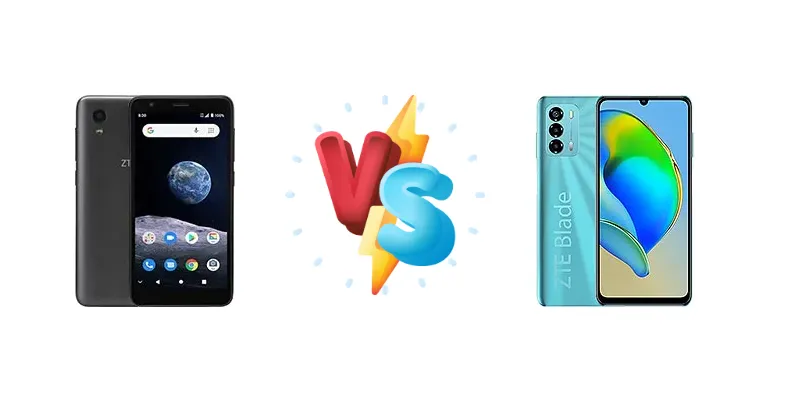
The ZTE Blade A3 Plus represents an older generation of entry-level smartphones, while the Blade V40 Vita aims to offer a more modern experience at a similar price point. This comparison dissects the key differences between these two devices, focusing on the significant chipset upgrade and its impact on daily usage.
🏆 Quick Verdict
For most users, the ZTE Blade V40 Vita is the superior choice. Its Unisoc T606 chipset delivers a substantial performance boost over the A3 Plus’s Mediatek MT6739W, offering a smoother experience for multitasking and app usage. The addition of 22.5W charging is a welcome improvement, despite the likely similar battery capacity.
| Network |
|---|
| 2G bands | GSM 850 / 1900 | GSM 850 / 900 / 1800 / 1900 |
| 3G bands | HSDPA 850 / 1700(AWS) / 1900 | HSDPA 850 / 900 / 1900 / 2100 |
| 4G bands | 2, 4, 5, 7, 12, 13, 66 | LTE |
| Speed | HSPA, LTE | HSPA, LTE |
| Technology | GSM / HSPA / LTE | GSM / HSPA / LTE |
| Launch |
|---|
| Announced | 2022, January | 2022, May 31 |
| Status | Available. Released 2022, January | Available. Released 2022, July 13 |
| Body |
|---|
| Dimensions | 137 x 68 x 10.5 mm (5.39 x 2.68 x 0.41 in) | 168 x 77.5 x 9.4 mm (6.61 x 3.05 x 0.37 in) |
| SIM | Nano-SIM | Nano-SIM + Nano-SIM |
| Weight | 188 g (6.63 oz) | 214.3 g (7.55 oz) |
| Display |
|---|
| Resolution | 480 x 960 pixels, 18:9 ratio (~215 ppi density) | 720 x 1600 pixels, 20:9 ratio (~260 ppi density) |
| Size | 5.0 inches, 64.5 cm2 (~69.3% screen-to-body ratio) | 6.75 inches, 110.0 cm2 (~84.5% screen-to-body ratio) |
| Type | TFT LCD | IPS LCD, 90Hz |
| Platform |
|---|
| CPU | Quad-core 1.5 GHz Cortex-A53 | Octa-core (2x1.6 GHz Cortex-A75 & 6x1.6 GHz Cortex-A55) |
| Chipset | Mediatek MT6739W (28 nm) | Unisoc T606 (12 nm) |
| GPU | PowerVR GE8100 | Mali-G57 MP1 |
| OS | Android 11 (Go edition) | Android 12 |
| Memory |
|---|
| Card slot | microSDHC (dedicated slot) | microSDXC (dedicated slot) |
| Internal | 16GB 2GB RAM | 128GB 4GB RAM |
| | eMMC 5.1 | UFS 2.2 |
| Main Camera |
|---|
| Features | LED flash | LED flash, HDR, panorama |
| Single | 5 MP | 8 MP, f/2.0, (wide) |
| Triple | - | 48 MP, f/1.8, 26mm (wide), PDAF
2 MP (macro)
Auxiliary lens |
| Video | 720p@30fps | 1080p@30fps |
| Selfie camera |
|---|
| Single | 3 MP | 8 MP, f/2.0, (wide) |
| Video | - | 1080p@30fps |
| Sound |
|---|
| 3.5mm jack | Yes | Yes |
| 35mm jack | Yes | Yes |
| Loudspeaker | Yes | Yes |
| Comms |
|---|
| Bluetooth | 4.2, A2DP, LE | 5.0, A2DP, LE |
| NFC | No | No |
| Positioning | GPS | GPS |
| Radio | No | Unspecified |
| USB | microUSB 2.0 | USB Type-C 2.0, OTG |
| WLAN | Wi-Fi 802.11 b/g/n | Yes |
| Features |
|---|
| Sensors | - | Fingerprint (side-mounted), accelerometer, proximity |
| Battery |
|---|
| Charging | - | 22.5W wired |
| Type | Li-Ion 2050 mAh, removable | Li-Po 6000 mAh |
| Misc |
|---|
| Colors | Black | Black, Blue, Red |
| Models | Z3353CA | 8045 |
| Price | About 70 EUR | About 130 EUR |
ZTE Blade A3 Plus
- Potentially lower price point
- Simple and straightforward user experience
- May be more readily available in some regions
- Outdated chipset with limited performance
- Less efficient processor leading to shorter battery life
- Slower charging speeds (likely 5W or 10W)
ZTE Blade V40 Vita
- Significantly faster and more responsive performance
- Faster 22.5W wired charging
- More efficient processor for potentially longer battery life
- May be slightly more expensive
- Potentially less readily available in some regions
- Software updates may be less frequent
Display Comparison
Neither ZTE provides detailed display specifications in the provided data. However, given the market segment, both likely utilize LCD panels. The V40 Vita’s newer design *may* benefit from slightly reduced bezels, but this is speculative. The absence of information regarding brightness nits or color accuracy makes a direct comparison impossible, but the V40 Vita’s newer manufacturing process could lead to minor improvements.
Camera Comparison
Without sensor details, a camera comparison is limited. Both phones likely feature basic camera setups geared towards casual photography. The A3 Plus’s camera is likely to be significantly less capable due to the older ISP within the MT6739W. The V40 Vita’s Unisoc T606 includes a more modern image signal processor, which should result in better image quality, particularly in low-light conditions. Any additional camera features on the V40 Vita, even a slightly larger main sensor, would further widen the gap.
Performance
The core difference lies in the chipsets. The ZTE Blade V40 Vita’s Unisoc T606, fabricated on a 12nm process, is a significant upgrade over the A3 Plus’s 28nm Mediatek MT6739W. The T606’s octa-core configuration (2x1.6 GHz Cortex-A75 & 6x1.6 GHz Cortex-A55) provides a substantial advantage in multi-core performance compared to the A3 Plus’s quad-core 1.5 GHz Cortex-A53. The Cortex-A75 cores in the V40 Vita are considerably more powerful than the A53 cores, resulting in faster app launches and smoother multitasking. The 12nm process also contributes to improved power efficiency, potentially extending battery life despite the increased processing power.
Battery Life
Battery capacity isn’t specified for either device. However, the V40 Vita’s 22.5W wired charging is a clear advantage. While the battery size may be similar, the faster charging will significantly reduce the time spent tethered to a wall outlet. The more efficient Unisoc T606 chipset in the V40 Vita could also contribute to slightly longer battery life during typical usage, even with a comparable battery capacity.
Buying Guide
Buy the ZTE Blade A3 Plus if you absolutely need the lowest possible price and your usage is limited to basic tasks like calls, texts, and light web browsing. Buy the ZTE Blade V40 Vita if you prioritize a more responsive user experience, faster charging, and a chipset capable of handling more demanding applications, even if it means spending a little more.
Frequently Asked Questions
❓ Will the ZTE Blade V40 Vita handle popular social media apps like TikTok and Instagram smoothly?
Yes, the Unisoc T606 chipset in the V40 Vita is significantly more capable than the MT6739W in the A3 Plus. It should handle social media apps, web browsing, and light gaming without significant lag or stuttering, providing a much smoother user experience.
❓ Is the 22.5W charging on the ZTE Blade V40 Vita a significant improvement over the A3 Plus?
Absolutely. While the exact charging speed of the A3 Plus isn't specified, it's likely around 5W or 10W. 22.5W charging will dramatically reduce charging times, allowing you to quickly top up your battery when needed. Expect a full charge in significantly less time with the V40 Vita.
❓ Can the ZTE Blade V40 Vita run demanding games like PUBG Mobile?
While the V40 Vita won't deliver a high-end gaming experience, the Unisoc T606 should be capable of running PUBG Mobile at lower settings. Expect playable frame rates with reduced graphics quality. The A3 Plus would likely struggle significantly with this title.
❓ How much of a difference will the 12nm process of the Unisoc T606 make in battery life compared to the 28nm process of the Mediatek MT6739W?
The 12nm process is significantly more efficient than 28nm. This means the Unisoc T606 consumes less power for the same level of performance. While battery capacity is unknown for both devices, the V40 Vita will likely offer longer battery life during typical usage due to this improved efficiency.