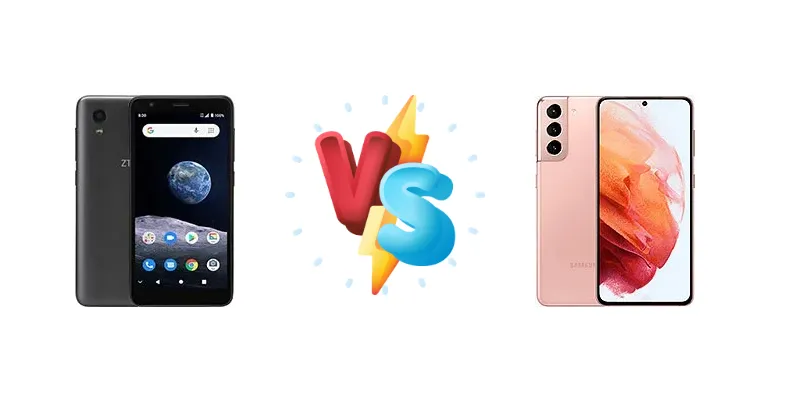
The smartphone market offers a vast range of options, from ultra-affordable devices to premium flagships. Today, we're pitting two extremes against each other: the budget-friendly ZTE Blade A3 Plus and the powerhouse Samsung Galaxy S21 5G. This comparison will reveal which phone best suits your needs and budget.
🏆 Quick Verdict
The Samsung Galaxy S21 5G utterly dominates this comparison. Its superior performance, stunning display, advanced camera system, and long-lasting battery make it a clear winner. The ZTE Blade A3 Plus offers basic functionality at a low price, but it's in a different league entirely.
| Network |
|---|
| 2G bands | GSM 850 / 1900 | GSM 850 / 900 / 1800 / 1900 |
| 3G bands | HSDPA 850 / 1700(AWS) / 1900 | HSDPA 850 / 900 / 1700(AWS) / 1900 / 2100 |
| 4G bands | 2, 4, 5, 7, 12, 13, 66 | 1, 2, 3, 4, 5, 7, 8, 12, 13, 14, 18, 19, 20, 25, 26, 28, 30, 38, 39, 40, 41, 46, 48, 66, 71 - SM-G991U1 |
| 5G bands | - | 2, 5, 25, 41, 66, 71, 260, 261 SA/NSA/Sub6/mmWave - SM-G991U1 |
| Speed | HSPA, LTE | HSPA 42.2/5.76 Mbps, LTE (7CA) Cat20 2000/200 Mbps, 5G (5+ Gbps DL) |
| Technology | GSM / HSPA / LTE | GSM / CDMA / HSPA / EVDO / LTE / 5G |
| | - | 1, 3, 5, 7, 8, 20, 28, 38, 40, 41, 66, 77, 78 SA/NSA/Sub6 - SM-G991B |
| Launch |
|---|
| Announced | 2022, January | 2021, January 14 |
| Status | Available. Released 2022, January | Available. Released 2021, January 29 |
| Body |
|---|
| Build | - | Glass front (Gorilla Glass Victus), plastic back, aluminum frame |
| Dimensions | 137 x 68 x 10.5 mm (5.39 x 2.68 x 0.41 in) | 151.7 x 71.2 x 7.9 mm (5.97 x 2.80 x 0.31 in) |
| SIM | Nano-SIM | · Nano-SIM + eSIM· Nano-SIM + Nano-SIM + eSIM (max 2 at a time) |
| Weight | 188 g (6.63 oz) | 169 g (Sub6), 171 g (mmWave) (5.96 oz) |
| | - | IP68 dust/water resistant (up to 1.5m for 30 min) |
| Display |
|---|
| Protection | - | Corning Gorilla Glass Victus |
| Resolution | 480 x 960 pixels, 18:9 ratio (~215 ppi density) | 1080 x 2400 pixels, 20:9 ratio (~421 ppi density) |
| Size | 5.0 inches, 64.5 cm2 (~69.3% screen-to-body ratio) | 6.2 inches, 94.1 cm2 (~87.2% screen-to-body ratio) |
| Type | TFT LCD | Dynamic AMOLED 2X, 120Hz, HDR10+, 1300 nits (peak) |
| | - | Always-on display |
| Platform |
|---|
| CPU | Quad-core 1.5 GHz Cortex-A53 | Octa-core (1x2.9 GHz Cortex-X1 & 3x2.80 GHz Cortex-A78 & 4x2.2 GHz Cortex-A55) - InternationalOcta-core (1x2.84 GHz Cortex-X1 & 3x2.42 GHz Cortex-A78 & 4x1.80 GHz Cortex-A55) - USA/China |
| Chipset | Mediatek MT6739W (28 nm) | Exynos 2100 (5 nm) - InternationalQualcomm SM8350 Snapdragon 888 5G (5 nm) - USA/China |
| GPU | PowerVR GE8100 | Mali-G78 MP14 - InternationalAdreno 660 - USA/China |
| OS | Android 11 (Go edition) | Android 11, up to 4 major Android upgrades, One UI 6.1 |
| Memory |
|---|
| Card slot | microSDHC (dedicated slot) | No |
| Internal | 16GB 2GB RAM | 128GB 6GB RAM, 128GB 8GB RAM, 256GB 8GB RAM |
| | eMMC 5.1 | UFS 3.1 |
| Main Camera |
|---|
| Features | LED flash | LED flash, auto-HDR, panorama |
| Single | 5 MP | - |
| Triple | - | 12 MP, f/1.8, 26mm (wide), 1/1.76", 1.8µm, dual pixel PDAF, OIS
64 MP, f/2.0, 29mm (telephoto), 1/1.72", 0.8µm, PDAF, OIS, 1.1x optical zoom, 3x hybrid zoom
12 MP, f/2.2, 13mm, 120˚ (ultrawide), 1/2.55" 1.4µm, Super Steady video |
| Video | 720p@30fps | 8K@24fps, 4K@30/60fps, 1080p@30/60/120/240fps, HDR10+, stereo sound rec., gyro-EIS |
| Selfie camera |
|---|
| Features | - | HDR |
| Single | 3 MP | 10 MP, f/2.2, 26mm (wide), 1/3.24", 1.22µm, dual pixel PDAF |
| Video | - | 4K@30/60fps, 1080p@30fps |
| Sound |
|---|
| 3.5mm jack | Yes | No |
| 35mm jack | Yes | No |
| Loudspeaker | Yes | Yes, with stereo speakers |
| | - | 32-bit/384kHz audio
Tuned by AKG |
| Comms |
|---|
| Bluetooth | 4.2, A2DP, LE | 5.0, A2DP, LE |
| NFC | No | Yes |
| Positioning | GPS | GPS, GLONASS, BDS, GALILEO |
| Radio | No | FM radio (Snapdragon model only; market/operator dependent) |
| USB | microUSB 2.0 | USB Type-C 3.2, OTG |
| WLAN | Wi-Fi 802.11 b/g/n | Wi-Fi 802.11 a/b/g/n/ac/6, dual-band, Wi-Fi Direct |
| Features |
|---|
| Sensors | - | Fingerprint (under display, ultrasonic), accelerometer, gyro, proximity, compass, barometer |
| | - | Samsung DeX, Samsung Wireless DeX (desktop experience support)
Bixby natural language commands and dictation
Samsung Pay (Visa, MasterCard certified) |
| Battery |
|---|
| Charging | - | 25W wired, PD3.0
15W wireless (Qi)
4.5W reverse wireless |
| Type | Li-Ion 2050 mAh, removable | Li-Ion 4000 mAh |
| Misc |
|---|
| Colors | Black | Phantom Gray, Phantom White, Phantom Violet, Phantom Pink |
| Models | Z3353CA | SM-G991B, SM-G991B/DS, SM-G991U, SM-G991U1, SM-G991W, SM-G991N, SM-G9910, SM-G991Q, SCG09 |
| Price | About 70 EUR | € 194.00 / $ 153.58 / £ 149.99 |
| SAR | - | 0.74 W/kg (head) 1.08 W/kg (body) |
| SAR EU | - | 0.46 W/kg (head) 1.51 W/kg (body) |
| Pricing |
|---|
| 128GB 8GB RAM | - | $ 249.00 |
| 256GB 8GB RAM | - | $ 289.99 |
| RENEWED | - | $ 317.00 |
| Tests |
|---|
| Battery life | - |
Endurance rating 93h
|
| Camera | - |
Photo / Video |
| Display | - |
Contrast ratio: Infinite (nominal) |
| Loudspeaker | - |
-26.4 LUFS (Good)
|
| Performance | - |
AnTuTu: 584055 (v8)
GeekBench: 3238 (v5.1)
GFXBench: 60fps (ES 3.1 onscreen) |
ZTE Blade A3 Plus
- Extremely affordable
- Decent battery life for basic use
- Lightweight design
- Weak performance
- Low-resolution display
- Basic camera
- Limited storage
- Outdated chipset
Samsung Galaxy S21 5G
- Exceptional performance
- Stunning display
- Advanced camera system
- Fast charging
- Premium design
- 5G connectivity
- Expensive
- Battery life could be better for heavy users
- No expandable storage
Display Comparison
The Samsung Galaxy S21 5G boasts a Dynamic AMOLED 2X display with a 120Hz refresh rate and a peak brightness of 856 nits, offering incredible color accuracy and smooth visuals. The ZTE Blade A3 Plus has a standard LCD display, likely with lower resolution and brightness, resulting in a significantly less immersive experience. Contrast ratio is infinite on the S21, a huge advantage.
Camera Comparison
The Samsung Galaxy S21 5G's camera system is a standout feature, offering exceptional image quality, versatile shooting modes, and impressive video recording capabilities. The ZTE Blade A3 Plus's camera is adequate for basic snapshots but lacks the detail, dynamic range, and features of the S21 5G.
Performance
The Galaxy S21 5G's Exynos 2100 (or Snapdragon 888) chipset and ample RAM (8GB) deliver blazing-fast performance, effortlessly handling demanding games and multitasking. The ZTE Blade A3 Plus's Mediatek MT6739W chipset and quad-core CPU struggle with even moderate workloads, resulting in noticeable lag and slower app loading times.
Battery Life
The Galaxy S21 5G provides excellent battery life, achieving an endurance rating of 93 hours. It also supports 25W wired and 15W wireless charging. The ZTE Blade A3 Plus likely has a smaller battery and slower charging speeds, offering less overall battery endurance.
Buying Guide
The ZTE Blade A3 Plus is ideal for users on a very tight budget who primarily need a phone for basic communication and light tasks. The Samsung Galaxy S21 5G is for those who demand top-tier performance, a premium camera, and a vibrant display, and are willing to pay a premium for it.
Frequently Asked Questions
❓ Is the ZTE Blade A3 Plus good for gaming?
No, the ZTE Blade A3 Plus's chipset is not powerful enough for demanding games. It can handle very basic games, but expect significant lag and low frame rates.
❓ Does the Samsung Galaxy S21 5G have expandable storage?
No, the Samsung Galaxy S21 5G does not offer expandable storage via microSD card. You'll need to choose a storage option (128GB or 256GB) at the time of purchase.