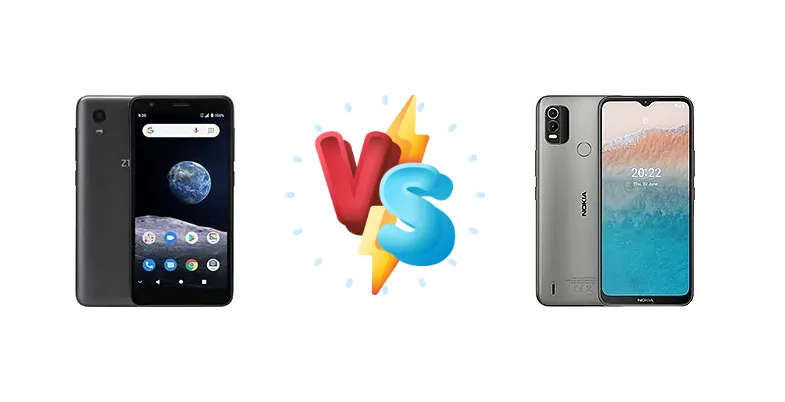
The ZTE Blade A3 Plus and Nokia C21 Plus represent the extreme end of the smartphone price spectrum. Both aim to deliver essential functionality at a minimal cost, but they take different approaches to achieving this. This comparison dissects their core components to determine which device offers the best value for users prioritizing affordability and basic smartphone features.
🏆 Quick Verdict
For the average user seeking a slightly more responsive experience, the Nokia C21 Plus emerges as the better choice. Its octa-core Unisoc SC9863A processor provides a noticeable performance uplift over the ZTE Blade A3 Plus’s quad-core Mediatek MT6739W, making everyday tasks smoother, despite both phones sharing a 28nm process.
| Network |
|---|
| 2G bands | GSM 850 / 1900 | GSM 850 / 900 / 1800 / 1900 |
| 3G bands | HSDPA 850 / 1700(AWS) / 1900 | HSDPA 850 / 900 / 2100 |
| 4G bands | 2, 4, 5, 7, 12, 13, 66 | LTE |
| Speed | HSPA, LTE | HSPA 42.2/5.76 Mbps, LTE Cat4 150/50 Mbps |
| Technology | GSM / HSPA / LTE | GSM / HSPA / LTE |
| | - | HSDPA 850 / 900 / 1700(AWS) / 1900 / 2100 |
| Launch |
|---|
| Announced | 2022, January | 2022, February 28 |
| Status | Available. Released 2022, January | Available. Released 2022, April 29 |
| Body |
|---|
| Build | - | Glass front, aluminum frame, plastic back |
| Dimensions | 137 x 68 x 10.5 mm (5.39 x 2.68 x 0.41 in) | 164.8 x 75.9 x 8.6 mm (6.49 x 2.99 x 0.34 in) |
| SIM | Nano-SIM | · Nano-SIM· Nano-SIM + Nano-SIM |
| Weight | 188 g (6.63 oz) | 178 g or 191 g (6.28 oz) |
| | - | Splash protection |
| Display |
|---|
| Protection | - | Scratch-resistant glass |
| Resolution | 480 x 960 pixels, 18:9 ratio (~215 ppi density) | 720 x 1600 pixels, 20:9 ratio (~269 ppi density) |
| Size | 5.0 inches, 64.5 cm2 (~69.3% screen-to-body ratio) | 6.52 inches, 102.6 cm2 (~82.1% screen-to-body ratio) |
| Type | TFT LCD | IPS LCD |
| Platform |
|---|
| CPU | Quad-core 1.5 GHz Cortex-A53 | Octa-core (4x1.6 GHz Cortex-A55 & 4x1.2 GHz Cortex-A55) |
| Chipset | Mediatek MT6739W (28 nm) | Unisoc SC9863A (28 nm) |
| GPU | PowerVR GE8100 | IMG8322 |
| OS | Android 11 (Go edition) | Android 11 (Go edition) |
| Memory |
|---|
| Card slot | microSDHC (dedicated slot) | microSDXC (dedicated slot) |
| Internal | 16GB 2GB RAM | 32GB 2GB RAM, 32GB 3GB RAM, 64GB 2GB RAM, 64GB 3GB RAM, 64GB 4GB RAM |
| | eMMC 5.1 | eMMC 5.1 |
| Main Camera |
|---|
| Dual | - | 13 MP, (wide), AF
Auxiliary lens |
| Features | LED flash | LED flash, HDR, panorama |
| Single | 5 MP | 5 MP |
| Video | 720p@30fps | 1080p@30fps |
| Selfie camera |
|---|
| Features | - | LED flash |
| Single | 3 MP | 5 MP |
| Video | - | 720p |
| Sound |
|---|
| 3.5mm jack | Yes | Yes |
| 35mm jack | Yes | Yes |
| Loudspeaker | Yes | Yes |
| Comms |
|---|
| Bluetooth | 4.2, A2DP, LE | 4.2, A2DP |
| NFC | No | No |
| Positioning | GPS | GPS |
| Radio | No | FM radio |
| USB | microUSB 2.0 | microUSB 2.0 |
| WLAN | Wi-Fi 802.11 b/g/n | Wi-Fi 802.11 b/g/n |
| Features |
|---|
| Sensors | - | Fingerprint (rear-mounted), accelerometer, proximity |
| Battery |
|---|
| Charging | - | 10W wired |
| Type | Li-Ion 2050 mAh, removable | Li-Ion 4000/5050 mAh |
| Misc |
|---|
| Colors | Black | Dark Cyan, Warm Gray |
| Models | Z3353CA | TA-1433, TA-1431, TA-1426, TA-1424 |
| Price | About 70 EUR | About 120 EUR |
| SAR | - | 0.57 W/kg (head) 0.65 W/kg (body) |
| SAR EU | - | 0.40 W/kg (head) 0.99 W/kg (body) |
ZTE Blade A3 Plus
- Potentially lower price point
- Simple and straightforward user experience
- Durable build quality (typical of ZTE)
- Outdated quad-core processor
- Likely slower performance
- No specified charging standard
Nokia C21 Plus
- Octa-core processor for smoother performance
- 10W wired charging support
- More efficient processor architecture (Cortex-A55)
- May be slightly more expensive
- Unisoc chipset may have limited software support
- Basic camera capabilities
Display Comparison
Neither device boasts a standout display. Given the shared target market, both likely utilize LCD panels with similar resolutions (720p is expected). The absence of detailed display specifications necessitates focusing on the processing power needed to drive the UI. A smoother processor, like the one in the Nokia, will contribute to a more responsive visual experience, even on a basic panel.
Camera Comparison
Both phones likely feature basic camera setups geared towards casual snapshots. Without specific sensor details, it’s safe to assume both utilize low-resolution primary sensors. Focusing on processing power, the Unisoc SC9863A in the Nokia C21 Plus will likely offer slightly faster image processing times, but the overall image quality will be heavily dependent on the sensor itself, which remains unknown. The presence of a dedicated image signal processor (ISP) within the Unisoc chip could also contribute to marginally better image clarity.
Performance
The core difference lies in the chipset. The Nokia C21 Plus’s Unisoc SC9863A is an octa-core processor, featuring four Cortex-A55 cores clocked at 1.6 GHz and another four at 1.2 GHz. This contrasts sharply with the ZTE Blade A3 Plus’s Mediatek MT6739W, a quad-core processor with Cortex-A53 cores clocked at 1.5 GHz. While both are built on a 28nm process, the higher core count and newer Cortex-A55 architecture in the Unisoc chip translate to significantly improved multi-tasking and app launch speeds. The A55 architecture is more efficient than the A53, potentially leading to slightly better battery life under load. The Nokia will handle basic social media and web browsing with noticeably less lag.
Battery Life
Battery capacity is not specified for either device, but given their price points, both likely house batteries in the 3000-4000 mAh range. However, the Nokia C21 Plus gains an advantage with its 10W wired charging support. The ZTE Blade A3 Plus lacks any charging specification, suggesting a slower, potentially less convenient charging experience. While battery life will depend on usage patterns, the more efficient Unisoc processor in the Nokia could contribute to slightly longer runtimes.
Buying Guide
Buy the ZTE Blade A3 Plus if you need a phone primarily for calls, texts, and very light app usage, and are prioritizing absolute lowest cost. Its simplicity and basic functionality are sufficient for minimal smartphone needs. Buy the Nokia C21 Plus if you prefer a more fluid user experience, even with basic apps, and appreciate the benefit of an octa-core processor for multitasking and slightly more demanding tasks. The Nokia also offers the convenience of 10W charging, a feature absent on the ZTE.
Frequently Asked Questions
❓ Will the Nokia C21 Plus handle popular social media apps like Facebook and WhatsApp smoothly?
Yes, the octa-core Unisoc SC9863A processor in the Nokia C21 Plus is significantly better equipped to handle the demands of social media apps compared to the ZTE Blade A3 Plus. While not a powerhouse, it will provide a noticeably smoother and more responsive experience when browsing feeds and sending messages.
❓ Is the Unisoc chipset in the Nokia C21 Plus likely to receive regular software updates?
Software update support for Unisoc-powered devices can be less consistent than those using Qualcomm or MediaTek chipsets. Nokia generally provides a reasonable level of support for its budget devices, but long-term updates are not guaranteed. Expect security patches for a limited period, but major Android version upgrades are less likely.
❓ How much slower is the Mediatek MT6739W in the ZTE Blade A3 Plus compared to the Unisoc SC9863A?
The Mediatek MT6739W is a significantly older and less powerful processor. The Unisoc SC9863A's octa-core configuration and newer Cortex-A55 architecture provide a substantial performance advantage, estimated to be around 30-50% faster in typical usage scenarios. This translates to quicker app loading times, smoother multitasking, and a more responsive user interface.