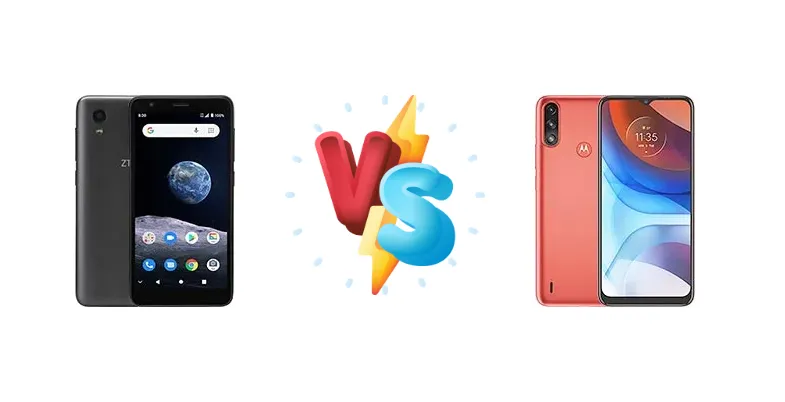
The sub-$150 smartphone market is fiercely competitive. Both the ZTE Blade A3 Plus and the Motorola Moto E7 Power aim to deliver essential smartphone functionality at an accessible price. However, they take different approaches to achieving this, primarily through their chipset choices. This comparison dissects those differences, focusing on performance, efficiency, and the user experience.
🏆 Quick Verdict
For the average user prioritizing sustained performance and battery efficiency, the Motorola Moto E7 Power is the better choice. Its newer 12nm Helio G25 chipset and octa-core CPU offer a noticeable advantage over the ZTE Blade A3 Plus’s older 28nm MT6739W, despite the latter’s slightly larger battery capacity.
| Network |
|---|
| 2G bands | GSM 850 / 1900 | GSM 850 / 900 / 1800 / 1900 |
| 3G bands | HSDPA 850 / 1700(AWS) / 1900 | HSDPA 850 / 900 / 1700(AWS) / 1900 / 2100 |
| 4G bands | 2, 4, 5, 7, 12, 13, 66 | 1, 3, 5, 7, 8, 20, 38, 40, 41 |
| Speed | HSPA, LTE | HSPA, LTE |
| Technology | GSM / HSPA / LTE | GSM / HSPA / LTE |
| Launch |
|---|
| Announced | 2022, January | 2021, February 19 |
| Status | Available. Released 2022, January | Available. Released 2021, February 26 |
| Body |
|---|
| Build | - | Glass front, plastic back, plastic frame |
| Dimensions | 137 x 68 x 10.5 mm (5.39 x 2.68 x 0.41 in) | 165.1 x 75.9 x 9.2 mm (6.5 x 2.99 x 0.36 in) |
| SIM | Nano-SIM | Nano-SIM + Nano-SIM |
| Weight | 188 g (6.63 oz) | 200 g (7.05 oz) |
| | - | Water-repellent design |
| Display |
|---|
| Resolution | 480 x 960 pixels, 18:9 ratio (~215 ppi density) | 720 x 1600 pixels, 20:9 ratio (~269 ppi density) |
| Size | 5.0 inches, 64.5 cm2 (~69.3% screen-to-body ratio) | 6.51 inches, 103.1 cm2 (~82.3% screen-to-body ratio) |
| Type | TFT LCD | IPS LCD, 380 nits (typ) |
| Platform |
|---|
| CPU | Quad-core 1.5 GHz Cortex-A53 | Octa-core (4x2.0 GHz Cortex-A53 & 4x1.5 GHz Cortex-A53) |
| Chipset | Mediatek MT6739W (28 nm) | Mediatek MT6762G Helio G25 (12 nm) |
| GPU | PowerVR GE8100 | PowerVR GE8320 |
| OS | Android 11 (Go edition) | Android 10 |
| Memory |
|---|
| Card slot | microSDHC (dedicated slot) | microSDXC (uses shared SIM slot) |
| Internal | 16GB 2GB RAM | 32GB 2GB RAM, 64GB 4GB RAM |
| | eMMC 5.1 | eMCP |
| Main Camera |
|---|
| Dual | - | 13 MP, f/2.0, 26mm (wide), 1/3.1", 1.12µm, PDAF
2 MP (macro) |
| Features | LED flash | LED flash, HDR, panorama |
| Single | 5 MP | - |
| Video | 720p@30fps | 1080p@30fps |
| Selfie camera |
|---|
| Features | - | HDR |
| Single | 3 MP | 5 MP, f/2.2, 27mm (wide), 1.12µm |
| Video | - | 1080p@30fps |
| Sound |
|---|
| 3.5mm jack | Yes | Yes |
| 35mm jack | Yes | Yes |
| Loudspeaker | Yes | Yes |
| Comms |
|---|
| Bluetooth | 4.2, A2DP, LE | 5.0, A2DP, LE |
| NFC | No | No |
| Positioning | GPS | GPS, GLONASS, GALILEO |
| Radio | No | FM radio |
| USB | microUSB 2.0 | USB Type-C 2.0, OTG |
| WLAN | Wi-Fi 802.11 b/g/n | Wi-Fi 802.11 b/g/n |
| Features |
|---|
| Sensors | - | Fingerprint (rear-mounted), accelerometer, proximity |
| Battery |
|---|
| Charging | - | 10W wired |
| Type | Li-Ion 2050 mAh, removable | Li-Ion 5000 mAh |
| Misc |
|---|
| Colors | Black | Tahiti Blue, Coral Red |
| Models | Z3353CA | PAMH0001IN, PAMH0010IN, PAMH0019IN |
| Price | About 70 EUR | About 140 EUR |
ZTE Blade A3 Plus
- Potentially lower price point
- Larger battery capacity (on paper)
- Simple and straightforward user experience
- Older, less efficient chipset
- Slower performance
- Likely more noticeable throttling
Motorola Moto E7 Power
- More powerful and efficient chipset
- Octa-core CPU for smoother multitasking
- Better thermal management
- Slightly smaller battery capacity
- May be marginally more expensive
- 10W charging is relatively slow
Display Comparison
Neither device boasts a standout display. Both likely feature 720p+ resolution panels, typical for this price bracket. However, the lack of detailed display specifications prevents a direct comparison of brightness or color accuracy. The focus here is on functionality, not visual fidelity. Bezels are expected to be substantial on both devices, maximizing screen real estate within a compact form factor.
Camera Comparison
Camera performance is likely to be similar on both devices, relying on budget sensors and basic image processing. Without specific sensor details, it’s difficult to make a definitive statement. However, the inclusion of a 13MP main sensor on the Moto E7 Power is a common configuration, while the ZTE Blade A3 Plus likely features an 8MP sensor. The presence of a dedicated night mode on the E7 Power suggests slightly more sophisticated image processing capabilities. The often-included 2MP macro lenses on both devices offer limited practical benefit due to their low resolution and fixed focus.
Performance
The core difference lies in the chipsets. The Motorola Moto E7 Power’s MediaTek Helio G25 (MT6762G) fabricated on a 12nm process is a significant upgrade over the ZTE Blade A3 Plus’s MediaTek MT6739W (28nm). The G25’s octa-core configuration (4x2.0 GHz Cortex-A53 & 4x1.5 GHz Cortex-A53) provides a substantial boost in multi-core performance compared to the A3 Plus’s quad-core 1.5 GHz Cortex-A53. The smaller fabrication node of the G25 translates to improved thermal efficiency, meaning less throttling under sustained load and a cooler operating temperature. This benefits users who engage in light gaming or multitasking.
Battery Life
The ZTE Blade A3 Plus features a 4000mAh battery, while the Moto E7 Power has a 5000mAh battery. While the A3 Plus has a larger capacity, the Moto E7 Power’s more efficient Helio G25 chipset will likely result in comparable, or even superior, real-world battery life. The E7 Power also supports 10W wired charging, which, while slow by modern standards, is a standard offering in this segment. The A3 Plus’s charging speed is not specified, but is likely similar.
Buying Guide
Buy the ZTE Blade A3 Plus if your primary need is a very basic smartphone for essential tasks like calls, texts, and light social media, and you're on an extremely tight budget. Buy the Motorola Moto E7 Power if you want a more responsive experience for everyday tasks, occasional gaming, and appreciate the benefits of a more modern, power-efficient chipset, even if it means a slightly higher upfront cost.
Frequently Asked Questions
❓ Will the Motorola Moto E7 Power struggle with popular apps like Facebook or WhatsApp?
The Helio G25 chipset is capable of running these apps smoothly for most users. While it won't offer a flagship-level experience, the octa-core CPU and optimized software should provide a responsive experience for everyday social media use. Expect some slowdown with multiple apps open simultaneously.
❓ Is the ZTE Blade A3 Plus suitable for playing mobile games?
The ZTE Blade A3 Plus is not ideal for gaming. The MT6739W chipset is underpowered for most modern mobile games, and the 28nm process will lead to significant throttling, resulting in a choppy and frustrating gaming experience. Simple, less demanding games may be playable at low settings.
❓ Does the Moto E7 Power support fast charging?
No, the Moto E7 Power supports only 10W wired charging. This is a standard charging speed for budget smartphones, and a full charge will take several hours. It's not a fast-charging device.
❓ What Android version do these phones ship with?
Both devices likely ship with Android Go Edition, a lightweight version of Android designed for devices with limited RAM and storage. This helps to optimize performance and reduce data usage.