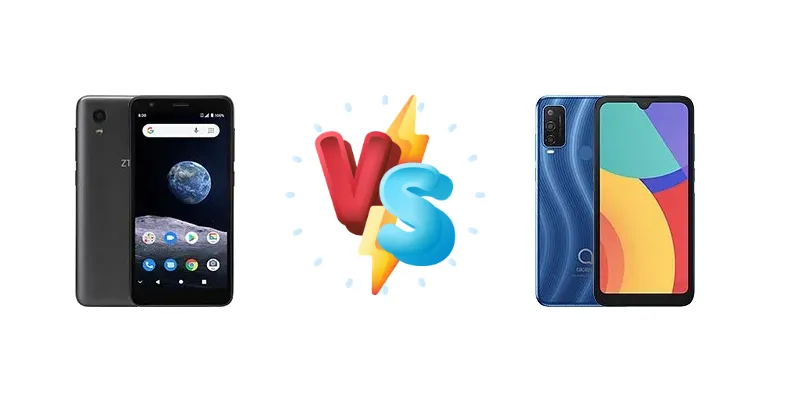
The ZTE Blade A3 Plus and the alcatel 1L Pro (2021) represent the extreme end of the smartphone price spectrum. Both aim to deliver basic smartphone functionality at the lowest possible cost. However, significant differences in their underlying hardware mean one offers a noticeably smoother experience, despite both utilizing 28nm fabrication processes. This comparison will dissect those differences to determine which device provides the best value.
🏆 Quick Verdict
For the average user prioritizing responsiveness and multitasking, the alcatel 1L Pro (2021) is the clear winner. Its octa-core Unisoc SC9863A processor provides a substantial performance advantage over the ZTE Blade A3 Plus’s quad-core Mediatek MT6739W, making everyday tasks feel significantly snappier.
| Network |
|---|
| 2G bands | GSM 850 / 1900 | GSM 850 / 900 / 1800 / 1900 |
| 3G bands | HSDPA 850 / 1700(AWS) / 1900 | HSDPA 850 / 900 / 1700(AWS) / 1900 / 2100 |
| 4G bands | 2, 4, 5, 7, 12, 13, 66 | 2, 3, 4, 5, 7, 8, 12, 17, 28, 66 - USA |
| Speed | HSPA, LTE | HSPA 21.1/5.76 Mbps, LTE Cat4 150/50 Mbps |
| Technology | GSM / HSPA / LTE | GSM / HSPA / LTE |
| Launch |
|---|
| Announced | 2022, January | 2021, June 25 |
| Status | Available. Released 2022, January | Available. Released 2021, Q2 |
| Body |
|---|
| Build | - | Glass front, plastic back, plastic frame |
| Dimensions | 137 x 68 x 10.5 mm (5.39 x 2.68 x 0.41 in) | 156.4 x 74.8 x 9.7 mm (6.16 x 2.94 x 0.38 in) |
| SIM | Nano-SIM | · Nano-SIM· Nano-SIM + Nano-SIM |
| Weight | 188 g (6.63 oz) | 190 g (6.70 oz) |
| Display |
|---|
| Resolution | 480 x 960 pixels, 18:9 ratio (~215 ppi density) | 720 x 1560 pixels, 19.5:9 ratio (~282 ppi density) |
| Size | 5.0 inches, 64.5 cm2 (~69.3% screen-to-body ratio) | 6.1 inches, 91.3 cm2 (~78.1% screen-to-body ratio) |
| Type | TFT LCD | IPS LCD |
| Platform |
|---|
| CPU | Quad-core 1.5 GHz Cortex-A53 | Octa-core (4x1.6 GHz Cortex-A55 & 4x1.2 GHz Cortex-A55) |
| Chipset | Mediatek MT6739W (28 nm) | Unisoc SC9863A (28 nm) |
| GPU | PowerVR GE8100 | IMG8322 |
| OS | Android 11 (Go edition) | Android 11 (Go edition) |
| Memory |
|---|
| Card slot | microSDHC (dedicated slot) | microSDXC (uses shared SIM slot) |
| Internal | 16GB 2GB RAM | 32GB 2GB RAM |
| | eMMC 5.1 | eMMC 5.1 |
| Main Camera |
|---|
| Dual | - | 13 MP, f/2.2, 26mm (wide), 1/3.06", 1.12µm, AF
Auxiliary lens |
| Features | LED flash | LED flash, HDR, panorama |
| Single | 5 MP | - |
| Video | 720p@30fps | 1080p@30fps |
| Selfie camera |
|---|
| Features | - | HDR |
| Single | 3 MP | 5 MP, f/2.2, 27mm (wide), 1/5.0", 1.12µm |
| Video | - | 1080p@30fps |
| Sound |
|---|
| 3.5mm jack | Yes | Yes |
| 35mm jack | Yes | Yes |
| Loudspeaker | Yes | Yes |
| Comms |
|---|
| Bluetooth | 4.2, A2DP, LE | 4.2, A2DP |
| NFC | No | No |
| Positioning | GPS | GPS |
| Radio | No | FM radio |
| USB | microUSB 2.0 | microUSB 2.0, OTG |
| WLAN | Wi-Fi 802.11 b/g/n | Wi-Fi 802.11 b/g/n, Wi-Fi Direct |
| Features |
|---|
| Sensors | - | Fingerprint (rear-mounted), accelerometer, proximity |
| Battery |
|---|
| Type | Li-Ion 2050 mAh, removable | Li-Ion 3000 mAh |
| Misc |
|---|
| Colors | Black | Power Grey, Twilight Blue |
| Models | Z3353CA | - |
| Price | About 70 EUR | About 110 EUR |
ZTE Blade A3 Plus
- Potentially lower price point
- Simple and straightforward user experience
- Compact form factor
- Significantly slower processor
- Limited multitasking capabilities
- Outdated CPU architecture
alcatel 1L Pro (2021)
- Faster octa-core processor
- More responsive user interface
- Improved multitasking performance
- May be slightly more expensive
- Camera quality is still limited
- Still utilizes a basic LCD display
Display Comparison
Neither device boasts a standout display. Both likely utilize LCD panels, typical for this price point. Specifics like resolution and brightness are unavailable, but given the target market, expectations should be tempered. The focus here isn't on visual fidelity, but on basic readability. Bezels are likely substantial on both, maximizing screen real estate within a compact form factor. Color accuracy is unlikely to be a priority, and both will likely lean towards warmer color temperatures to conserve power.
Camera Comparison
Camera performance on both devices will be limited. Details on sensor size and aperture are unavailable, but it's safe to assume both feature basic sensors. The presence of a 2MP macro camera on the alcatel 1L Pro (2021) is largely marketing fluff; its image quality will be minimal. The primary camera on the alcatel will likely offer slightly better results due to the more capable processor handling image processing tasks. Expect washed-out colors and limited detail in low-light conditions on both.
Performance
The core difference lies in the processors. The alcatel 1L Pro (2021) features the Unisoc SC9863A, an octa-core chip with four Cortex-A55 cores clocked at 1.6 GHz and another four at 1.2 GHz. This contrasts sharply with the ZTE Blade A3 Plus’s Mediatek MT6739W, a quad-core processor using older Cortex-A53 cores clocked at 1.5 GHz. The A55 architecture is more efficient and offers improved performance per clock cycle compared to the A53. The additional cores on the Unisoc chip provide a significant advantage in multitasking and handling more demanding applications. While both are 28nm, the architectural improvements of the Unisoc chip are key. Expect noticeable lag and slowdowns on the ZTE when switching between apps or running multiple processes.
Battery Life
Battery capacity details are missing for both devices. However, given their low-power processors and basic displays, both should offer all-day battery life with moderate usage. Charging wattage is also unknown, but likely falls in the 5W-10W range. The alcatel 1L Pro (2021)'s more efficient processor may translate to slightly longer battery life, even with a similar capacity battery, as it spends less time under load.
Buying Guide
Buy the ZTE Blade A3 Plus if you absolutely need the lowest possible upfront cost and are willing to tolerate slower performance and limited multitasking. It's suitable for users who primarily make calls, send texts, and occasionally browse the web. Buy the alcatel 1L Pro (2021) if you prefer a more responsive user experience, even for basic tasks, and anticipate using multiple apps or light gaming. The extra processing power justifies the potentially slightly higher price.
Frequently Asked Questions
❓ Will the alcatel 1L Pro (2021) struggle with popular social media apps like Facebook and Instagram?
While the alcatel 1L Pro (2021) won't offer a flagship-level experience, its octa-core processor and more modern architecture should handle Facebook and Instagram reasonably well. Expect some loading times and occasional slowdowns, but it will be significantly smoother than the ZTE Blade A3 Plus, which will likely struggle with these apps.
❓ Is the ZTE Blade A3 Plus suitable for a first-time smartphone user?
The ZTE Blade A3 Plus could be suitable for a very basic first-time smartphone user who primarily needs calling and texting functionality. However, its slow performance may lead to frustration when attempting to use more complex apps or features. The alcatel 1L Pro (2021) offers a more forgiving experience for new users.
❓ Can either of these phones run multiple apps simultaneously without significant lag?
The alcatel 1L Pro (2021) is better equipped for multitasking. While it won't handle heavy multitasking, it can run two or three apps simultaneously without excessive lag. The ZTE Blade A3 Plus will struggle even with two apps open, frequently forcing apps to reload in the background.