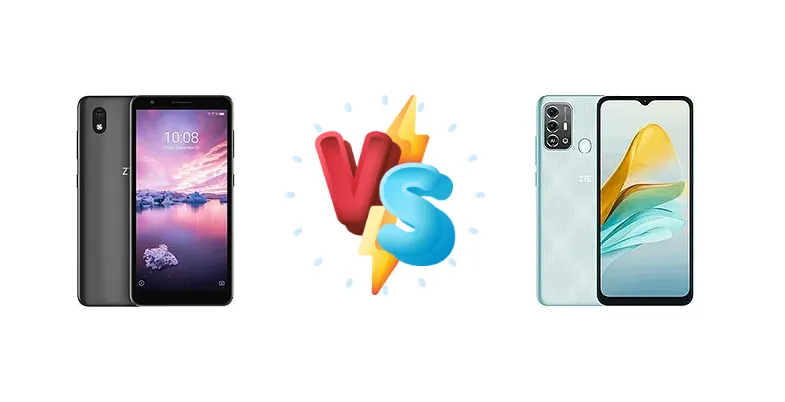
ZTE's Blade series consistently targets the ultra-budget segment, but even within that space, choices exist. The A3 Joy and A53 Pro represent different approaches to affordability. The A3 Joy prioritizes a streamlined experience with a simpler chipset, while the A53 Pro attempts to offer more processing power with an octa-core processor. This comparison dissects the key differences to help you determine which device best fits your needs.
🏆 Quick Verdict
For the average user prioritizing basic functionality like calls, messaging, and light social media, the ZTE Blade A3 Joy offers a sufficient experience at a potentially lower price point. However, the ZTE Blade A53 Pro’s octa-core processor provides a noticeable performance boost for multitasking and slightly more demanding apps, making it the better choice for those seeking a more responsive device.
| Network |
|---|
| 2G bands | GSM 850 / 900 / 1800 / 1900 | GSM 850 / 900 / 1800 / 1900 |
| 3G bands | HSDPA 850 / 1700(AWS) / 1900 | HSDPA 850 / 900 / 1900 / 2100 |
| 4G bands | 2, 4, 5, 12, 41, 66, 71 | LTE |
| Speed | HSPA, LTE | HSPA, LTE |
| Technology | GSM / HSPA / LTE | GSM / HSPA / LTE |
| Launch |
|---|
| Announced | 2020, June. Released 2020, June | 2023, April |
| Status | Discontinued | Available. Released 2023, April |
| Body |
|---|
| Dimensions | 142.2 x 63.2 x 7.9 mm (5.60 x 2.49 x 0.31 in) | 164 x 75.8 x 8.7 mm (6.46 x 2.98 x 0.34 in) |
| SIM | Nano-SIM | Nano-SIM + Nano-SIM |
| Weight | 162 g (5.71 oz) | - |
| Display |
|---|
| Resolution | 720 x 1440 pixels, 18:9 ratio (~293 ppi density) | 720 x 1600 pixels, 20:9 ratio (~269 ppi density) |
| Size | 5.5 inches, 78.1 cm2 (~86.9% screen-to-body ratio) | 6.52 inches, 102.6 cm2 (~82.6% screen-to-body ratio) |
| Type | IPS LCD | IPS LCD |
| Platform |
|---|
| CPU | Quad-core 1.8 GHz Cortex-A53 | Octa-core (4x1.6 GHz Cortex-A55 & 4x1.2 GHz Cortex-A55) |
| Chipset | Mediatek MT6761D Helio A20 (12 nm) | Unisoc SC9863A1 (22 nm) |
| GPU | PowerVR GE8320 | IMG8322 |
| OS | Android 10 | Android 12 |
| Memory |
|---|
| Card slot | microSDXC | microSDXC (uses shared SIM slot) |
| Internal | 32GB 2GB RAM | 64GB 4GB RAM |
| | eMMC 5.1 | - |
| Main Camera |
|---|
| Dual | - | 13 MP, AF
Auxiliary lens |
| Features | - | LED flash |
| Single | 8 MP | - |
| Video | - | 1080p@30fps |
| Selfie camera |
|---|
| Single | 2 MP | 5 MP |
| Video | - | Yes |
| Sound |
|---|
| 3.5mm jack | Yes | - |
| 35mm jack | Yes | Yes |
| Loudspeaker | Yes | Yes |
| Comms |
|---|
| Bluetooth | 4.2, A2DP | 4.2, A2DP |
| NFC | No | Yes (market/region dependent) |
| Positioning | GPS | GPS |
| Radio | No | Unspecified |
| USB | microUSB 2.0 | microUSB |
| WLAN | Wi-Fi 802.11 b/g/n | Wi-Fi 802.11 b/g/n |
| Features |
|---|
| Sensors | Accelerometer, proximity | Fingerprint (rear-mounted), accelerometer, proximity |
| Battery |
|---|
| Charging | - | 10W wired |
| Type | Li-Ion 2650 mAh, removable | 5000 mAh |
| Misc |
|---|
| Colors | Black | Dark Blue, Green |
| Models | Z5156CC | - |
| Price | About 50 EUR | - |
ZTE Blade A3 Joy
- Potentially lower price point
- More power-efficient processor (12nm)
- Simpler, streamlined experience
- Significantly slower performance
- Limited multitasking capabilities
- May lack fast charging
ZTE Blade A53 Pro
- Octa-core processor for smoother performance
- 10W wired charging support
- Better multitasking capabilities
- Less power-efficient processor (22nm)
- Potentially higher price
- May experience more battery drain under heavy load
Display Comparison
Neither ZTE provides detailed display specifications beyond size. However, given the price points, both likely utilize LCD panels. The key difference lies under the hood. The A53 Pro’s Unisoc chipset may offer slightly better image processing capabilities, potentially resulting in marginally improved color reproduction. The A3 Joy’s Mediatek Helio A20 is a more basic processor, and its display output will reflect that. Expect both to struggle in direct sunlight.
Camera Comparison
Both devices likely feature basic camera setups. Without specific sensor details, it’s difficult to make a definitive judgment. However, the A53 Pro’s more powerful processor could enable slightly better image processing, potentially leading to improved dynamic range and noise reduction. It’s reasonable to assume both phones will struggle in low-light conditions. The inclusion of a 2MP macro camera on either device is largely a marketing gimmick and shouldn’t be a deciding factor.
Performance
The performance gap is the most significant differentiator. The ZTE Blade A3 Joy’s Mediatek MT6761D Helio A20, a quad-core Cortex-A53 processor built on a 12nm process, is designed for basic tasks. The A53 Pro’s Unisoc SC9863A1, while built on a less efficient 22nm process, features an octa-core configuration (4x1.6 GHz Cortex-A55 & 4x1.2 GHz Cortex-A55). This means the A53 Pro can handle more simultaneous processes and will exhibit less lag when multitasking. The Cortex-A55 cores in the A53 Pro are also architecturally more efficient than the A53 cores in the A3 Joy, even accounting for the larger node size. This translates to a smoother user experience, particularly for app switching and light gaming.
Battery Life
Battery capacity isn’t specified for either device. However, the A53 Pro’s 10W wired charging is a notable feature, suggesting a slightly more modern design. The A3 Joy may lack fast charging capabilities. The less efficient 22nm process of the Unisoc chip in the A53 Pro will likely result in faster battery drain under load compared to the 12nm Helio A20 in the A3 Joy, but the performance benefits may outweigh this for many users. Real-world battery life will heavily depend on usage patterns.
Buying Guide
Buy the ZTE Blade A3 Joy if you need a reliably basic smartphone for essential communication and minimal app usage, and are highly price-sensitive. It’s ideal for first-time smartphone users or as a simple backup device. Buy the ZTE Blade A53 Pro if you prefer a smoother experience when switching between apps, occasionally play casual games, or anticipate using more resource-intensive applications, and are willing to spend a bit more for improved performance.
Frequently Asked Questions
❓ Will the ZTE Blade A53 Pro handle popular social media apps like TikTok and Instagram without significant lag?
Yes, the octa-core Unisoc SC9863A1 processor in the A53 Pro is sufficiently powerful to run social media apps smoothly. While it won’t offer a flagship-level experience, you should expect acceptable performance for browsing feeds, recording videos, and basic editing.
❓ Is the ZTE Blade A3 Joy suitable for playing mobile games?
The ZTE Blade A3 Joy is only suitable for very basic, low-graphics mobile games. The Helio A20 processor will struggle with more demanding titles, resulting in low frame rates and significant lag. It’s best suited for simple puzzle games or older, less resource-intensive games.
❓ How much storage does each phone have, and can it be expanded?
Storage capacity isn't specified in the provided data. However, given the target market, both devices likely offer a base storage of 32GB or 64GB. It's highly probable that both phones include a microSD card slot for storage expansion, allowing you to add more space for photos, videos, and apps.
❓ What version of Android do these phones run?
The Android version isn't specified. However, given the hardware and target market, it's likely both devices run a relatively older version of Android, potentially Android 11 or 12, with a customized ZTE user interface. Expect limited software update support.