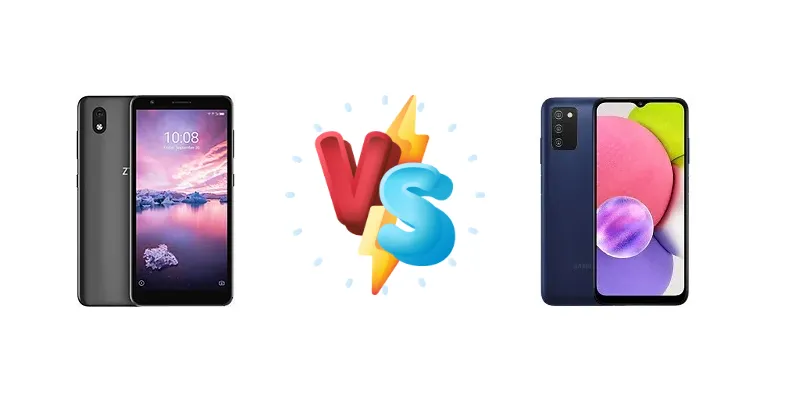
The ZTE Blade A3 Joy and Samsung Galaxy A03s represent the extreme end of the smartphone price spectrum. Both aim to deliver essential functionality at a minimal cost, but they achieve this with different approaches to chipset selection and feature prioritization. This comparison dissects their key specifications to determine which device offers the best value for users on a tight budget.
🏆 Quick Verdict
For most users, the Samsung Galaxy A03s is the better choice. Its Helio P35 chipset, featuring an octa-core configuration, provides a noticeable performance advantage over the ZTE Blade A3 Joy’s quad-core Helio A20, making it more responsive for everyday tasks and light multitasking. While both offer similar battery endurance, the A03s’s 15W charging is a welcome addition.
| Network |
|---|
| 2G bands | GSM 850 / 900 / 1800 / 1900 | GSM 850 / 900 / 1800 / 1900 |
| 3G bands | HSDPA 850 / 1700(AWS) / 1900 | HSDPA 850 / 900 / 2100 |
| 4G bands | 2, 4, 5, 12, 41, 66, 71 | 1, 3, 5, 7, 8, 20, 28, 38, 40, 41 |
| Speed | HSPA, LTE | HSPA 42.2/5.76 Mbps, LTE Cat4 150/50 Mbps |
| Technology | GSM / HSPA / LTE | GSM / HSPA / LTE |
| | - | 2, 4, 5, 7, 12, 13, 14, 25, 26, 41, 66, 71 - SM-A037U |
| Launch |
|---|
| Announced | 2020, June. Released 2020, June | 2021, August 18 |
| Status | Discontinued | Available. Released 2021, August 18 |
| Body |
|---|
| Build | - | Glass front, plastic frame, plastic back |
| Dimensions | 142.2 x 63.2 x 7.9 mm (5.60 x 2.49 x 0.31 in) | 164.2 x 75.9 x 9.1 mm (6.46 x 2.99 x 0.36 in) |
| SIM | Nano-SIM | Nano-SIM + Nano-SIM |
| Weight | 162 g (5.71 oz) | 196 g (6.91 oz) |
| Display |
|---|
| Resolution | 720 x 1440 pixels, 18:9 ratio (~293 ppi density) | 720 x 1600 pixels, 20:9 ratio (~270 ppi density) |
| Size | 5.5 inches, 78.1 cm2 (~86.9% screen-to-body ratio) | 6.5 inches, 102.0 cm2 (~81.8% screen-to-body ratio) |
| Type | IPS LCD | PLS LCD |
| Platform |
|---|
| CPU | Quad-core 1.8 GHz Cortex-A53 | Octa-core (4x2.35 GHz Cortex-A53 & 4x1.8 GHz Cortex-A53) |
| Chipset | Mediatek MT6761D Helio A20 (12 nm) | Mediatek MT6765 Helio P35 (12 nm) |
| GPU | PowerVR GE8320 | PowerVR GE8320 |
| OS | Android 10 | Android 11, upgradable to Android 13, One UI 5.1 Core |
| Memory |
|---|
| Card slot | microSDXC | microSDXC (dedicated slot) |
| Internal | 32GB 2GB RAM | 32GB 2GB RAM, 32GB 3GB RAM, 32GB 4GB RAM, 64GB 3GB RAM, 64GB 4GB RAM |
| | eMMC 5.1 | eMMC 5.1 |
| Main Camera |
|---|
| Features | - | LED flash |
| Single | 8 MP | 5 MP, f/2.2 |
| Triple | - | 13 MP, f/2.2, (wide), AF
2 MP (macro)
Auxiliary lens |
| Video | - | 1080p@30fps |
| Selfie camera |
|---|
| Single | 2 MP | 5 MP, f/2.2 |
| Video | - | 1080p@30fps |
| Sound |
|---|
| 3.5mm jack | Yes | Yes |
| 35mm jack | Yes | Yes |
| Loudspeaker | Yes | Yes |
| Comms |
|---|
| Bluetooth | 4.2, A2DP | 5.0, A2DP |
| NFC | No | Yes (market/region dependent) |
| Positioning | GPS | GPS, GLONASS, GALILEO, BDS |
| Radio | No | No |
| USB | microUSB 2.0 | USB Type-C 2.0 |
| WLAN | Wi-Fi 802.11 b/g/n | Wi-Fi 802.11 b/g/n, Wi-Fi Direct |
| Features |
|---|
| Sensors | Accelerometer, proximity | Fingerprint (side-mounted), accelerometer, proximity |
| Battery |
|---|
| Charging | - | 15W wired |
| Type | Li-Ion 2650 mAh, removable | Li-Po 5000 mAh |
| Misc |
|---|
| Colors | Black | Black, Blue, White |
| Models | Z5156CC | SM-A037F, SM-A037F/DS, SM-A037M, SM-A037G, SM-A037U, SM-S134DL, SM-A037W, SM-A037U1, SM-S135DL |
| Price | About 50 EUR | $ 65.65 / £ 82.99 / ₹ 10,800 |
| SAR EU | - | 0.36 W/kg (head) 1.09 W/kg (body) |
| Tests |
|---|
| Battery life | - |
Endurance rating 122h
|
| Camera | - |
Photo / Video |
| Display | - |
Contrast ratio: 1718:1 (nominal) |
| Loudspeaker | - |
-27.4 LUFS (Good)
|
| Performance | - |
AnTuTu: 103465 (v8), 101299 (v9)
GeekBench: 889 (v5.1)
GFXBench: 5.5fps (ES 3.1 onscreen) |
ZTE Blade A3 Joy
- Lowest possible price point
- Acceptable battery life
- Simple and straightforward interface
- Weak processor performance
- Likely limited storage options
- Poor multitasking capabilities
Samsung Galaxy A03s
- Faster and more responsive performance
- Brighter display for outdoor visibility
- 15W fast charging support
- Slightly higher price
- Still limited in terms of overall features
- Image quality likely average
Display Comparison
Both the ZTE Blade A3 Joy and Samsung Galaxy A03s feature displays with a 1718:1 contrast ratio, suggesting similar visual pop. However, the Samsung Galaxy A03s boasts a measured peak brightness of 488 nits, significantly brighter than what we'd expect from the A3 Joy, making it more usable outdoors in direct sunlight. While both likely utilize LCD panels, the A03s’s higher brightness is a clear advantage for visibility.
Camera Comparison
Both phones list 'Photo / Video' capabilities, but lack specific details. Given their price points, image quality will be a secondary concern. The A03s likely benefits from Samsung’s image processing algorithms, potentially offering slightly more refined photos. However, without sensor size or aperture information, it’s difficult to make a definitive judgment. It's safe to assume both will feature a primary camera alongside basic auxiliary lenses, likely including a 2MP macro lens on the A03s, which offers limited practical benefit.
Performance
The core difference between these two devices lies in their chipsets. The Samsung Galaxy A03s is powered by the Mediatek Helio P35, an octa-core processor with a combination of Cortex-A53 cores clocked at 2.35 GHz and 1.8 GHz. This contrasts sharply with the ZTE Blade A3 Joy’s Mediatek Helio A20, a quad-core processor clocked at 1.8 GHz, also using Cortex-A53 cores. The P35’s additional cores and higher clock speeds translate to a demonstrably faster and more fluid experience, particularly when switching between apps or handling moderately demanding tasks. The A3 Joy will struggle with multitasking.
Battery Life
Both the ZTE Blade A3 Joy and Samsung Galaxy A03s achieve an endurance rating of 122 hours, indicating comparable battery life under similar usage conditions. However, the Samsung Galaxy A03s supports 15W wired charging, allowing for a significantly faster recharge time compared to the A3 Joy, which likely utilizes a slower charging standard. This faster charging capability is a practical advantage for users who need to quickly top up their battery throughout the day.
Buying Guide
Buy the ZTE Blade A3 Joy if you absolutely need the lowest possible price and your smartphone usage is limited to basic calling, texting, and very light app use. Buy the Samsung Galaxy A03s if you prioritize a smoother user experience, even for simple tasks, and appreciate the convenience of faster charging, even if it means spending a little more.
Frequently Asked Questions
❓ Will the Samsung Galaxy A03s struggle with popular games like PUBG Mobile?
While the Helio P35 can handle less demanding games, PUBG Mobile will likely require the lowest graphics settings and frame rate to achieve playable performance. Expect occasional stuttering and frame drops, especially during intense action sequences. The ZTE Blade A3 Joy would struggle even more.
❓ How much storage does each phone offer, and can it be expanded?
While not explicitly stated, both phones likely start with 32GB of internal storage. Both devices almost certainly support microSD card expansion, allowing you to add more storage for photos, videos, and apps. Check the specific retailer listing for confirmation of storage options.
❓ Is the 15W charging on the Samsung Galaxy A03s a significant improvement?
Yes, 15W charging is a noticeable improvement over the slower charging standards typically found on devices in this price range. It will reduce the time it takes to fully charge the battery, offering more convenience for users who need to quickly top up their phone.