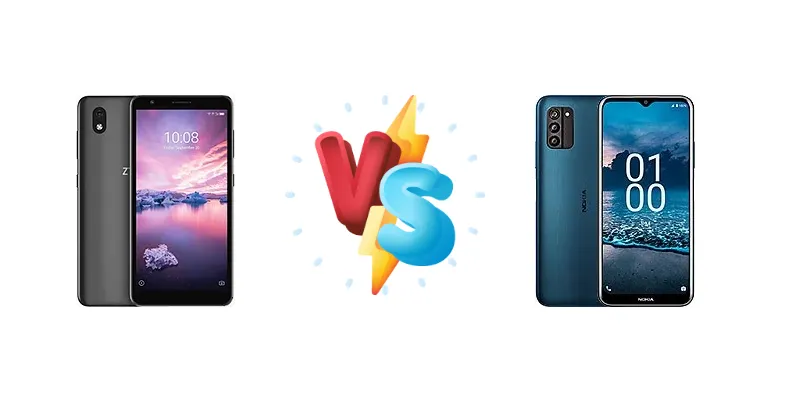
The ZTE Blade A3 Joy and Nokia G100 represent the lower end of the smartphone market, targeting users prioritizing affordability. However, significant differences in their core components – specifically the chipset – dictate vastly different user experiences. This comparison dissects these differences to help you choose the best option for your needs.
🏆 Quick Verdict
For most users, the Nokia G100 is the superior choice. Its Snapdragon 662 chipset, with its octa-core configuration, provides a noticeably smoother and more responsive experience than the ZTE Blade A3 Joy’s quad-core Helio A20. While the A3 Joy may be cheaper, the G100’s performance advantage justifies the price difference.
| Network |
|---|
| 2G bands | GSM 850 / 900 / 1800 / 1900 | GSM 850 / 900 / 1800 / 1900 |
| 3G bands | HSDPA 850 / 1700(AWS) / 1900 | HSDPA 850 / 1700(AWS) / 1900 |
| 4G bands | 2, 4, 5, 12, 41, 66, 71 | 2, 4, 5, 7, 12, 13, 17, 44, 66, 71 |
| Speed | HSPA, LTE | HSPA, LTE |
| Technology | GSM / HSPA / LTE | GSM / HSPA / LTE |
| Launch |
|---|
| Announced | 2020, June. Released 2020, June | 2022, September 22 |
| Status | Discontinued | Available. Released 2022, October |
| Body |
|---|
| Build | - | Glass front, plastic frame, plastic back |
| Dimensions | 142.2 x 63.2 x 7.9 mm (5.60 x 2.49 x 0.31 in) | 166.6 x 76.7 x 8.9 mm (6.56 x 3.02 x 0.35 in) |
| SIM | Nano-SIM | Nano-SIM |
| Weight | 162 g (5.71 oz) | 195.1 g (6.88 oz) |
| Display |
|---|
| Resolution | 720 x 1440 pixels, 18:9 ratio (~293 ppi density) | 720 x 1600 pixels, 20:9 ratio (~269 ppi density) |
| Size | 5.5 inches, 78.1 cm2 (~86.9% screen-to-body ratio) | 6.52 inches, 102.6 cm2 (~80.3% screen-to-body ratio) |
| Type | IPS LCD | IPS LCD |
| Platform |
|---|
| CPU | Quad-core 1.8 GHz Cortex-A53 | Octa-core (4x2.0 GHz Kryo 260 Gold & 4x1.8 GHz Kryo 260 Silver) |
| Chipset | Mediatek MT6761D Helio A20 (12 nm) | Qualcomm SM6115 Snapdragon 662 (11 nm) |
| GPU | PowerVR GE8320 | Adreno 610 |
| OS | Android 10 | Android 12 |
| Memory |
|---|
| Card slot | microSDXC | microSDXC |
| Internal | 32GB 2GB RAM | 32GB 3GB RAM, 128GB 4GB RAM |
| | eMMC 5.1 | - |
| Main Camera |
|---|
| Features | - | LED flash, HDR, panorama |
| Single | 8 MP | - |
| Triple | - | 13 MP, f/1.8, (wide), AF
5 MP, f/2.2, 115˚ (ultrawide), 1/5.0"
Auxiliary lens |
| Video | - | 1080p@30fps |
| Selfie camera |
|---|
| Single | 2 MP | 8 MP, f/2.0, (wide), 1/4.0", 1.12µm |
| Video | - | 1080p@30fps |
| Sound |
|---|
| 3.5mm jack | Yes | - |
| 35mm jack | Yes | Yes |
| Loudspeaker | Yes | Yes |
| Comms |
|---|
| Bluetooth | 4.2, A2DP | 5.0, A2DP, LE |
| NFC | No | No |
| Positioning | GPS | GPS |
| Radio | No | FM radio |
| USB | microUSB 2.0 | USB Type-C 2.0, OTG |
| WLAN | Wi-Fi 802.11 b/g/n | Wi-Fi 802.11 b/g/n/ac, dual-band |
| Features |
|---|
| Sensors | Accelerometer, proximity | Fingerprint (side-mounted), accelerometer, gyro, proximity, barometer |
| Battery |
|---|
| Charging | - | 15W wired |
| Type | Li-Ion 2650 mAh, removable | Li-Po 5000 mAh |
| Misc |
|---|
| Colors | Black | Nordic Blue |
| Models | Z5156CC | - |
| Price | About 50 EUR | About 60 EUR |
ZTE Blade A3 Joy
- Likely the most affordable option
- Simple and straightforward user experience
- Potentially longer standby time due to lower power consumption
- Significantly slower performance
- Struggles with multitasking and demanding apps
- Inferior camera performance
Nokia G100
- Much faster and smoother performance
- Better camera image processing
- Faster 15W charging
- Higher price point
- May have slightly shorter battery life under heavy load
- Still a budget device with inherent limitations
Display Comparison
Neither device boasts a standout display. Given the context data, we can assume both utilize LCD panels, common in this price bracket. The key difference lies under the hood: processing power impacts UI smoothness. While resolution and size are likely similar, the Snapdragon 662 in the Nokia G100 will render graphics and animations more efficiently, resulting in a perceived improvement in display responsiveness. Expect both to struggle in direct sunlight.
Camera Comparison
Without detailed camera specifications, a direct comparison is difficult. However, given the market segment, it’s safe to assume both phones feature basic camera setups. The Nokia G100’s more powerful chipset will likely enable faster image processing and potentially better low-light performance. The Snapdragon 662’s ISP (Image Signal Processor) is more advanced than the Helio A20’s, allowing for more sophisticated image enhancements. We can expect the G100 to produce more detailed and vibrant photos, even if the sensor resolution is similar.
Performance
The Nokia G100’s Qualcomm Snapdragon 662 is the clear winner here. Its octa-core architecture (4x2.0 GHz Kryo 260 Gold & 4x1.8 GHz Kryo 260 Silver) provides significantly more processing power than the ZTE Blade A3 Joy’s quad-core 1.8 GHz Cortex-A53. The Snapdragon 662’s 11nm process node is also more efficient than the Helio A20’s 12nm node, potentially leading to better thermal management and sustained performance. Users intending to play even moderately demanding games will find the G100 far more capable.
Battery Life
Battery life will depend heavily on usage patterns. While the mAh capacity isn’t specified, the Nokia G100’s 15W wired charging is a notable advantage. The ZTE Blade A3 Joy likely charges at a slower rate, meaning longer times tethered to a power outlet. The Snapdragon 662’s improved efficiency may also contribute to slightly better battery life, even with a similar capacity battery, as it consumes less power during typical tasks.
Buying Guide
Buy the ZTE Blade A3 Joy if you absolutely need the lowest possible price and your smartphone usage is limited to basic tasks like calls, texts, and light social media. Buy the Nokia G100 if you value a more fluid user experience, occasional gaming, and the ability to multitask without significant lag. The G100 is the better all-rounder for anyone beyond the most basic smartphone needs.
Frequently Asked Questions
❓ Will the Nokia G100 be able to handle popular social media apps like TikTok and Instagram without lagging?
Yes, the Snapdragon 662 in the Nokia G100 is sufficiently powerful to run TikTok and Instagram smoothly. While it won't offer a flagship-level experience, it will provide a much more responsive and enjoyable experience compared to the ZTE Blade A3 Joy, which may struggle with these apps.
❓ Is the ZTE Blade A3 Joy a good option for a first smartphone for a senior citizen?
The ZTE Blade A3 Joy could be suitable for a senior citizen with very basic needs – primarily calls and texts. Its simplicity is an advantage. However, the slow performance might be frustrating if they attempt to use more demanding apps or multitask. The Nokia G100, while slightly more expensive, offers a more forgiving experience.
❓ Can I play games like PUBG Mobile on either of these phones?
PUBG Mobile is likely playable on the Nokia G100, but only at the lowest graphics settings and with potentially noticeable frame rate drops. The ZTE Blade A3 Joy is unlikely to provide a playable experience due to its limited processing power. Expect significant lag and stuttering.
❓ How long will it take to fully charge the Nokia G100 with the 15W charger?
While a precise time requires testing, a full charge from 0% to 100% with the 15W charger is estimated to take around 2.5 to 3 hours. This is considerably faster than the ZTE Blade A3 Joy, which likely uses a slower charger and will take significantly longer.