
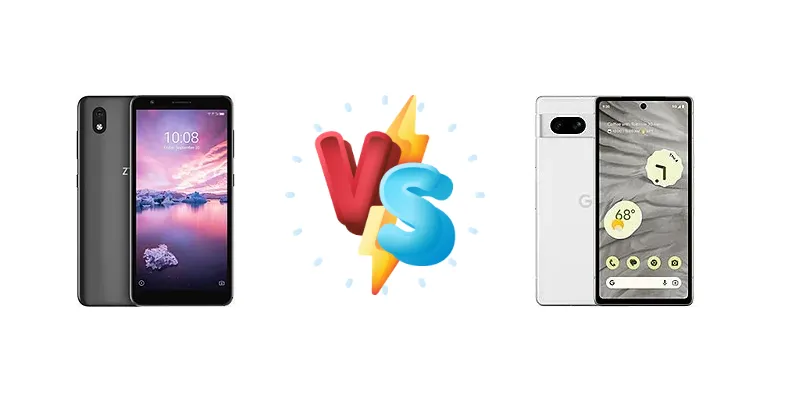
ZTE Blade A3 Joy vs. Google Pixel 7a: A David vs. Goliath Showdown
| Phones Images | |||||
|---|---|---|---|---|---|
|
🏆 Quick Verdict
The Google Pixel 7a is the clear winner. While the ZTE Blade A3 Joy offers incredible value for its price, the Pixel 7a’s superior performance, camera quality, and display make it a significantly better overall experience, justifying its higher cost. It's a flagship experience at a mid-range price.
| PHONES | ||
|---|---|---|
| Phone Names | ZTE Blade A3 Joy | Google Pixel 7a |
| Network | ||
|---|---|---|
| 2G bands | GSM 850 / 900 / 1800 / 1900 | GSM 850 / 900 / 1800 / 1900 |
| 3G bands | HSDPA 850 / 1700(AWS) / 1900 | HSDPA 800 / 850 / 900 / 1700(AWS) / 1900 / 2100 |
| 4G bands | 2, 4, 5, 12, 41, 66, 71 | 1, 2, 3, 4, 5, 7, 8, 12, 13, 14, 17, 20, 25, 26, 28, 29, 30, 38, 40, 41, 48, 66, 71 - GWKK3, G0DZQ |
| 5G bands | - | 1, 2, 3, 5, 7, 8, 12, 14, 20, 25, 28, 30, 38, 41, 48, 66, 71, 77, 78 SA/NSA/Sub6 - GWKK3 |
| Speed | HSPA, LTE | HSPA, LTE, 5G |
| Technology | GSM / HSPA / LTE | GSM / HSPA / LTE / 5G |
| - | 1, 2, 3, 5, 7, 8, 12, 20, 25, 28, 38, 40, 41, 66, 75, 76, 77, 78, 79 SA/NSA/Sub6 - GHL1X, G82U8 | |
| Launch | ||
|---|---|---|
| Announced | 2020, June. Released 2020, June | 2023, May 10 |
| Status | Discontinued | Available. Released 2023, May 10 |
| Body | ||
|---|---|---|
| Build | - | Glass front (Gorilla Glass 3), aluminum frame, plastic back |
| Dimensions | 142.2 x 63.2 x 7.9 mm (5.60 x 2.49 x 0.31 in) | 152 x 72.9 x 9 mm (5.98 x 2.87 x 0.35 in) |
| SIM | Nano-SIM | Nano-SIM + eSIM |
| Weight | 162 g (5.71 oz) | 193.5 g (6.84 oz) |
| - | IP67 dust/water resistant (up to 1m for 30 min) | |
| Display | ||
|---|---|---|
| Protection | - | Corning Gorilla Glass 3 |
| Resolution | 720 x 1440 pixels, 18:9 ratio (~293 ppi density) | 1080 x 2400 pixels, 20:9 ratio (~429 ppi density) |
| Size | 5.5 inches, 78.1 cm2 (~86.9% screen-to-body ratio) | 6.1 inches, 90.7 cm2 (~81.8% screen-to-body ratio) |
| Type | IPS LCD | OLED, HDR, 90Hz |
| - | Always-on display | |
| Platform | ||
|---|---|---|
| CPU | Quad-core 1.8 GHz Cortex-A53 | Octa-core (2x2.85 GHz Cortex-X1 & 2x2.35 GHz Cortex-A78 & 4x1.80 GHz Cortex-A55) |
| Chipset | Mediatek MT6761D Helio A20 (12 nm) | Google Tensor G2 (5 nm) |
| GPU | PowerVR GE8320 | Mali-G710 MP7 |
| OS | Android 10 | Android 13, upgradable to Android 15, up to 5 major Android upgrades |
| Memory | ||
|---|---|---|
| Card slot | microSDXC | No |
| Internal | 32GB 2GB RAM | 128GB 8GB RAM |
| eMMC 5.1 | UFS 3.1 | |
| Main Camera | ||
|---|---|---|
| Dual | - | 64 MP, f/1.9, 26mm (wide), 1/1.73", 0.8µm, dual pixel PDAF, OIS 13 MP, f/2.2, 120˚ (ultrawide), 1.12µm |
| Features | - | Dual-LED flash, Pixel Shift, Auto-HDR, panorama |
| Single | 8 MP | - |
| Video | - | 4K@30/60fps, 1080p@30/60/120/240fps, OIS |
| Selfie camera | ||
|---|---|---|
| Features | - | HDR, panorama |
| Single | 2 MP | 13 MP, f/2.2, 20mm (ultrawide), 1.12µm |
| Video | - | 4K@30fps, 1080p@30fps |
| Sound | ||
|---|---|---|
| 3.5mm jack | Yes | No |
| 35mm jack | Yes | No |
| Loudspeaker | Yes | Yes, with stereo speakers |
| Comms | ||
|---|---|---|
| Bluetooth | 4.2, A2DP | 5.3, A2DP, LE |
| NFC | No | Yes |
| Positioning | GPS | GPS, GLONASS, GALILEO, BDS, QZSS, NavIC |
| Radio | No | No |
| USB | microUSB 2.0 | USB Type-C 3.2 |
| WLAN | Wi-Fi 802.11 b/g/n | Wi-Fi 802.11 a/b/g/n/ac/6e, tri-band |
| Features | ||
|---|---|---|
| Sensors | Accelerometer, proximity | Fingerprint (under display, optical), accelerometer, gyro, proximity, compass, barometer |
| Battery | ||
|---|---|---|
| Charging | - | 18W wired, PD3.0 7.5W wireless |
| Type | Li-Ion 2650 mAh, removable | Li-Po 4385 mAh |
| Misc | ||
|---|---|---|
| Colors | Black | Charcoal, Snow, Sea, Coral |
| Models | Z5156CC | GWKK3, GHL1X, G0DZQ, G82U8 |
| Price | About 50 EUR | € 179.90 / $ 150.00 / £ 170.00 / ₹ 25,980 |
ZTE Blade A3 Joy
- Extremely affordable
- Lightweight and compact
- Decent battery life for basic use
- Slow performance
- Low-resolution display
- Mediocre camera
- Limited storage
Google Pixel 7a
- Excellent camera quality
- Smooth performance
- Bright and vibrant display
- Clean Android experience
- Fast charging (wired & wireless)
- Higher price point
- Tensor G2 can get warm under heavy load
Display Comparison
The Pixel 7a boasts a significantly brighter and more vibrant display (1070 nits peak brightness) compared to the Blade A3 Joy. Expect sharper visuals, better outdoor visibility, and a more enjoyable viewing experience on the Pixel 7a. The Blade A3 Joy's display is adequate for basic use but lacks the premium feel of the Pixel 7a.
Camera Comparison
The Pixel 7a’s camera is a major selling point, offering exceptional image quality, computational photography features, and excellent video recording capabilities. The Blade A3 Joy’s camera is functional but produces noticeably inferior results, particularly in low light. The Pixel 7a consistently delivers stunning photos.
Performance
The Google Pixel 7a’s Google Tensor G2 chipset and octa-core CPU absolutely dominate the Blade A3 Joy’s Mediatek Helio A20. Expect noticeably faster app loading, smoother multitasking, and a more responsive overall experience on the Pixel 7a. The Blade A3 Joy can feel sluggish, especially with demanding apps.
Battery Life
The Pixel 7a demonstrates impressive battery endurance (76h endurance rating), far exceeding what we'd expect from a phone of its size. While the Blade A3 Joy has a decent battery capacity, the Pixel 7a's optimization and efficient chipset contribute to its superior longevity. The Pixel 7a also supports faster charging (18W wired, 7.5W wireless).
Buying Guide
The ZTE Blade A3 Joy is perfect for users on a tight budget who primarily need a phone for basic communication, light social media use, and essential apps. The Google Pixel 7a is ideal for those who prioritize a great camera, smooth performance, and a clean Android experience, even if it means spending a bit more.