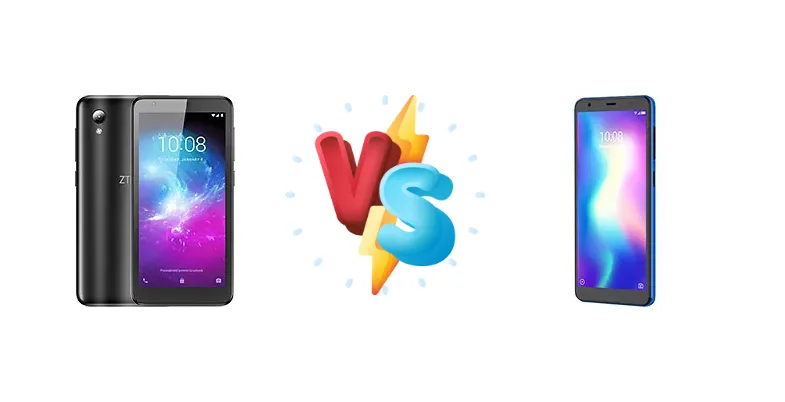
The ZTE Blade A3 and A5 (2019) represent ZTE’s attempt to capture the ultra-budget smartphone market. Both devices utilize Unisoc chipsets, but diverge significantly in CPU core count. This comparison dissects the implications of these differences, helping you determine which device delivers the best value for basic smartphone tasks.
🏆 Quick Verdict
For the average user prioritizing responsiveness and multitasking, the ZTE Blade A5 (2019) is the clear winner. Its octa-core processor provides a noticeable performance advantage over the A3’s quad-core setup, making it better suited for running multiple apps and handling slightly more demanding tasks. However, the A3 remains a viable option for extremely basic use cases.
| Network |
|---|
| 2G bands | GSM 850 / 900 / 1800 / 1900 | GSM 850 / 900 / 1800 / 1900 |
| 3G bands | HSDPA 850 / 900 / 2100 | HSDPA 850 / 900 / 2100 |
| 4G bands | 1, 3, 5, 7, 8, 20, 38 | 1, 3, 5, 7, 8, 38 |
| Speed | HSPA 42.2/5.76 Mbps, LTE Cat4 150/50 Mbps | HSPA 42.2/5.76 Mbps, LTE Cat4 150/50 Mbps |
| Technology | GSM / HSPA / LTE | GSM / HSPA / LTE |
| Launch |
|---|
| Announced | 2019, April. Released 2019, April | 2019, May. Released 2019, May |
| Status | Discontinued | Discontinued |
| Body |
|---|
| Build | - | Glass front, plastic back, plastic frame |
| Dimensions | 137.4 x 67.5 x 10.5 mm (5.41 x 2.66 x 0.41 in) | 145.8 x 70 x 9.6 mm (5.74 x 2.76 x 0.38 in) |
| SIM | Nano-SIM + Nano-SIM | Nano-SIM + Nano-SIM |
| Weight | 144 g (5.08 oz) | 157 g (5.54 oz) |
| Display |
|---|
| Resolution | 480 x 960 pixels, 18:9 ratio (~215 ppi density) | 720 x 1440 pixels, 18:9 ratio (~295 ppi density) |
| Size | 5.0 inches, 64.5 cm2 (~69.6% screen-to-body ratio) | 5.45 inches, 76.7 cm2 (~75.1% screen-to-body ratio) |
| Type | IPS LCD | IPS LCD |
| Platform |
|---|
| CPU | Quad-core 1.4 GHz | Octa-core (4x1.6 GHz Cortex-A55 & 4x1.2 GHz Cortex-A55) |
| Chipset | Unisoc SC9832E (28 nm) | Unisoc SC9863A (28 nm) |
| GPU | Mali-T820 MP1 | IMG8322 |
| OS | Android 9.0 Pie (Go edition) | Android 9.0 (Pie) |
| Memory |
|---|
| Card slot | microSDXC | microSDXC (dedicated slot) |
| Internal | 16GB 1GB RAM, 32GB 1GB RAM | 16GB 2GB RAM |
| Main Camera |
|---|
| Features | LED flash, HDR | LED flash, HDR |
| Single | 8 MP, AF | 13 MP, f/2.0, AF |
| Video | 720p@30fps | 1080p@30fps |
| Selfie camera |
|---|
| Single | 5 MP | 8 MP, f/2.4 |
| Sound |
|---|
| 3.5mm jack | Yes | Yes |
| 35mm jack | Yes | Yes |
| Loudspeaker | Yes | Yes |
| Comms |
|---|
| Bluetooth | 4.2, A2DP, LE | 4.2, A2DP, LE |
| NFC | No | No |
| Positioning | GPS, GLONASS | GPS, GLONASS |
| Radio | FM radio | FM radio |
| USB | microUSB 2.0 | microUSB 2.0 |
| WLAN | Wi-Fi 802.11 b/g/n | Wi-Fi 802.11 b/g/n, Wi-Fi Direct |
| Features |
|---|
| Sensors | Accelerometer | Accelerometer, proximity |
| Battery |
|---|
| Type | Li-Ion 2000 mAh, non-removable | Li-Ion 2600 mAh, non-removable |
| Misc |
|---|
| Colors | Black, Blue | Black, Blue |
| Price | About 60 EUR | About 80 EUR |
ZTE Blade A3 (2019)
- Potentially longer battery life due to lower power consumption.
- Simpler user experience for basic tasks.
- Likely lower price point.
- Significantly slower performance.
- Struggles with multitasking.
- Laggy user interface.
ZTE Blade A5 (2019)
- Faster and more responsive performance.
- Better multitasking capabilities.
- Smoother user interface.
- Potentially shorter battery life.
- May be slightly more expensive.
- More powerful processor may generate slightly more heat.
Display Comparison
Neither ZTE provides detailed display specifications beyond size. Given the price point, both likely utilize IPS LCD panels. The focus here isn't on display quality, but rather on the processing power needed to drive the UI smoothly. A more powerful processor, like the one in the A5, will contribute to smoother scrolling and animations, even on a basic display.
Camera Comparison
Both devices likely feature basic camera setups, and detailed sensor information is scarce. It’s safe to assume both rely on relatively low-resolution sensors. The processing power of the chipset plays a role here; the A5’s more powerful CPU can handle image processing tasks more efficiently, potentially resulting in slightly faster capture times and marginally improved image quality, though the sensor itself remains the limiting factor. Expect similar results in good lighting conditions, but the A5 will likely perform better in low-light scenarios due to faster processing.
Performance
The core difference lies in the chipset: the A3 features the Unisoc SC9832E with a quad-core CPU clocked at 1.4 GHz, while the A5 boasts the Unisoc SC9863A with an octa-core CPU (4x1.6 GHz Cortex-A55 & 4x1.2 GHz Cortex-A55). This is a substantial leap. The A5’s octa-core configuration, utilizing ARM Cortex-A55 cores, allows for more efficient multitasking and better handling of background processes. While both are built on a 28nm process, the A5’s architecture is significantly more capable. The A5 will exhibit less lag when switching between apps and will handle more complex web pages without stuttering. The A3 will struggle with even moderate multitasking.
Battery Life
Battery capacity isn’t specified in the provided data. However, given the lower processing demands of the A3, it’s plausible it could achieve comparable battery life to the A5, despite potentially having a smaller capacity. The A5’s more powerful processor will consume more power, but the efficiency gains from the Cortex-A55 cores might offset some of this. Charging wattage is also unknown, making it difficult to assess charging speeds.
Buying Guide
Buy the ZTE Blade A3 (2019) if you need a smartphone solely for calls, texts, and very light app usage – think basic social media and messaging. It’s ideal for users who prioritize simplicity and minimal cost. Buy the ZTE Blade A5 (2019) if you prefer a smoother, more responsive experience, even with basic tasks, and anticipate occasionally running multiple apps or engaging in light multitasking. It’s a better choice for users who want a phone that feels less sluggish.
Frequently Asked Questions
❓ Will the ZTE Blade A5 handle popular social media apps like Facebook and Instagram without lag?
Yes, the ZTE Blade A5’s octa-core processor and Cortex-A55 cores are significantly better equipped to handle the demands of social media apps compared to the A3. You should experience smoother scrolling, faster loading times, and less lag when switching between apps.
❓ Is the ZTE Blade A3 suitable for playing mobile games?
The ZTE Blade A3 is not ideal for gaming. Its quad-core processor will struggle with even basic 3D games. While it might be able to run very simple games, expect low frame rates and frequent stuttering. The A5 offers a slightly better gaming experience, but still isn’t designed for demanding titles.
❓ How much storage do these phones have, and can it be expanded?
Storage capacity isn't specified. However, given the target market, both likely ship with 16GB or 32GB of internal storage. Both devices almost certainly include a microSD card slot for storage expansion, which is highly recommended given the limited internal space.
❓ What version of Android do these phones run?
Given the 2019 release date, both devices likely shipped with Android 9 Pie or Android 10. Updates beyond that are unlikely, so expect a relatively outdated software experience.