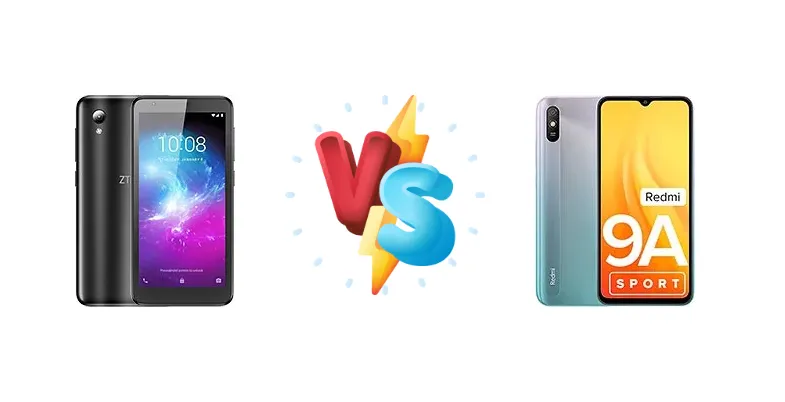
The ZTE Blade A3 (2019) and Xiaomi Redmi 9A Sport represent the extreme end of the budget smartphone spectrum. While both aim to deliver essential smartphone functionality at a low price, they take different approaches to achieving this. The Blade A3 is an older model, likely available at deeply discounted prices, while the Redmi 9A Sport offers a more modern chipset and features, albeit still within the entry-level category. This comparison will dissect their key differences to help you determine which best suits your needs.
🏆 Quick Verdict
For the average user, the Xiaomi Redmi 9A Sport is the clear winner. Its Mediatek Helio G25 chipset, with its octa-core configuration, provides a substantial performance uplift over the ZTE Blade A3’s quad-core Unisoc SC9832E. While both phones are limited in features, the Redmi 9A Sport offers a smoother, more responsive experience for everyday tasks and light gaming.
| Network |
|---|
| 2G bands | GSM 850 / 900 / 1800 / 1900 | GSM 850 / 900 / 1800 / 1900 |
| 3G bands | HSDPA 850 / 900 / 2100 | HSDPA 850 / 900 / 2100 |
| 4G bands | 1, 3, 5, 7, 8, 20, 38 | 1, 3, 5, 8, 40, 41 |
| Speed | HSPA 42.2/5.76 Mbps, LTE Cat4 150/50 Mbps | HSPA, LTE |
| Technology | GSM / HSPA / LTE | GSM / HSPA / LTE |
| Launch |
|---|
| Announced | 2019, April. Released 2019, April | 2021, September 28 |
| Status | Discontinued | Available. Released 2021, September 28 |
| Body |
|---|
| Dimensions | 137.4 x 67.5 x 10.5 mm (5.41 x 2.66 x 0.41 in) | 164.9 x 77.1 x 9 mm (6.49 x 3.04 x 0.35 in) |
| SIM | Nano-SIM + Nano-SIM | Nano-SIM + Nano-SIM |
| Weight | 144 g (5.08 oz) | 194 g (6.84 oz) |
| | - | Water-repellent coating |
| Display |
|---|
| Resolution | 480 x 960 pixels, 18:9 ratio (~215 ppi density) | 720 x 1600 pixels, 20:9 ratio (~269 ppi density) |
| Size | 5.0 inches, 64.5 cm2 (~69.6% screen-to-body ratio) | 6.53 inches, 102.9 cm2 (~81.0% screen-to-body ratio) |
| Type | IPS LCD | IPS LCD, 400 nits (typ) |
| Platform |
|---|
| CPU | Quad-core 1.4 GHz | Octa-core (4x2.0 GHz Cortex-A53 & 4x1.5 GHz Cortex-A53) |
| Chipset | Unisoc SC9832E (28 nm) | Mediatek MT6762G Helio G25 (12 nm) |
| GPU | Mali-T820 MP1 | PowerVR GE8320 |
| OS | Android 9.0 Pie (Go edition) | Android 10, MIUI 12 |
| Memory |
|---|
| Card slot | microSDXC | microSDXC (dedicated slot) |
| Internal | 16GB 1GB RAM, 32GB 1GB RAM | 32GB 2GB RAM, 32GB 3GB RAM |
| | - | eMMC 5.1 |
| Main Camera |
|---|
| Features | LED flash, HDR | LED flash, HDR |
| Single | 8 MP, AF | 13 MP, f/2.2, 28mm (wide), 1.0µm, PDAF |
| Video | 720p@30fps | 1080p@30/60fps |
| Selfie camera |
|---|
| Features | - | HDR |
| Single | 5 MP | 5 MP, f/2.2, (wide), 1.12µm |
| Video | - | 1080p@30fps |
| Sound |
|---|
| 3.5mm jack | Yes | Yes |
| 35mm jack | Yes | Yes |
| Loudspeaker | Yes | Yes |
| Comms |
|---|
| Bluetooth | 4.2, A2DP, LE | 5.0, A2DP, LE |
| NFC | No | No |
| Positioning | GPS, GLONASS | GPS, GLONASS, BDS |
| Radio | FM radio | FM radio |
| USB | microUSB 2.0 | microUSB 2.0, OTG |
| WLAN | Wi-Fi 802.11 b/g/n | Wi-Fi 802.11 a/b/g/n, Wi-Fi Direct |
| Features |
|---|
| Sensors | Accelerometer | Accelerometer, proximity |
| Battery |
|---|
| Charging | - | 10W wired |
| Type | Li-Ion 2000 mAh, non-removable | Li-Po 5000 mAh |
| Misc |
|---|
| Colors | Black, Blue | Carbon Black, Coral Green, Metallic Blue |
| Price | About 60 EUR | About 100 EUR |
ZTE Blade A3 (2019)
- Potentially the lowest price point available.
- Simple and straightforward user experience.
- May be suitable for very basic communication needs.
- Significantly slower performance.
- Outdated chipset architecture.
- Likely limited software support.
Xiaomi Redmi 9A Sport
- Faster and more responsive performance.
- More efficient chipset.
- Better suited for light gaming and multitasking.
- 10W charging support.
- Still a very basic smartphone.
- Limited camera capabilities.
- Slow charging speed.
Display Comparison
Neither device boasts a standout display. Specifics regarding panel type (IPS vs. TFT) and resolution are missing for the ZTE Blade A3, but given its price point, it’s likely a lower-resolution TFT panel. The Redmi 9A Sport also lacks detailed display specs, but its market positioning suggests a similar IPS LCD. The key difference lies in processing power impacting UI smoothness, not display quality. Both will likely suffer from limited viewing angles and color accuracy, making them suitable only for basic content consumption.
Camera Comparison
Both phones are expected to feature basic camera setups. Details are scarce, but both likely include a primary camera and potentially a secondary depth sensor. Given the price bracket, image quality will be limited, particularly in low-light conditions. The Redmi 9A Sport’s chipset may offer slightly better image processing capabilities, but the overall experience will be similar. Focusing on megapixel counts would be misleading; sensor size and image processing algorithms are far more important, and details on these are unavailable for either device.
Performance
The performance gap is the most significant differentiator. The ZTE Blade A3’s Unisoc SC9832E is a quad-core processor built on a 28nm process, indicating lower efficiency and performance. In contrast, the Xiaomi Redmi 9A Sport features the Mediatek Helio G25, an octa-core chip fabricated on a more efficient 12nm process. The Helio G25’s configuration – four Cortex-A53 cores clocked at 2.0 GHz and four at 1.5 GHz – provides a substantial advantage in multi-tasking and app responsiveness. This translates to faster app loading times and a smoother overall user experience on the Redmi 9A Sport. The older architecture and fewer cores of the Unisoc chip will result in noticeable lag and slowdowns, especially with multiple apps open.
Battery Life
Battery capacity details are missing for the ZTE Blade A3. The Redmi 9A Sport includes 10W wired charging. While 10W is slow by modern standards, it’s adequate for these devices, given their limited processing demands. The Redmi 9A Sport’s more efficient chipset will likely translate to longer battery life despite potentially having a similar capacity to the Blade A3. The 12nm process node of the Helio G25 contributes to lower power consumption, extending usage time between charges.
Buying Guide
Buy the ZTE Blade A3 (2019) if you absolutely need the cheapest possible smartphone for basic communication – calls, texts, and very light web browsing – and are willing to accept significant performance limitations. Buy the Xiaomi Redmi 9A Sport if you prioritize a more fluid user experience, occasional gaming, and a slightly more modern feature set, even if it means spending a bit more. The Redmi 9A Sport is the better choice for anyone beyond the most basic smartphone usage.
Frequently Asked Questions
❓ Will the Redmi 9A Sport handle popular apps like WhatsApp and Facebook smoothly?
Yes, the Mediatek Helio G25 in the Redmi 9A Sport is capable of running apps like WhatsApp and Facebook without significant lag. While it won't offer a high-end experience, it provides a usable and responsive experience for these common applications, unlike the ZTE Blade A3 which may struggle.
❓ Is the Redmi 9A Sport suitable for playing mobile games?
The Redmi 9A Sport can handle some light mobile games, but don't expect high frame rates or demanding graphics. Games like Subway Surfers or Candy Crush will run adequately. More graphically intensive titles like PUBG Mobile will likely require very low settings and may still experience performance issues. The ZTE Blade A3 is even less suited for gaming.
❓ How long will the battery last on the ZTE Blade A3 with typical usage?
Given the older chipset and likely smaller battery capacity, the ZTE Blade A3 will likely offer around 6-8 hours of battery life with moderate usage (calls, texts, light browsing). Heavy usage will drain the battery much faster. The Redmi 9A Sport, with its more efficient processor, should provide a longer runtime.