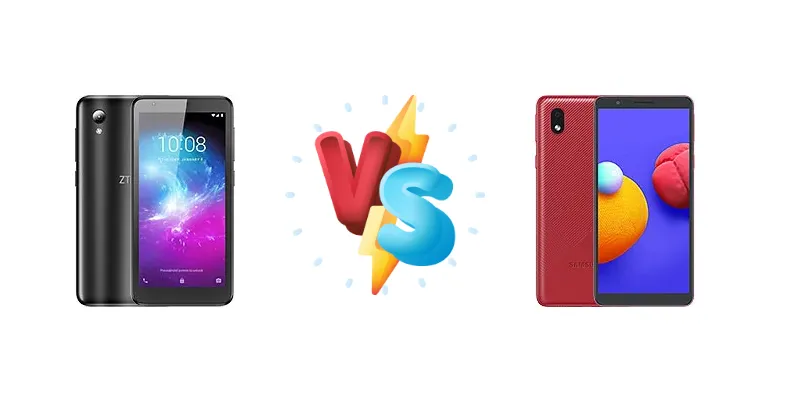
The ZTE Blade A3 (2019) and Samsung Galaxy A01 Core represent the absolute bottom end of the smartphone market. Both devices target first-time smartphone buyers or those needing a very basic, affordable device. This comparison dissects their core components to determine which offers the best experience for the price, focusing on real-world usability rather than raw specifications.
🏆 Quick Verdict
For the average user prioritizing slightly smoother performance, the Samsung Galaxy A01 Core edges out the ZTE Blade A3. Its marginally faster 1.5 GHz CPU, built on the same 28nm process, translates to a more responsive user experience, especially when navigating the Android Go operating system. However, the difference is minimal.
| Network |
|---|
| 2G bands | GSM 850 / 900 / 1800 / 1900 | GSM 850 / 900 / 1800 / 1900 |
| 3G bands | HSDPA 850 / 900 / 2100 | HSDPA 850 / 900 / 2100 |
| 4G bands | 1, 3, 5, 7, 8, 20, 38 | 1, 3, 5, 7, 8, 20, 28, 38, 40, 41 |
| Speed | HSPA 42.2/5.76 Mbps, LTE Cat4 150/50 Mbps | HSPA 21.1/5.76 Mbps, LTE |
| Technology | GSM / HSPA / LTE | GSM / HSPA / LTE |
| Launch |
|---|
| Announced | 2019, April. Released 2019, April | 2020, July 21. Released 2020, August 06 |
| Status | Discontinued | Discontinued |
| Body |
|---|
| Build | - | Plastic back, plastic frame |
| Dimensions | 137.4 x 67.5 x 10.5 mm (5.41 x 2.66 x 0.41 in) | 141.7 x 67.5 x 8.6 mm (5.58 x 2.66 x 0.34 in) |
| SIM | Nano-SIM + Nano-SIM | · Nano-SIM· Nano-SIM + Nano-SIM |
| Weight | 144 g (5.08 oz) | 150 g (5.29 oz) |
| Display |
|---|
| Resolution | 480 x 960 pixels, 18:9 ratio (~215 ppi density) | 720 x 1480 pixels, 18.5:9 ratio (~311 ppi density) |
| Size | 5.0 inches, 64.5 cm2 (~69.6% screen-to-body ratio) | 5.3 inches, 71.3 cm2 (~74.5% screen-to-body ratio) |
| Type | IPS LCD | PLS LCD |
| Platform |
|---|
| CPU | Quad-core 1.4 GHz | Quad-core 1.5 GHz Cortex-A53 |
| Chipset | Unisoc SC9832E (28 nm) | Mediatek MT6739 (28 nm) |
| GPU | Mali-T820 MP1 | PowerVR GE8100 |
| OS | Android 9.0 Pie (Go edition) | Android 10 (Go edition) |
| Memory |
|---|
| Card slot | microSDXC | microSDXC (dedicated slot) |
| Internal | 16GB 1GB RAM, 32GB 1GB RAM | 16GB 1GB RAM, 16GB 2GB RAM, 32GB 2GB RAM |
| | - | eMMC 5.1 |
| Main Camera |
|---|
| Features | LED flash, HDR | LED flash |
| Single | 8 MP, AF | 8 MP, f/2.2, AF |
| Video | 720p@30fps | 1080p@30fps |
| Selfie camera |
|---|
| Single | 5 MP | 5 MP, f/2.4 |
| Sound |
|---|
| 3.5mm jack | Yes | Yes |
| 35mm jack | Yes | Yes |
| Loudspeaker | Yes | Yes |
| Comms |
|---|
| Bluetooth | 4.2, A2DP, LE | 5.0, A2DP, LE |
| NFC | No | No |
| Positioning | GPS, GLONASS | GPS |
| Radio | FM radio | FM radio |
| USB | microUSB 2.0 | microUSB 2.0 |
| WLAN | Wi-Fi 802.11 b/g/n | Wi-Fi 802.11 b/g/n, Wi-Fi Direct |
| Features |
|---|
| Sensors | Accelerometer | Accelerometer |
| Battery |
|---|
| Type | Li-Ion 2000 mAh, non-removable | Li-Ion 3000 mAh |
| Misc |
|---|
| Colors | Black, Blue | Black, Blue, Red |
| Models | - | SM-A013F, SM-A013F/DS, SM-A013G, SM-A013G/DS, SM-A013M |
| Price | About 60 EUR | About 150 EUR |
| SAR EU | - | 0.64 W/kg (head) 1.18 W/kg (body) |
ZTE Blade A3 (2019)
- Potentially lower price point
- Simple and straightforward Android experience
- Reliable for basic communication
- Slightly slower CPU performance
- Unisoc chipset may have limited software support
- Likely lower build quality
Samsung Galaxy A01 Core
- Slightly faster CPU performance
- Samsung’s software optimization for Android Go
- Better brand recognition
- May be slightly more expensive
- Mediatek chipset can be prone to driver issues
- Limited storage options
Display Comparison
Neither device boasts a standout display. Both likely utilize LCD panels, typical for this price bracket. Specifics like resolution and brightness are not provided, but we can assume they are both 720p or lower, and brightness will be adequate for indoor use but struggle in direct sunlight. The lack of detailed display specs highlights the cost-cutting measures taken in both designs.
Camera Comparison
Camera performance on both devices will be limited. Details are scarce, but both likely feature a basic primary sensor and potentially a secondary depth sensor. Image quality will be acceptable in good lighting conditions, but expect significant noise and lack of detail in low light. The absence of Optical Image Stabilization (OIS) on either device further limits their low-light capabilities. Focusing on megapixel counts alone is misleading; image processing and sensor size are far more important, and neither device provides details on these aspects.
Performance
The core difference lies in the chipsets: the ZTE Blade A3 uses the Unisoc SC9832E with a quad-core 1.4 GHz CPU, while the Samsung Galaxy A01 Core features the Mediatek MT6739 with a quad-core 1.5 GHz Cortex-A53 CPU. Both are 28nm chips, meaning power efficiency is similar. However, the Cortex-A53 architecture in the MT6739 is generally considered slightly more efficient and capable than the cores found in the SC9832E, resulting in a small performance advantage for the A01 Core. Both will struggle with demanding applications and multitasking.
Battery Life
Battery capacity is not specified for either device. Given their low-power chipsets and basic displays, both should offer all-day battery life with moderate usage. Charging speeds are also unknown, but likely slow due to the use of micro-USB ports and low-wattage chargers. The focus here isn't on fast charging, but on maximizing runtime on a single charge.
Buying Guide
Buy the ZTE Blade A3 (2019) if you need a phone primarily for basic communication – calls, texts, and light app usage – and are looking for the absolute lowest price point. Buy the Samsung Galaxy A01 Core if you prefer a slightly more responsive experience, even for simple tasks, and value Samsung’s brand recognition and software optimization for entry-level devices.
Frequently Asked Questions
❓ Will the Samsung Galaxy A01 Core struggle with popular apps like WhatsApp and Facebook?
While the A01 Core can run these apps, expect a somewhat sluggish experience, especially with multiple chats or tabs open. The Mediatek MT6739 chipset and limited RAM are the bottlenecks. Android Go edition helps mitigate this by offering lightweight versions of these apps.
❓ Is the Unisoc SC9832E chipset in the ZTE Blade A3 known for overheating?
The Unisoc SC9832E is a low-power chipset and is unlikely to overheat under normal usage conditions. However, prolonged gaming or demanding tasks could lead to thermal throttling, reducing performance.
❓ Can either of these phones be used for basic video streaming (YouTube, Netflix)?
Yes, both phones can handle basic video streaming at lower resolutions (480p or 720p). However, buffering may occur on slower Wi-Fi connections, and the small screen size may not provide the best viewing experience.