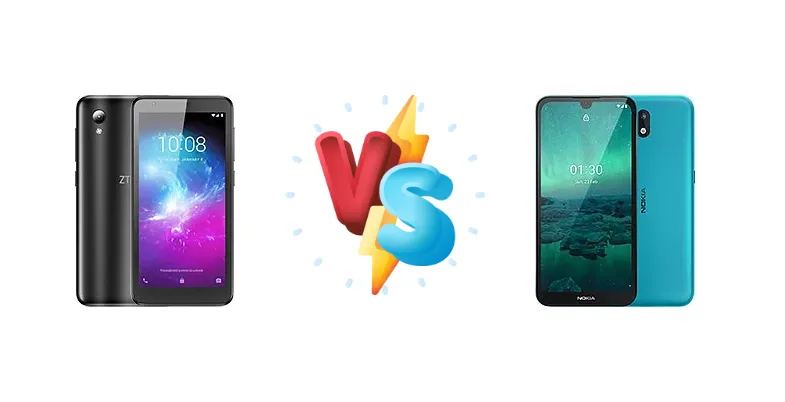
The ZTE Blade A3 (2019) and Nokia 1.3 represent the absolute bottom end of the smartphone market, targeting users prioritizing affordability above all else. Both devices rely on entry-level chipsets and are often found heavily discounted. This comparison dissects their key differences to determine which offers the best experience for the price.
🏆 Quick Verdict
For the average user seeking a functional, if basic, smartphone experience, the Nokia 1.3 edges out the ZTE Blade A3. While both utilize 28nm chipsets, the Qualcomm Snapdragon 215 generally provides a smoother, more responsive user interface, particularly when paired with Android Go. The slight CPU clock speed difference isn't a major factor, but the Qualcomm architecture offers a marginal advantage.
| Network |
|---|
| 2G bands | GSM 850 / 900 / 1800 / 1900 | GSM 850 / 900 / 1800 / 1900 |
| 3G bands | HSDPA 850 / 900 / 2100 | HSDPA 850 / 900 / 2100 - International |
| 4G bands | 1, 3, 5, 7, 8, 20, 38 | 1, 3, 5, 7, 8, 20, 28 - International |
| Speed | HSPA 42.2/5.76 Mbps, LTE Cat4 150/50 Mbps | HSPA 42.2/5.76 Mbps, LTE Cat4 150/50 Mbps |
| Technology | GSM / HSPA / LTE | GSM / HSPA / LTE |
| | - | 1, 2, 3, 4, 5, 7, 8, 12, 17, 28, 66 - LATAM |
| Launch |
|---|
| Announced | 2019, April. Released 2019, April | 2020, March 19. Released 2020, April 02 |
| Status | Discontinued | Discontinued |
| Body |
|---|
| Build | - | Glass front, plastic back, plastic frame |
| Dimensions | 137.4 x 67.5 x 10.5 mm (5.41 x 2.66 x 0.41 in) | 147.3 x 71.2 x 9.4 mm (5.80 x 2.80 x 0.37 in) |
| SIM | Nano-SIM + Nano-SIM | · Nano-SIM· Nano-SIM + Nano-SIM |
| Weight | 144 g (5.08 oz) | 155 g (5.47 oz) |
| Display |
|---|
| Resolution | 480 x 960 pixels, 18:9 ratio (~215 ppi density) | 720 x 1520 pixels, 19:9 ratio (~295 ppi density) |
| Size | 5.0 inches, 64.5 cm2 (~69.6% screen-to-body ratio) | 5.71 inches, 81.4 cm2 (~77.6% screen-to-body ratio) |
| Type | IPS LCD | IPS LCD, 400 nits (typ) |
| Platform |
|---|
| CPU | Quad-core 1.4 GHz | Quad-core 1.3 GHz Cortex-A53 |
| Chipset | Unisoc SC9832E (28 nm) | Qualcomm QM215 Snapdragon 215 (28 nm) |
| GPU | Mali-T820 MP1 | Adreno 308 |
| OS | Android 9.0 Pie (Go edition) | Android 10 (Go edition), upgradable to Android 11 (Go edition), Android One |
| Memory |
|---|
| Card slot | microSDXC | microSDXC (dedicated slot) |
| Internal | 16GB 1GB RAM, 32GB 1GB RAM | 16GB 1GB RAM |
| | - | eMMC 5.1 |
| Main Camera |
|---|
| Features | LED flash, HDR | LED flash, HDR |
| Single | 8 MP, AF | 8 MP, (wide), AF |
| Video | 720p@30fps | 720p@30fps |
| Selfie camera |
|---|
| Single | 5 MP | 5 MP |
| Video | - | 720p@30fps |
| Sound |
|---|
| 3.5mm jack | Yes | Yes |
| 35mm jack | Yes | Yes |
| Loudspeaker | Yes | Yes |
| Comms |
|---|
| Bluetooth | 4.2, A2DP, LE | 4.2, A2DP, LE, aptX HD |
| NFC | No | No |
| Positioning | GPS, GLONASS | GPS, GLONASS, BDS |
| Radio | FM radio | FM radio |
| USB | microUSB 2.0 | microUSB 2.0, OTG |
| WLAN | Wi-Fi 802.11 b/g/n | Wi-Fi 802.11 b/g/n |
| Features |
|---|
| Sensors | Accelerometer | Accelerometer, proximity |
| Battery |
|---|
| Type | Li-Ion 2000 mAh, non-removable | Li-Po 3000 mAh, removable |
| Misc |
|---|
| Colors | Black, Blue | Cyan, Charcoal, Sand |
| Models | - | TA-1216, TA-1205 |
| Price | About 60 EUR | About 170 EUR |
| SAR | - | 0.64 W/kg (head) 1.17 W/kg (body) |
| SAR EU | - | 0.38 W/kg (head) 0.86 W/kg (body) |
ZTE Blade A3 (2019)
- Potentially larger display size
- Slightly higher CPU clock speed
- May be available at a lower price point
- Unisoc chipset generally offers lower performance
- Likely less optimized software experience
Nokia 1.3
- Qualcomm Snapdragon 215 offers better efficiency
- Optimized for Android Go, resulting in smoother performance
- More compact form factor
- Smaller display size
- May be slightly more expensive
Display Comparison
Neither the ZTE Blade A3 nor the Nokia 1.3 boast impressive displays. Specifics like brightness nits and color accuracy are unavailable, but given their price point, expect basic LCD panels. The Blade A3 likely has a slightly larger screen size, which may appeal to some, but the Nokia 1.3’s smaller footprint could be preferable for one-handed use. Both will struggle in direct sunlight.
Camera Comparison
Camera performance on both devices will be limited. Details regarding sensor size and lens apertures are scarce, but it’s safe to assume both feature basic sensors. The presence of a 2MP macro camera on either device is largely marketing fluff; image quality will be poor. Expect acceptable results in well-lit conditions, but significant noise and lack of detail in low light. The image processing capabilities of each chipset will play a larger role than the sensors themselves.
Performance
The core difference lies in the chipsets: the ZTE Blade A3 uses the Unisoc SC9832E, while the Nokia 1.3 employs the Qualcomm Snapdragon 215. Both are quad-core processors fabricated on a 28nm process, indicating similar power efficiency concerns. However, the Snapdragon 215’s Cortex-A53 cores are generally more efficient than the cores found in the SC9832E, leading to a smoother experience. The 1.3 GHz clock speed on the Nokia 1.3 is slightly lower than the 1.4 GHz on the ZTE, but the architectural advantages of Qualcomm’s design likely offset this difference. Both phones will struggle with demanding applications and multitasking.
Battery Life
Battery capacity details are missing for both devices. However, given the power-efficient (though dated) chipsets and likely small battery sizes, both should provide all-day battery life with light usage. Charging wattage is also unknown, but expect slow charging speeds. The efficiency gains of the Snapdragon 215 might translate to slightly longer battery life for the Nokia 1.3, but the difference will likely be minimal.
Buying Guide
Buy the ZTE Blade A3 (2019) if you need a slightly larger display and are comfortable with potentially slower performance. It's a viable option for extremely basic tasks like calls and texts. Buy the Nokia 1.3 if you prioritize a more fluid user experience, even with a smaller screen, and appreciate the benefits of Qualcomm's chipset optimization for Android Go. It's better suited for light social media browsing and messaging.
Frequently Asked Questions
❓ Will either of these phones run popular games like PUBG Mobile or Call of Duty Mobile?
No. Both the Unisoc SC9832E and Snapdragon 215 are far too underpowered to run demanding games like PUBG Mobile or Call of Duty Mobile at playable frame rates. You might be able to run very basic 2D games, but don't expect a gaming experience.
❓ How well do these phones handle multitasking with apps like WhatsApp and Facebook?
Multitasking will be limited. The Nokia 1.3, with its Snapdragon 215 and Android Go optimization, will handle a few apps slightly better than the ZTE Blade A3. However, expect apps to frequently reload when switching between them, and avoid running too many apps simultaneously.
❓ Are these phones compatible with 4G LTE networks?
Yes, both the ZTE Blade A3 and Nokia 1.3 support 4G LTE connectivity. However, the specific LTE bands supported may vary depending on the region. Check compatibility with your carrier before purchasing.
❓ What version of Android do these phones run?
The Nokia 1.3 launched with Android 10 (Go edition). The ZTE Blade A3 likely runs an older version of Android, potentially Android 9 Pie. Software updates are unlikely for either device.