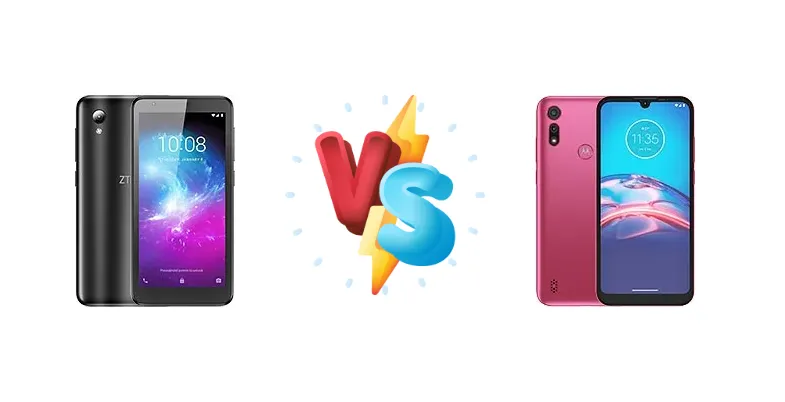
Both the Motorola Moto E6i and the ZTE Blade A3 (2019) occupy the ultra-budget smartphone segment, aiming to deliver essential functionality at the lowest possible price. However, despite similar price points, a significant difference in processor architecture separates these two devices, impacting real-world performance and user experience. This comparison will dissect the key specifications to determine which phone offers the best value.
🏆 Quick Verdict
For the average user, the Motorola Moto E6i is the superior choice. Its Unisoc SC9863A chipset, featuring an octa-core CPU, provides a noticeable performance boost over the ZTE Blade A3’s quad-core Unisoc SC9832E. While both phones are limited in features, the E6i offers a smoother, more responsive experience for everyday tasks.
| Network |
|---|
| 2G bands | GSM 850 / 900 / 1800 / 1900 | GSM 850 / 900 / 1800 / 1900 |
| 3G bands | HSDPA 850 / 900 / 2100 | HSDPA 850 / 900 / 1700(AWS) / 1900 / 2100 |
| 4G bands | 1, 3, 5, 7, 8, 20, 38 | 1, 2, 3, 4, 5, 7, 8, 19, 28, 66 |
| Speed | HSPA 42.2/5.76 Mbps, LTE Cat4 150/50 Mbps | HSPA, LTE |
| Technology | GSM / HSPA / LTE | GSM / HSPA / LTE |
| Launch |
|---|
| Announced | 2019, April. Released 2019, April | 2021, February 11 |
| Status | Discontinued | Available. Released 2021, February 11 |
| Body |
|---|
| Build | - | Glass front, plastic back, plastic frame |
| Dimensions | 137.4 x 67.5 x 10.5 mm (5.41 x 2.66 x 0.41 in) | 155.6 x 73 x 8.5 mm (6.13 x 2.87 x 0.33 in) |
| SIM | Nano-SIM + Nano-SIM | Nano-SIM + Nano-SIM |
| Weight | 144 g (5.08 oz) | 160 g (5.64 oz) |
| Display |
|---|
| Resolution | 480 x 960 pixels, 18:9 ratio (~215 ppi density) | 720 x 1560 pixels, 19.5:9 ratio (~282 ppi density) |
| Size | 5.0 inches, 64.5 cm2 (~69.6% screen-to-body ratio) | 6.1 inches, 91.3 cm2 (~80.4% screen-to-body ratio) |
| Type | IPS LCD | IPS LCD |
| Platform |
|---|
| CPU | Quad-core 1.4 GHz | Octa-core (4x1.6 GHz Cortex-A55 & 4x1.2 GHz Cortex-A55) |
| Chipset | Unisoc SC9832E (28 nm) | Unisoc SC9863A (28 nm) |
| GPU | Mali-T820 MP1 | IMG8322 |
| OS | Android 9.0 Pie (Go edition) | Android 10 (Go edition) |
| Memory |
|---|
| Card slot | microSDXC | microSDXC (uses shared SIM slot) |
| Internal | 16GB 1GB RAM, 32GB 1GB RAM | 32GB 2GB RAM |
| | - | eMMC 5.1 |
| Main Camera |
|---|
| Dual | - | 13 MP, f/2.2, 26mm (wide), 1/3.1", 1.12µm, PDAF
Auxiliary lens |
| Features | LED flash, HDR | LED flash, HDR, panorama |
| Single | 8 MP, AF | - |
| Video | 720p@30fps | 1080p@30fps |
| Selfie camera |
|---|
| Single | 5 MP | 5 MP, f/2.2, 27mm (wide), 1.12µm |
| Video | - | 1080p@30fps |
| Sound |
|---|
| 3.5mm jack | Yes | Yes |
| 35mm jack | Yes | Yes |
| Loudspeaker | Yes | Yes |
| Comms |
|---|
| Bluetooth | 4.2, A2DP, LE | 4.2, A2DP, LE |
| NFC | No | No |
| Positioning | GPS, GLONASS | GPS, GLONASS |
| Radio | FM radio | Unspecified |
| USB | microUSB 2.0 | microUSB 2.0, OTG |
| WLAN | Wi-Fi 802.11 b/g/n | Wi-Fi 802.11 b/g/n |
| Features |
|---|
| Sensors | Accelerometer | Fingerprint (rear-mounted), accelerometer, proximity |
| Battery |
|---|
| Charging | - | 10W wired |
| Type | Li-Ion 2000 mAh, non-removable | Li-Ion 3000 mAh |
| Misc |
|---|
| Colors | Black, Blue | Titanium Gray, Pink |
| Models | - | XT2053-5 |
| Price | About 60 EUR | About 170 EUR |
ZTE Blade A3 (2019)
- Potentially lower price point
- Basic functionality for essential tasks
- Compact and lightweight design (likely)
- Significantly slower processor
- Limited multitasking capabilities
- Poor gaming performance
Motorola Moto E6i
- Octa-core processor for smoother performance
- More responsive user experience
- 10W wired charging
- May be slightly more expensive
- Still limited by budget components
- Camera performance likely similar to ZTE
Display Comparison
Neither device boasts a standout display. Both utilize panels manufactured with cost-optimization as the primary goal. Specifics like resolution and panel type are not provided, but given the price bracket, expect 720p LCDs. The lack of detailed display specs suggests neither phone will excel in brightness, color accuracy, or viewing angles. Bezels are likely to be substantial on both models, maximizing screen real estate within a compact form factor.
Camera Comparison
Camera performance is likely to be similar and underwhelming on both devices. Without specific sensor details, it’s safe to assume both feature basic cameras suitable for casual snapshots in good lighting conditions. The market segment suggests the presence of a primary sensor paired with a depth or macro sensor of minimal resolution. Image processing will be basic, and low-light performance will be poor. Focusing on megapixel counts would be misleading; the quality of the image sensor and image signal processor (ISP) are far more critical, and details are unavailable for either device.
Performance
The core difference lies in the chipset. The Motorola Moto E6i’s Unisoc SC9863A is an octa-core processor, comprised of four Cortex-A55 cores clocked at 1.6 GHz and four at 1.2 GHz. This contrasts sharply with the ZTE Blade A3 (2019)’s Unisoc SC9832E, a quad-core processor clocked at 1.4 GHz. The E6i’s octa-core configuration allows for better multitasking and smoother app launches. While both chips are built on a 28nm process, the additional cores and higher clock speeds of the SC9863A translate to a demonstrably faster user experience. The E6i will handle basic social media, web browsing, and light gaming more effectively.
Battery Life
Battery capacity is not specified for either device. However, given the budget nature of both phones, expect capacities around 3000-4000 mAh. The Moto E6i includes 10W wired charging, which, while slow by modern standards, is a welcome addition. The ZTE Blade A3 (2019) charging speed is unknown, but likely similar. Real-world battery life will depend heavily on usage patterns, but the more efficient processor in the E6i may contribute to slightly longer runtimes.
Buying Guide
Buy the ZTE Blade A3 (2019) if your primary need is a basic, functional phone for calls and light messaging, and you prioritize minimizing cost above all else. Buy the Motorola Moto E6i if you prefer a more responsive user experience, even for simple tasks, and anticipate using apps beyond basic communication – the octa-core processor will make a tangible difference.
Frequently Asked Questions
❓ Will the Motorola Moto E6i handle popular apps like WhatsApp and Facebook smoothly?
Yes, the Moto E6i’s octa-core processor is significantly better equipped to handle apps like WhatsApp and Facebook than the ZTE Blade A3 (2019). While it won’t offer a flagship-level experience, you should expect a noticeably smoother and more responsive experience when using these apps.
❓ Is the Unisoc SC9863A chipset in the Moto E6i capable of playing any mobile games?
The Unisoc SC9863A can handle basic 2D games and some less demanding 3D titles at low settings. However, don’t expect to play graphically intensive games like PUBG or Call of Duty Mobile at playable frame rates. The ZTE Blade A3 (2019) will struggle even more with gaming.
❓ How much storage does each phone offer, and can it be expanded?
Storage capacity is not specified in the provided data. However, given the price point, both phones likely offer 16GB or 32GB of internal storage. It's highly probable that both devices feature a microSD card slot for storage expansion, allowing you to add more space for photos, videos, and apps.