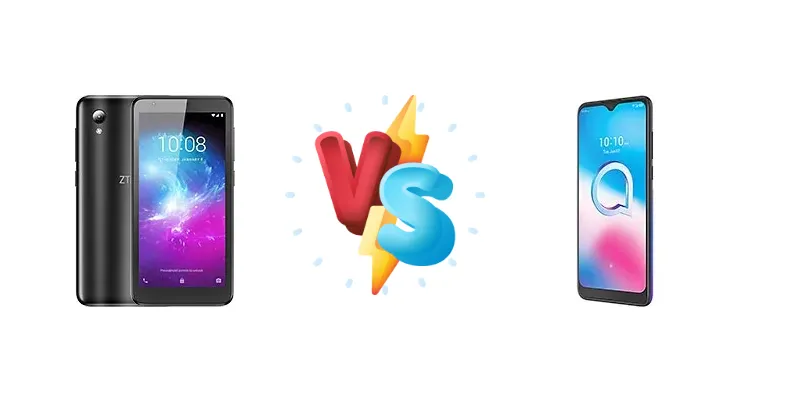
The ZTE Blade A3 (2019) and the alcatel 1V (2020) represent the extreme end of the smartphone price spectrum. Both devices aim to deliver basic smartphone functionality at an incredibly low cost. However, significant differences in their underlying hardware mean one offers a noticeably smoother and more capable experience than the other, despite their similar target audience.
🏆 Quick Verdict
For the average user prioritizing responsiveness and multitasking, the alcatel 1V (2020) is the clear winner. Its Mediatek Helio P22 chipset, with its octa-core CPU, provides a substantial performance advantage over the ZTE Blade A3’s quad-core Unisoc SC9832E, making everyday tasks feel significantly snappier.
| Network |
|---|
| 2G bands | GSM 850 / 900 / 1800 / 1900 | GSM 850 / 900 / 1800 / 1900 |
| 3G bands | HSDPA 850 / 900 / 2100 | HSDPA 850 / 900 / 1900 / 2100 - 5007U |
| 4G bands | 1, 3, 5, 7, 8, 20, 38 | 1, 3, 5, 7, 8, 20, 28, 38, 40, 41 - 5007U |
| Speed | HSPA 42.2/5.76 Mbps, LTE Cat4 150/50 Mbps | HSPA 42.2/5.76 Mbps, LTE Cat4 150/50 Mbps |
| Technology | GSM / HSPA / LTE | GSM / HSPA / LTE |
| | - | 2, 3, 4, 5, 7, 8, 13, 17, 28, 66 - 5007G, 5007A |
| Launch |
|---|
| Announced | 2019, April. Released 2019, April | 2020, January. Released 2020, May |
| Status | Discontinued | Discontinued |
| Body |
|---|
| Build | - | Glass front, plastic back, plastic frame |
| Dimensions | 137.4 x 67.5 x 10.5 mm (5.41 x 2.66 x 0.41 in) | 158.7 x 74.8 x 8.9 mm (6.25 x 2.94 x 0.35 in) |
| SIM | Nano-SIM + Nano-SIM | Nano-SIM + Nano-SIM |
| Weight | 144 g (5.08 oz) | 160 g (5.64 oz) |
| Display |
|---|
| Resolution | 480 x 960 pixels, 18:9 ratio (~215 ppi density) | 720 x 1520 pixels, 19:9 ratio (~270 ppi density) |
| Size | 5.0 inches, 64.5 cm2 (~69.6% screen-to-body ratio) | 6.22 inches, 96.6 cm2 (~81.3% screen-to-body ratio) |
| Type | IPS LCD | IPS LCD |
| Platform |
|---|
| CPU | Quad-core 1.4 GHz | Octa-core 1.8 GHz Cortex-A53 |
| Chipset | Unisoc SC9832E (28 nm) | Mediatek MT6762D Helio P22 (12 nm) |
| GPU | Mali-T820 MP1 | PowerVR GE8320 |
| OS | Android 9.0 Pie (Go edition) | Android 10 |
| Memory |
|---|
| Card slot | microSDXC | microSDXC (uses shared SIM slot) |
| Internal | 16GB 1GB RAM, 32GB 1GB RAM | 32GB 2GB RAM |
| | - | eMMC 5.1 |
| Main Camera |
|---|
| Dual | - | 13 MP, f/1.8, (wide), 1/3.1", 1.12µm, AF
Auxiliary lens |
| Features | LED flash, HDR | LED flash, HDR, panorama |
| Single | 8 MP, AF | 5 MP, f/2.2, (wide), 1/5", 1.12µm |
| Video | 720p@30fps | 1080p@30fps |
| Selfie camera |
|---|
| Single | 5 MP | 5 MP, f/2.2, (wide), 1/5.0", 1.12µm |
| Video | - | 1080p@30fps |
| Sound |
|---|
| 3.5mm jack | Yes | Yes |
| 35mm jack | Yes | Yes |
| Loudspeaker | Yes | Yes |
| Comms |
|---|
| Bluetooth | 4.2, A2DP, LE | 5.0, A2DP, LE |
| NFC | No | No |
| Positioning | GPS, GLONASS | GPS |
| Radio | FM radio | FM radio |
| USB | microUSB 2.0 | microUSB 2.0 |
| WLAN | Wi-Fi 802.11 b/g/n | Wi-Fi 802.11 b/g/n, Wi-Fi Direct |
| Features |
|---|
| Sensors | Accelerometer | Fingerprint (rear-mounted), accelerometer, proximity |
| Battery |
|---|
| Type | Li-Ion 2000 mAh, non-removable | Li-Po 4000 mAh |
| Misc |
|---|
| Colors | Black, Blue | Prime Black, Pine Green, Metallic Black, Agate Green |
| Models | - | 5007U, 5007G, 5007A, 5007U_EEA |
| Price | About 60 EUR | About 80 EUR |
ZTE Blade A3 (2019)
- Lowest possible price point
- Simple and straightforward Android experience
- Potentially longer software support (due to simpler hardware)
- Significantly slower performance
- Limited multitasking capabilities
- Poor gaming performance
alcatel 1V (2020)
- Faster and more responsive performance
- Better multitasking capabilities
- More efficient processor for longer battery life
- Slightly higher price
- May receive fewer software updates
- Potentially more bloatware
Display Comparison
Neither device boasts a standout display. Both likely feature LCD panels, typical for this price point. However, the display comparison is less about quality and more about the processing power needed to drive it. The more powerful Helio P22 in the alcatel 1V will handle UI animations and scrolling more smoothly on its display, even if the resolution and brightness are similar. We can assume both displays are 720p, given the target market.
Camera Comparison
Both phones likely feature basic camera setups. Given the price bracket, expecting high-quality photography is unrealistic. While specific sensor details are unavailable, it’s safe to assume both will include a primary camera and potentially a secondary depth sensor. The alcatel 1V’s more powerful ISP (Image Signal Processor) within the Helio P22 chipset will likely result in slightly better image processing, even with similar sensors. Any differences in image quality will be marginal, and both cameras will struggle in low-light conditions.
Performance
The core difference lies in the chipsets. The Unisoc SC9832E in the ZTE Blade A3 is a quad-core processor built on a 28nm process. This older manufacturing node and lower core count translate to significantly lower performance. Conversely, the alcatel 1V’s Mediatek Helio P22 is an octa-core processor fabricated on a more efficient 12nm process. This means the Helio P22 delivers more processing power *and* better thermal efficiency, reducing the likelihood of throttling during sustained use. The 1.8 GHz clock speed of the Helio P22’s Cortex-A53 cores further contributes to its performance advantage over the ZTE’s 1.4 GHz cores.
Battery Life
Battery life will depend heavily on usage patterns. While specific battery capacities are not provided, the more efficient 12nm Helio P22 in the alcatel 1V will likely contribute to longer battery life compared to the 28nm Unisoc chip in the ZTE Blade A3. The alcatel 1V’s ability to handle tasks more efficiently means less power is consumed during typical use. Charging speeds are also likely to be similar, with both devices probably including a basic 5W charger.
Buying Guide
Buy the ZTE Blade A3 (2019) if you absolutely need the lowest possible price and are willing to tolerate significant performance limitations for basic tasks like calls and messaging. Buy the alcatel 1V (2020) if you prefer a more responsive user experience, even for simple apps, and value the ability to run multiple applications without excessive lag. The alcatel 1V is the better choice for anyone who uses social media or light web browsing.
Frequently Asked Questions
❓ Will the alcatel 1V struggle with popular apps like Facebook or WhatsApp?
While the alcatel 1V won't offer a flagship-level experience, its Helio P22 chipset is capable of running apps like Facebook and WhatsApp reasonably well. Expect some occasional lag when scrolling through feeds or loading images, but it should be usable for basic social media interaction. The ZTE Blade A3 will struggle more noticeably with these apps.
❓ Is the Unisoc SC9832E chipset in the ZTE Blade A3 suitable for gaming?
No, the Unisoc SC9832E is not suitable for gaming. Even simple 2D games may experience significant lag and frame rate drops. The alcatel 1V, while not a gaming powerhouse, will offer a slightly better experience with less demanding titles, but don't expect to play graphically intensive games on either device.
❓ Do either of these phones support Google's Android Go Edition?
Both devices are likely candidates for running Android Go Edition, a lightweight version of Android designed for low-end hardware. This could help mitigate some of the performance limitations of the ZTE Blade A3, but the alcatel 1V will still offer a smoother experience even without it due to its superior chipset.
❓ How much storage do these phones typically offer, and can it be expanded?
Both phones likely come with limited internal storage (around 16GB or 32GB). Fortunately, both typically include a microSD card slot, allowing you to expand the storage capacity to accommodate more apps, photos, and videos. This is crucial given the limited internal storage.