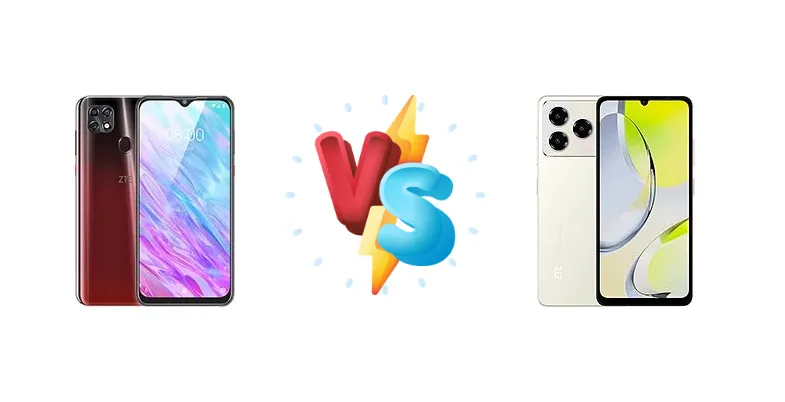
ZTE's Blade series consistently targets the value-conscious smartphone user. The Blade 20 and Blade A76 4G represent two distinct approaches within this segment: the Blade 20 prioritizes a more powerful, albeit older, chipset, while the A76 4G focuses on extended battery life and faster charging. This comparison dissects these trade-offs to determine which device delivers the best experience for your needs.
🏆 Quick Verdict
For users prioritizing raw processing power for tasks like gaming or demanding apps, the ZTE Blade 20 offers a performance edge thanks to its Helio P60 chipset. However, the ZTE Blade A76 4G is the better choice for the average user who values all-day battery life and quicker top-ups with its impressive 54+ hour endurance and 22.5W charging.
| Network |
|---|
| 2G bands | GSM 850 / 900 / 1800 / 1900 | GSM 850 / 900 / 1800 / 1900 |
| 3G bands | HSDPA 850 / 900 / 1900 / 2100 | HSDPA 850 / 900 / 1900 / 2100 |
| 4G bands | 1, 3, 5, 8, 40, 41 | LTE |
| Speed | HSPA, LTE | HSPA, LTE |
| Technology | GSM / CDMA / HSPA / EVDO / LTE | GSM / HSPA / LTE |
| | CDMA2000 1xEV-DO | - |
| Launch |
|---|
| Announced | 2019, October. Released 2019, October | 2025, October |
| Status | Discontinued | Available. Released 2025, October |
| Body |
|---|
| Build | Glass front, plastic back, plastic frame | - |
| Dimensions | 162.9 x 76.6 x 9 mm (6.41 x 3.02 x 0.35 in) | - |
| SIM | Nano-SIM + Nano-SIM | Nano-SIM + Nano-SIM |
| Weight | 190 g (6.70 oz) | - |
| Display |
|---|
| Protection | - | Mohs level 4 |
| Resolution | 720 x 1560 pixels, 19.5:9 ratio (~265 ppi density) | 720 x 1612 pixels, 20:9 ratio (~262 ppi density) |
| Size | 6.49 inches, 103.4 cm2 (~82.9% screen-to-body ratio) | 6.75 inches, 109.5 cm2 (~89.3% screen-to-body ratio) |
| Type | IPS LCD | IPS LCD, 90Hz |
| Platform |
|---|
| CPU | Octa-core (4x2.0 GHz Cortex-A73 & 4x2.0 GHz Cortex-A53) | Octa-core 1.8 GHz |
| Chipset | Mediatek MT6771 Helio P60 (12 nm) | - |
| GPU | Mali-G72 MP3 | - |
| OS | Android 9.0 (Pie) | Android 15 |
| Memory |
|---|
| Card slot | microSDXC (uses shared SIM slot) | No |
| Internal | 128GB 4GB RAM | 64GB 4GB RAM, 128GB 4GB RAM |
| | eMMC 5.1 | - |
| Main Camera |
|---|
| Dual | 16 MP, f/1.8, (wide), PDAF
8 MP, f/2.2, 12mm (ultrawide)
Auxiliary lens | 50 MP, (wide), AF
Auxiliary lens |
| Features | LED flash, HDR, panorama | LED flash, HDR |
| Video | 1080p@30fps | 1080p@30fps |
| Selfie camera |
|---|
| Single | 8 MP, f/2.0 | Yes |
| Video | 1080p@30fps | 1080p@30fps |
| Sound |
|---|
| 3.5mm jack | Yes | - |
| 35mm jack | Yes | Yes |
| Loudspeaker | Yes | Yes |
| Comms |
|---|
| Bluetooth | 5.0, A2DP, LE | Yes |
| NFC | No | Unspecified |
| Positioning | GPS, GLONASS | GPS |
| Radio | FM radio, recording | Unspecified |
| USB | USB Type-C 2.0, OTG | USB Type-C 2.0 |
| WLAN | Wi-Fi 802.11 b/g/n | Wi-Fi 802.11 a/b/g/n/ac, dual-band |
| Features |
|---|
| Sensors | Fingerprint (rear-mounted), accelerometer, proximity, compass | Yes |
| Battery |
|---|
| Charging | 18W wired | 22.5W wired |
| Type | Li-Po 5000 mAh, non-removable | 5000 mAh |
| Misc |
|---|
| Colors | Turquoise, Magic red | Silver, Gold, Violet |
| Models | V1050 | Z2474 |
| Price | About 130 EUR | € 93.19 |
| EU LABEL |
|---|
| Battery | - | 54:20h endurance, 800 cycles |
| Energy | - | Class A |
| Free fall | - | Class C (90 falls) |
| Repairability | - | Class B |
ZTE Blade 20
- More powerful processor for demanding tasks
- Helio P60 offers better gaming performance
- Potentially smoother multitasking experience
- Likely shorter battery life
- Slower charging speed (18W)
- Battery longevity unknown
ZTE Blade A76 4G
- Exceptional battery endurance (54:20h)
- Faster charging (22.5W)
- Long-lasting battery with 800 cycles
- Less powerful processor
- May struggle with demanding apps
- Potentially slower app loading times
Display Comparison
Display specifications are absent from the provided data, making a direct comparison impossible. However, given the price points of these devices, it's reasonable to assume both utilize LCD panels. The absence of information regarding refresh rates suggests both likely operate at the standard 60Hz. Users should investigate independent reviews for details on brightness, color accuracy, and viewing angles before making a decision.
Camera Comparison
Camera details are limited. Without sensor size, aperture, or image processing information, a meaningful comparison is difficult. It’s likely both devices feature basic camera setups geared towards casual photography. The absence of any mention of advanced features like OIS suggests image stabilization will rely heavily on software processing. Users should consult independent camera samples to assess image quality in various lighting conditions.
Performance
The ZTE Blade 20’s Mediatek MT6771 Helio P60, built on a 12nm process, features an octa-core CPU configuration with a split of 4x2.0 GHz Cortex-A73 and 4x2.0 GHz Cortex-A53 cores. This architecture provides a noticeable performance boost over the ZTE Blade A76 4G’s unspecified octa-core CPU clocked at 1.8 GHz. While the A76 4G’s core count is the same, the lower clock speed suggests reduced single-core and multi-core performance. This translates to faster app loading times and smoother multitasking on the Blade 20, particularly for resource-intensive applications. The 12nm process of the Helio P60, while not cutting-edge, offers a reasonable balance between performance and power efficiency.
Battery Life
The ZTE Blade A76 4G clearly excels in battery performance. Its stated 54:20h endurance and 800 charge cycles indicate a significantly longer lifespan and usability between charges compared to the Blade 20, which lacks any battery life data. Furthermore, the A76 4G’s 22.5W wired charging is considerably faster than the Blade 20’s 18W charging, allowing for quicker top-ups. This difference in charging speed is crucial for users who frequently find themselves needing to recharge throughout the day. The 800 cycle rating also suggests a more durable battery that will retain capacity for a longer period.
Buying Guide
Buy the ZTE Blade 20 if you need a phone capable of handling more demanding applications and occasional gaming, and are willing to compromise on battery longevity. Buy the ZTE Blade A76 4G if you prioritize long-lasting battery life, fast charging, and a consistently smooth experience for everyday tasks like browsing, social media, and communication.
Frequently Asked Questions
❓ Will the ZTE Blade 20 struggle with graphically intensive games like PUBG or Call of Duty?
While the Helio P60 is capable of running these games, you'll likely need to lower graphics settings to achieve a smooth frame rate. The A76 4G's processor is less powerful and may require even more significant compromises in visual quality.
❓ How long will it take to fully charge the ZTE Blade A76 4G from 0% to 100%?
With 22.5W charging, the ZTE Blade A76 4G should fully charge in approximately 1 hour and 30 minutes to 2 hours, depending on usage during charging. This is significantly faster than the Blade 20's 18W charging.
❓ Does the ZTE Blade A76 4G's battery degrade quickly over time?
The A76 4G's battery is rated for 800 charge cycles, indicating good longevity. This means it should retain a significant portion of its original capacity even after extended use, exceeding the typical lifespan of many budget smartphones.
❓ Is the difference in processor speed between the Blade 20 and A76 4G noticeable for everyday tasks?
For basic tasks like browsing, social media, and messaging, the difference will be minimal. However, when opening multiple apps simultaneously or running demanding applications, the Blade 20's Helio P60 will provide a smoother and more responsive experience.