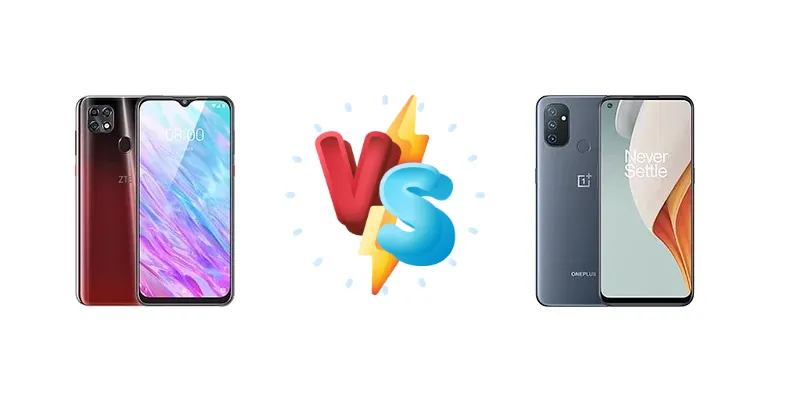
The sub-$150 smartphone market is fiercely competitive. The ZTE Blade 20 and OnePlus Nord N100 both aim to deliver a functional Android experience without breaking the bank, but they take different approaches. The Blade 20 relies on Mediatek’s older Helio P60, while the Nord N100 opts for Qualcomm’s Snapdragon 460. This comparison dissects the architectural differences and real-world implications of these chipsets to determine which phone offers the best value.
🏆 Quick Verdict
For the average user prioritizing a slightly smoother, more modern software experience and potential for longer software support, the OnePlus Nord N100 is the better choice. While the ZTE Blade 20’s Helio P60 offers comparable CPU performance, the Snapdragon 460’s more efficient 11nm process and Qualcomm’s software optimizations provide a noticeable edge in responsiveness and sustained performance.
| Network |
|---|
| 2G bands | GSM 850 / 900 / 1800 / 1900 | GSM 850 / 900 / 1800 / 1900 |
| 3G bands | HSDPA 850 / 900 / 1900 / 2100 | HSDPA 850 / 900 / 1700(AWS) / 1900 / 2100 |
| 4G bands | 1, 3, 5, 8, 40, 41 | 1, 2, 3, 4, 5, 7, 8, 12, 17, 20, 28, 38, 40, 41 - International |
| Speed | HSPA, LTE | HSPA 42.2/5.76 Mbps, LTE Cat13 400/50 Mbps |
| Technology | GSM / CDMA / HSPA / EVDO / LTE | GSM / CDMA / HSPA / LTE |
| | CDMA2000 1xEV-DO | 1, 2, 3, 4, 5, 7, 8, 12, 13, 17, 20, 25, 26, 28, 38, 41, 66, 71 - USA |
| Launch |
|---|
| Announced | 2019, October. Released 2019, October | 2020, October 26 |
| Status | Discontinued | Available. Released 2020, November 11 |
| Body |
|---|
| Build | Glass front, plastic back, plastic frame | Glass front (Gorilla Glass 3), plastic frame |
| Dimensions | 162.9 x 76.6 x 9 mm (6.41 x 3.02 x 0.35 in) | 164.9 x 75.1 x 8.5 mm (6.49 x 2.96 x 0.33 in) |
| SIM | Nano-SIM + Nano-SIM | Nano-SIM + Nano-SIM |
| Weight | 190 g (6.70 oz) | 188 g (6.63 oz) |
| Display |
|---|
| Protection | - | Corning Gorilla Glass 3 |
| Resolution | 720 x 1560 pixels, 19.5:9 ratio (~265 ppi density) | 720 x 1600 pixels, 20:9 ratio (~269 ppi density) |
| Size | 6.49 inches, 103.4 cm2 (~82.9% screen-to-body ratio) | 6.52 inches, 102.6 cm2 (~82.9% screen-to-body ratio) |
| Type | IPS LCD | IPS LCD, 90Hz |
| Platform |
|---|
| CPU | Octa-core (4x2.0 GHz Cortex-A73 & 4x2.0 GHz Cortex-A53) | Octa-core (4x1.8 GHz Kryo 240 & 4x1.6 GHz Kryo 240) |
| Chipset | Mediatek MT6771 Helio P60 (12 nm) | Qualcomm SM4250 Snapdragon 460 (11 nm) |
| GPU | Mali-G72 MP3 | Adreno 610 |
| OS | Android 9.0 (Pie) | Android 10, OxygenOS 10.5.9 |
| Memory |
|---|
| Card slot | microSDXC (uses shared SIM slot) | microSDXC |
| Internal | 128GB 4GB RAM | 64GB 4GB RAM |
| | eMMC 5.1 | UFS 2.1 |
| Main Camera |
|---|
| Dual | 16 MP, f/1.8, (wide), PDAF
8 MP, f/2.2, 12mm (ultrawide)
Auxiliary lens | - |
| Features | LED flash, HDR, panorama | LED flash, HDR, panorama |
| Triple | - | 13 MP, f/2.2, (wide), PDAF
2 MP (macro)
Auxiliary lens |
| Video | 1080p@30fps | 1080p@30fps, gyro-EIS |
| Selfie camera |
|---|
| Features | - | HDR |
| Single | 8 MP, f/2.0 | 8 MP, f/2.0 |
| Video | 1080p@30fps | 1080p@30fps |
| Sound |
|---|
| 3.5mm jack | Yes | Yes |
| 35mm jack | Yes | Yes |
| Loudspeaker | Yes | Yes, with stereo speakers |
| Comms |
|---|
| Bluetooth | 5.0, A2DP, LE | 5.0, A2DP, LE |
| NFC | No | - |
| Positioning | GPS, GLONASS | GPS, GLONASS, GALILEO, BDS |
| Radio | FM radio, recording | FM radio |
| USB | USB Type-C 2.0, OTG | USB Type-C 2.0, OTG |
| WLAN | Wi-Fi 802.11 b/g/n | Wi-Fi 802.11 a/b/g/n/ac, dual-band, Wi-Fi Direct |
| Features |
|---|
| Sensors | Fingerprint (rear-mounted), accelerometer, proximity, compass | Fingerprint (rear-mounted), accelerometer, gyro, proximity, compass |
| Battery |
|---|
| Charging | 18W wired | 18W wired |
| Type | Li-Po 5000 mAh, non-removable | Li-Po 5000 mAh |
| Misc |
|---|
| Colors | Turquoise, Magic red | Midnight Frost |
| Models | V1050 | BE2013, BE2015, BE2011, BE2012 |
| Price | About 130 EUR | About 80 EUR |
| Pricing |
|---|
| 64GB 4GB RAM | - | $ 125.00 |
| RENEWED | - | $ 129.00 |
ZTE Blade 20
- Potentially lower price point
- Comparable CPU performance for basic tasks
- Established Mediatek chipset
- Older 12nm manufacturing process
- Less efficient power consumption
- Potentially limited software support
OnePlus Nord N100
- More efficient Snapdragon 460 chipset
- Better sustained performance due to 11nm process
- Potential for longer software support from OnePlus
- Slightly higher price
- CPU clock speeds are lower than the Blade 20
- May not offer significant camera improvements
Display Comparison
Neither device boasts a standout display. Both likely utilize LCD panels, a common cost-saving measure in this price bracket. The key difference lies under the hood. While specific display specs are unavailable for the Blade 20, the Nord N100’s reliance on the Snapdragon 460 suggests a focus on efficiency, potentially impacting display brightness and color accuracy. The 11nm process of the Snapdragon 460 allows for more efficient power delivery to the display controller, potentially resulting in slightly better sustained brightness.
Camera Comparison
Camera performance is likely to be similar on both devices, focusing on basic image capture. Neither phone is expected to excel in low-light conditions. The absence of detailed camera specs suggests both rely on relatively simple sensor setups. The OnePlus Nord N100’s Qualcomm ISP (Image Signal Processor) within the Snapdragon 460 may offer slightly better image processing capabilities, particularly in terms of noise reduction and dynamic range, but the difference will likely be marginal. Expect both to feature a primary camera and potentially depth or macro sensors of limited utility.
Performance
The core of this comparison is the chipset battle. The ZTE Blade 20’s Mediatek Helio P60 (12nm) features an octa-core CPU with a mix of Cortex-A73 and A53 cores, peaking at 2.0 GHz. The OnePlus Nord N100’s Qualcomm Snapdragon 460 (11nm) also uses an octa-core configuration, but with Kryo 240 cores clocked at 1.8 GHz and 1.6 GHz. While the P60’s clock speed is higher, the Snapdragon 460 benefits from a smaller 11nm manufacturing process, leading to improved power efficiency and thermal management. This translates to less throttling under sustained load, making the Nord N100 more suitable for moderate gaming and multitasking. The Snapdragon 460’s Adreno 610 GPU also provides a performance advantage over the P60’s Mali-G72 MP3.
Battery Life
Both the ZTE Blade 20 and OnePlus Nord N100 support 18W wired charging. Battery capacity is not specified for the Blade 20, but the Nord N100’s efficiency gains from the Snapdragon 460’s 11nm process could translate to slightly longer battery life despite potentially having a similar capacity. The more efficient chipset means less power wasted during everyday tasks, extending the time between charges. While both offer 18W charging, the actual 0-100% charge time will depend on the charger used and the battery capacity of each device.
Buying Guide
Buy the ZTE Blade 20 if you need a functional smartphone for basic tasks like calling, texting, and light social media use, and are comfortable with potentially limited software updates. Buy the OnePlus Nord N100 if you prefer a more responsive user experience, slightly better gaming performance, and the assurance of a more established brand with a history of software support, even if it comes at a small price premium.
Frequently Asked Questions
❓ Will the ZTE Blade 20 struggle with multitasking compared to the Nord N100?
The ZTE Blade 20’s Helio P60 can handle basic multitasking, but the Snapdragon 460 in the Nord N100 is better equipped for sustained multitasking due to its more efficient architecture and improved thermal management. Expect more app retention and smoother switching between applications on the Nord N100.
❓ Is the gaming experience significantly different between these two phones?
While neither phone is a gaming powerhouse, the OnePlus Nord N100 offers a noticeably better gaming experience. The Snapdragon 460’s Adreno 610 GPU provides a performance advantage over the Helio P60’s Mali-G72 MP3, allowing for higher frame rates and smoother gameplay in less demanding titles. The 11nm process also helps prevent throttling during extended gaming sessions.
❓ How long can I realistically expect software updates for the ZTE Blade 20?
ZTE’s update track record is less consistent than OnePlus. It’s likely the Blade 20 will receive only one major Android update, if any, and limited security patches. The Nord N100, backed by OnePlus, is more likely to receive at least one major Android update and regular security patches for a longer period.