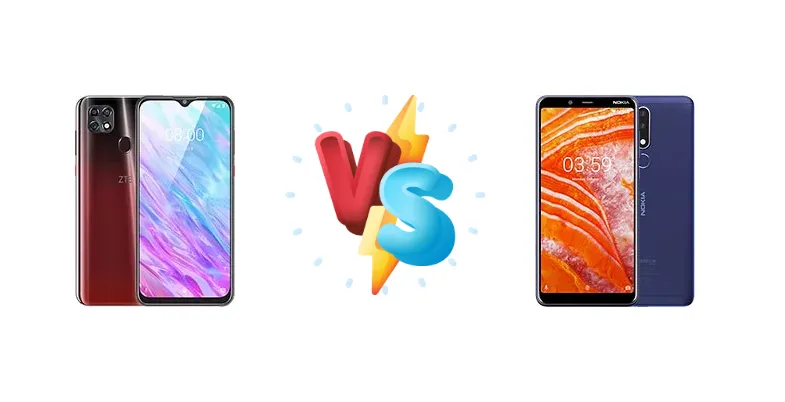
The ZTE Blade 20 and Nokia 3.1 Plus represent two approaches to the ultra-budget smartphone market. The Blade 20 aims for a performance boost with a more modern chipset, while the Nokia 3.1 Plus prioritizes a clean Android experience and brand recognition. This comparison dissects their key differences to determine which device delivers the best value for users seeking affordability.
🏆 Quick Verdict
For the average user prioritizing responsiveness and future-proofing, the ZTE Blade 20 is the clear winner. Its Mediatek Helio P60 chipset provides a significant performance advantage over the Nokia 3.1 Plus’s Helio P22 (or Snapdragon 439 in the US variant), making it better suited for multitasking and demanding apps. However, Nokia’s software experience may appeal to those seeking simplicity.
| Network |
|---|
| 2G bands | GSM 850 / 900 / 1800 / 1900 | GSM 850 / 900 / 1800 / 1900 |
| 3G bands | HSDPA 850 / 900 / 1900 / 2100 | HSDPA 850 / 900 / 1900 / 2100 |
| 4G bands | 1, 3, 5, 8, 40, 41 | 2, 4, 5, 12, 14, 29, 30 - USA |
| Speed | HSPA, LTE | HSPA 42.2/5.76 Mbps, LTE Cat4 150/50 Mbps |
| Technology | GSM / CDMA / HSPA / EVDO / LTE | GSM / HSPA / LTE |
| | CDMA2000 1xEV-DO | HSDPA 850 / 1700(AWS) / 1900 - USA |
| Launch |
|---|
| Announced | 2019, October. Released 2019, October | 2018, October. Released 2018, October |
| Status | Discontinued | Discontinued |
| Body |
|---|
| Build | Glass front, plastic back, plastic frame | Glass front, aluminum back, aluminum frame |
| Dimensions | 162.9 x 76.6 x 9 mm (6.41 x 3.02 x 0.35 in) | 156.9 x 76.4 x 8.2 mm (6.18 x 3.01 x 0.32 in) |
| SIM | Nano-SIM + Nano-SIM | Nano-SIM + Nano-SIM |
| Weight | 190 g (6.70 oz) | 180 g (6.35 oz) |
| Display |
|---|
| Resolution | 720 x 1560 pixels, 19.5:9 ratio (~265 ppi density) | 720 x 1440 pixels, 18:9 ratio (~268 ppi density) |
| Size | 6.49 inches, 103.4 cm2 (~82.9% screen-to-body ratio) | 6.0 inches, 92.9 cm2 (~77.5% screen-to-body ratio) |
| Type | IPS LCD | IPS LCD |
| Platform |
|---|
| CPU | Octa-core (4x2.0 GHz Cortex-A73 & 4x2.0 GHz Cortex-A53) | Octa-core 2.0 GHz Cortex-A53 - GlobalOcta-core (4x1.95 GHz Cortex-A53 & 4x1.45 GHz Cortex A53) - USA |
| Chipset | Mediatek MT6771 Helio P60 (12 nm) | Mediatek MT6762 Helio P22 (12 nm) - GlobalQualcomm SDM439 Snapdragon 439 (12 nm) - USA |
| GPU | Mali-G72 MP3 | PowerVR GE8320 - GlobalAdreno 505 - USA |
| OS | Android 9.0 (Pie) | Android 8.1 (Oreo), upgradable to Android 10, Android One |
| Memory |
|---|
| Card slot | microSDXC (uses shared SIM slot) | microSDXC (dedicated slot) |
| Internal | 128GB 4GB RAM | 16GB 2GB RAM, 32GB 2GB RAM, 32GB 3GB RAM |
| | eMMC 5.1 | eMMC 5.1 |
| Main Camera |
|---|
| Dual | 16 MP, f/1.8, (wide), PDAF
8 MP, f/2.2, 12mm (ultrawide)
Auxiliary lens | 13 MP, f/2.0, AF
Auxiliary lens |
| Features | LED flash, HDR, panorama | LED flash, HDR, panorama |
| Video | 1080p@30fps | 1080p@30fps |
| Selfie camera |
|---|
| Features | - | LED flash, HDR |
| Single | 8 MP, f/2.0 | 8 MP, f/2.2 |
| Video | 1080p@30fps | 720p@30fps |
| Sound |
|---|
| 3.5mm jack | Yes | Yes |
| 35mm jack | Yes | Yes |
| Loudspeaker | Yes | Yes |
| Comms |
|---|
| Bluetooth | 5.0, A2DP, LE | 4.1, A2DP, LE |
| NFC | No | Yes (USA, APAC & EMEA) |
| Positioning | GPS, GLONASS | GPS, GLONASS, BDS, GALILEO |
| Radio | FM radio, recording | FM radio |
| USB | USB Type-C 2.0, OTG | microUSB 2.0, OTG |
| WLAN | Wi-Fi 802.11 b/g/n | Wi-Fi 802.11 b/g/n, Wi-Fi Direct |
| Features |
|---|
| Sensors | Fingerprint (rear-mounted), accelerometer, proximity, compass | Fingerprint (rear-mounted), accelerometer, gyro, proximity, compass |
| Battery |
|---|
| Charging | 18W wired | 10W wired |
| Type | Li-Po 5000 mAh, non-removable | Li-Ion 3500 mAh, non-removable |
| Misc |
|---|
| Colors | Turquoise, Magic red | Blue, White, Gray |
| Models | V1050 | TA-1118, TA-1125, TA-1113, TA-1117, TA-1124, TA-1125 |
| Price | About 130 EUR | About 120 EUR |
| SAR EU | - | 0.41 W/kg (head) 1.58 W/kg (body) |
ZTE Blade 20
- Faster processor for smoother performance
- 18W fast charging for quicker top-ups
- Potentially better multitasking capabilities
- Software experience may not be as clean as Nokia's
- Brand recognition is lower than Nokia
Nokia 3.1 Plus
- Clean, stock Android experience
- Strong brand reputation for reliability
- Potentially more efficient power consumption (depending on chipset variant)
- Slower processor for less demanding tasks
- 10W charging is significantly slower
- Limited performance headroom for future apps
Display Comparison
Neither device boasts a standout display. Both utilize 12nm chipsets, suggesting similar power constraints impacting display capabilities. Specific display specs (resolution, panel type) are missing, but given the price point, expect 720p LCD panels. The focus here isn't on visual fidelity, but rather on basic usability. Bezels are likely comparable, reflecting the budget nature of both phones.
Camera Comparison
Camera performance is likely to be similar, with both phones targeting the entry-level segment. Details on sensor sizes and apertures are unavailable, but it’s safe to assume both feature basic camera setups. The presence of a 2MP macro lens on either device is largely a marketing gimmick, offering limited practical benefit. Image processing will likely be the differentiating factor, with Nokia potentially offering more natural-looking images due to its software optimizations, while ZTE might lean towards more saturated colors.
Performance
The core difference lies in the chipsets. The ZTE Blade 20’s Mediatek Helio P60, built on a 12nm process, features an octa-core configuration with a distinct cluster of four Cortex-A73 cores clocked at 2.0 GHz, paired with four Cortex-A53 cores. This architecture provides a substantial performance uplift compared to the Nokia 3.1 Plus’s Mediatek Helio P22 (global) or Snapdragon 439 (US). The P22/439 relies solely on Cortex-A53 cores clocked at 2.0 GHz (P22) or a split 1.95/1.45 GHz configuration (SDM439). The A73 cores in the P60 offer significantly higher single-core performance, crucial for app launch speeds and general responsiveness. This translates to a smoother user experience on the Blade 20, especially when multitasking.
Battery Life
Battery capacity is not specified for either device. However, the ZTE Blade 20’s 18W wired charging is a significant advantage over the Nokia 3.1 Plus’s 10W charging. While battery life will depend on usage patterns, the faster charging speed on the Blade 20 will reduce downtime and provide a more convenient user experience. Even with a similarly sized battery, the more efficient Helio P60 could contribute to slightly longer battery life under moderate use.
Buying Guide
Buy the ZTE Blade 20 if you need a phone capable of handling more demanding applications, enjoy occasional gaming, and value raw processing power. Buy the Nokia 3.1 Plus if you prioritize a clean, stock Android experience, prefer a well-established brand, and primarily use your phone for basic communication and light tasks. The Nokia 3.1 Plus is a good choice for first-time smartphone users or those seeking simplicity.
Frequently Asked Questions
❓ Will the ZTE Blade 20 struggle with popular social media apps like TikTok and Instagram?
While the Helio P60 is a budget chipset, it's capable of running most social media apps smoothly. However, expect some occasional slowdowns when multitasking or using the apps for extended periods. The Nokia 3.1 Plus, with its less powerful chipset, is more likely to exhibit performance issues with these apps.
❓ Is the Snapdragon 439 version of the Nokia 3.1 Plus (US model) significantly better than the Helio P22 version?
Yes, the Snapdragon 439 offers a modest performance improvement over the Helio P22. The split core configuration (4x1.95 GHz & 4x1.45 GHz) provides a slight edge in multitasking. However, it still falls short of the overall performance offered by the ZTE Blade 20’s Helio P60.
❓ Does the ZTE Blade 20 support widevine L1 for HD streaming on Netflix or Amazon Prime Video?
This information is not readily available. Budget phones often omit Widevine L1 support, limiting streaming quality to SD. Checking user forums or contacting ZTE directly is recommended to confirm.