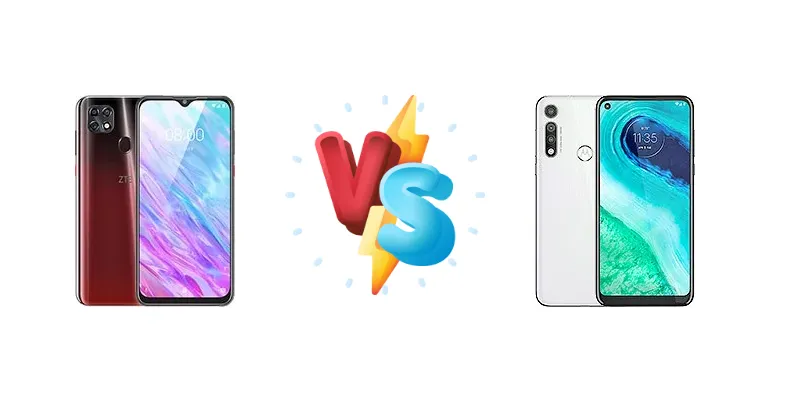
The ZTE Blade 20 and Motorola Moto G Fast represent two approaches to the ultra-budget smartphone market. The Blade 20 leverages Mediatek's Helio P60, while the Moto G Fast opts for Qualcomm's Snapdragon 665. This comparison dissects the core differences between these chipsets and their impact on everyday use, focusing on performance, efficiency, and charging capabilities.
🏆 Quick Verdict
For the average user, the Motorola Moto G Fast is the better choice. While the ZTE Blade 20 offers 18W charging, the Snapdragon 665's superior 11nm process and optimized architecture deliver better sustained performance and efficiency, translating to a smoother user experience and potentially longer battery life.
| Network |
|---|
| 2G bands | GSM 850 / 900 / 1800 / 1900 | GSM 850 / 900 / 1800 / 1900 |
| 3G bands | HSDPA 850 / 900 / 1900 / 2100 | HSDPA 850 / 900 / 1700(AWS) / 1900 / 2100 |
| 4G bands | 1, 3, 5, 8, 40, 41 | 1, 2, 3, 4, 5, 7, 8, 12, 13, 14, 17, 25, 26, 29, 30, 38, 41, 66, 71 |
| Speed | HSPA, LTE | HSPA, LTE |
| Technology | GSM / CDMA / HSPA / EVDO / LTE | GSM / CDMA / HSPA / EVDO / LTE |
| | CDMA2000 1xEV-DO | CDMA2000 1xEV-DO |
| Launch |
|---|
| Announced | 2019, October. Released 2019, October | 2020, June 05. Released 2020, June 12 |
| Status | Discontinued | Discontinued |
| Body |
|---|
| Build | Glass front, plastic back, plastic frame | - |
| Dimensions | 162.9 x 76.6 x 9 mm (6.41 x 3.02 x 0.35 in) | 161.9 x 75.7 x 9.1 mm (6.37 x 2.98 x 0.36 in) |
| SIM | Nano-SIM + Nano-SIM | Nano-SIM + Nano-SIM |
| Weight | 190 g (6.70 oz) | 189.4 g (6.67 oz) |
| | - | Water-repellent coating |
| Display |
|---|
| Resolution | 720 x 1560 pixels, 19.5:9 ratio (~265 ppi density) | 720 x 1560 pixels, 19.5:9 ratio (~268 ppi density) |
| Size | 6.49 inches, 103.4 cm2 (~82.9% screen-to-body ratio) | 6.4 inches, 100.5 cm2 (~82.0% screen-to-body ratio) |
| Type | IPS LCD | IPS LCD |
| Platform |
|---|
| CPU | Octa-core (4x2.0 GHz Cortex-A73 & 4x2.0 GHz Cortex-A53) | Octa-core (4x2.0 GHz Kryo 260 Gold & 4x1.8 GHz Kryo 260 Silver) |
| Chipset | Mediatek MT6771 Helio P60 (12 nm) | Qualcomm SM6125 Snapdragon 665 (11 nm) |
| GPU | Mali-G72 MP3 | Adreno 610 |
| OS | Android 9.0 (Pie) | Android 10 |
| Memory |
|---|
| Card slot | microSDXC (uses shared SIM slot) | microSDXC (uses shared SIM slot) |
| Internal | 128GB 4GB RAM | 32GB 3GB RAM |
| | eMMC 5.1 | eMMC 5.1 |
| Main Camera |
|---|
| Dual | 16 MP, f/1.8, (wide), PDAF
8 MP, f/2.2, 12mm (ultrawide)
Auxiliary lens | - |
| Features | LED flash, HDR, panorama | LED flash, HDR, panorama |
| Triple | - | 16 MP, f/1.7, (wide), 1/2.8", 1.12µm, PDAF
8 MP, f/2.2, 118˚ (ultrawide), 1/4.0", 1.12µm
2 MP (macro) |
| Video | 1080p@30fps | 4K@30fps, 1080p@30/60fps, gyro-EIS |
| Selfie camera |
|---|
| Features | - | HDR |
| Single | 8 MP, f/2.0 | 8 MP, f/2.0, (wide), 1.12µm |
| Video | 1080p@30fps | 1080p@30fps, gyro-EIS |
| Sound |
|---|
| 3.5mm jack | Yes | Yes |
| 35mm jack | Yes | Yes |
| Loudspeaker | Yes | Yes |
| Comms |
|---|
| Bluetooth | 5.0, A2DP, LE | 5.0, A2DP, LE |
| NFC | No | No |
| Positioning | GPS, GLONASS | GPS, GLONASS, GALILEO |
| Radio | FM radio, recording | - |
| USB | USB Type-C 2.0, OTG | USB Type-C 2.0 |
| WLAN | Wi-Fi 802.11 b/g/n | Wi-Fi 802.11 a/b/g/n/ac, dual-band, Wi-Fi Direct |
| Features |
|---|
| Sensors | Fingerprint (rear-mounted), accelerometer, proximity, compass | Fingerprint (rear-mounted), accelerometer, gyro, proximity |
| Battery |
|---|
| Charging | 18W wired | 10W wired |
| Type | Li-Po 5000 mAh, non-removable | Li-Po 4000 mAh |
| Misc |
|---|
| Colors | Turquoise, Magic red | Pearl White |
| Models | V1050 | XT2045-3 |
| Price | About 130 EUR | About 90 EUR |
ZTE Blade 20
- Faster 18W charging
- Potentially lower cost (depending on retailer)
- Octa-core CPU for multitasking
- Less efficient 12nm chipset
- Potential for thermal throttling
- Older CPU architecture
Motorola Moto G Fast
- More efficient 11nm Snapdragon 665
- Better sustained performance
- Qualcomm's image signal processing
- Smoother UI experience
- Slower 10W charging
- May be slightly more expensive
Display Comparison
Neither device is known for display prowess in this segment. Details are limited, but both likely feature 720p+ LCD panels. The key difference isn't the display itself, but how the chipsets drive it. The Snapdragon 665's Adreno 610 GPU is generally more efficient at rendering UI elements and handling graphics, potentially leading to smoother scrolling and animations on the Moto G Fast.
Camera Comparison
Without detailed camera specs beyond the chipsets, it's difficult to make a definitive statement. However, the Snapdragon 665 typically pairs with Qualcomm's Spectra ISP, known for its image processing capabilities. This ISP often delivers better dynamic range and noise reduction compared to the ISP found in the Helio P60. While both phones likely feature similar sensor resolutions in this price bracket, the image signal processing pipeline of the Snapdragon 665 gives it an edge in image quality.
Performance
The core of the difference lies in the chipsets. The Mediatek Helio P60 (MT6771) is built on a 12nm process, while the Qualcomm Snapdragon 665 (SM6125) utilizes a more efficient 11nm process. This smaller node generally translates to lower power consumption and reduced heat generation. While both CPUs feature octa-core configurations with similar peak clock speeds (2.0 GHz), the Snapdragon 665's Kryo 260 cores are architecturally more advanced than the Cortex-A73/A53 combination in the Helio P60. This means the Snapdragon 665 will likely exhibit better single-core and multi-core performance, especially in sustained workloads. The 11nm process also means less thermal throttling under load, benefiting gaming and demanding applications.
Battery Life
Battery capacity isn't specified, but both phones likely hover around the 4000mAh mark. The critical difference is charging speed. The ZTE Blade 20 supports 18W wired charging, while the Moto G Fast is limited to 10W. This means the Blade 20 can theoretically charge faster, potentially reaching a full charge in under two hours. However, the Snapdragon 665's superior efficiency means the Moto G Fast may offer comparable or even better overall battery life despite the slower charging speed, as it consumes less power during normal use.
Buying Guide
Buy the ZTE Blade 20 if you prioritize faster charging speeds and frequently top up your phone throughout the day. However, be prepared for potentially more noticeable thermal throttling during extended use. Buy the Motorola Moto G Fast if you value consistent performance, better power efficiency, and a more refined software experience, even if it means slower charging. It's the better all-rounder for daily tasks and light gaming.
Frequently Asked Questions
❓ Will the ZTE Blade 20 get noticeably warmer than the Moto G Fast during gaming?
Yes, the ZTE Blade 20, powered by the Helio P60 on a 12nm process, is likely to generate more heat during prolonged gaming sessions compared to the Moto G Fast's Snapdragon 665 on the more efficient 11nm node. This can lead to thermal throttling, reducing performance over time.
❓ Is the difference in charging speed between 10W and 18W really that significant?
Yes, while both are relatively slow by modern standards, 18W charging on the ZTE Blade 20 can shave off a considerable amount of charging time – potentially 30-60 minutes – compared to the Moto G Fast's 10W charging. However, the Moto G Fast's better efficiency means you may not need to charge as frequently.
❓ Which phone is better for running multiple apps simultaneously?
The Motorola Moto G Fast is better suited for multitasking. The Snapdragon 665's more advanced CPU architecture and efficient power management allow it to handle multiple apps running in the background more smoothly than the Helio P60 in the ZTE Blade 20.