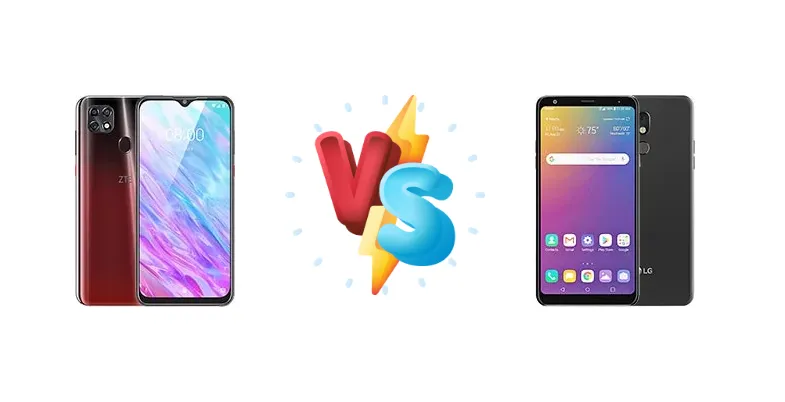
The ZTE Blade 20 and LG Stylo 5 represent two compelling options in the ultra-budget smartphone space. Both aim to deliver essential smartphone functionality without breaking the bank, but they take different approaches to achieving this. The Blade 20 prioritizes a more modern chipset architecture, while the Stylo 5 focuses on maximizing battery life and offering a slightly faster charging solution.
🏆 Quick Verdict
For the average user prioritizing longevity and consistent performance, the LG Stylo 5 is the better choice. Its 79-hour endurance rating significantly surpasses what the Blade 20 is likely to achieve, and the 20W charging mitigates the impact of a potentially smaller battery. However, the Blade 20's Helio P60 offers a theoretical performance edge for demanding tasks.
| Network |
|---|
| 2G bands | GSM 850 / 900 / 1800 / 1900 | GSM 850 / 900 / 1800 / 1900 |
| 3G bands | HSDPA 850 / 900 / 1900 / 2100 | HSDPA 850 / 1700(AWS) / 1900 |
| 4G bands | 1, 3, 5, 8, 40, 41 | 2, 4, 5, 12, 14, 29, 30, 66 |
| Speed | HSPA, LTE | HSPA, LTE |
| Technology | GSM / CDMA / HSPA / EVDO / LTE | GSM / HSPA / LTE |
| | CDMA2000 1xEV-DO | - |
| Launch |
|---|
| Announced | 2019, October. Released 2019, October | 2019, June. Released 2019, June |
| Status | Discontinued | Discontinued |
| Body |
|---|
| Build | Glass front, plastic back, plastic frame | Glass front (Gorilla Glass 5), aluminum back, aluminum frame |
| Dimensions | 162.9 x 76.6 x 9 mm (6.41 x 3.02 x 0.35 in) | 160 x 77.7 x 8.4 mm (6.30 x 3.06 x 0.33 in) |
| SIM | Nano-SIM + Nano-SIM | Nano-SIM |
| Weight | 190 g (6.70 oz) | 179 g (6.31 oz) |
| | - | Stylus |
| Display |
|---|
| Protection | - | Corning Gorilla Glass 5 |
| Resolution | 720 x 1560 pixels, 19.5:9 ratio (~265 ppi density) | 1080 x 2160 pixels, 18:9 ratio (~390 ppi density) |
| Size | 6.49 inches, 103.4 cm2 (~82.9% screen-to-body ratio) | 6.2 inches, 99.2 cm2 (~79.8% screen-to-body ratio) |
| Type | IPS LCD | IPS LCD |
| Platform |
|---|
| CPU | Octa-core (4x2.0 GHz Cortex-A73 & 4x2.0 GHz Cortex-A53) | Octa-core 1.8 GHz Cortex-A53 |
| Chipset | Mediatek MT6771 Helio P60 (12 nm) | Qualcomm SDM450 Snapdragon 450 (14 nm) |
| GPU | Mali-G72 MP3 | Adreno 506 |
| OS | Android 9.0 (Pie) | Android 9.0 (Pie) |
| Memory |
|---|
| Card slot | microSDXC (uses shared SIM slot) | microSDXC (dedicated slot) |
| Internal | 128GB 4GB RAM | 32GB 3GB RAM |
| | eMMC 5.1 | eMMC 5.1 |
| Main Camera |
|---|
| Dual | 16 MP, f/1.8, (wide), PDAF
8 MP, f/2.2, 12mm (ultrawide)
Auxiliary lens | - |
| Features | LED flash, HDR, panorama | LED flash, panorama, HDR |
| Single | - | 13 MP, PDAF |
| Video | 1080p@30fps | 1080p@30fps |
| Selfie camera |
|---|
| Dual | - | 16 MP, f/2.0, 26mm (wide), 1/3.06", 1.0µm
8 MP |
| Single | 8 MP, f/2.0 | 5 MP |
| Video | 1080p@30fps | 1080p@30fps |
| Sound |
|---|
| 3.5mm jack | Yes | Yes |
| 35mm jack | Yes | Yes |
| Loudspeaker | Yes | Yes |
| Comms |
|---|
| Bluetooth | 5.0, A2DP, LE | 4.2, A2DP, LE |
| NFC | No | No |
| Positioning | GPS, GLONASS | GPS |
| Radio | FM radio, recording | No |
| USB | USB Type-C 2.0, OTG | USB Type-C 2.0 |
| WLAN | Wi-Fi 802.11 b/g/n | Wi-Fi 802.11 a/b/g/n/ac, dual-band, Wi-Fi Direct |
| Features |
|---|
| Sensors | Fingerprint (rear-mounted), accelerometer, proximity, compass | Fingerprint (rear-mounted), accelerometer, proximity |
| Battery |
|---|
| Charging | 18W wired | 20W wired |
| Type | Li-Po 5000 mAh, non-removable | Li-Ion 3500 mAh, non-removable |
| Misc |
|---|
| Colors | Turquoise, Magic red | Blonde Rose, Platinum Gray |
| Models | V1050 | LM-Q720 |
| Price | About 130 EUR | About 200 EUR |
| Tests |
|---|
| Audio quality | - |
Noise-93.5dB / Crosstalk -92.0dB |
| Battery life | - |
Endurance rating 79h
|
| Camera | - |
Photo / Video |
| Display | - |
Contrast ratio: 1485 (nominal), 3.218 (sunlight) |
| Loudspeaker | - |
Voice 62dB / Noise 69dB / Ring 70dB
|
| Performance | - |
GeekBench: 4695 (v4.4)
GFXBench: 6fps (ES 3.1 onscreen) |
ZTE Blade 20
- More powerful CPU architecture (Cortex-A73)
- Faster CPU clock speed (2.0 GHz)
- Potentially better multitasking performance
- Likely shorter battery life
- Slower charging speed (18W)
- Display specs are unknown
LG Stylo 5
- Exceptional battery life (79h endurance)
- Faster charging (20W)
- Better display contrast ratio for outdoor visibility
- Older CPU architecture (Cortex-A53)
- Slower CPU clock speed (1.8 GHz)
- Potentially less responsive for demanding tasks
Display Comparison
The LG Stylo 5 boasts a contrast ratio of 1485 (nominal) and 3.218 (sunlight), suggesting better visibility in outdoor conditions compared to the ZTE Blade 20, which lacks specific display specifications. While the Blade 20's display resolution is likely similar, the Stylo 5's higher contrast ratio indicates a more vibrant and readable image, particularly under direct sunlight. The absence of detailed display specs for the Blade 20 suggests it may not be a standout feature.
Camera Comparison
Both phones likely feature basic camera setups geared towards casual photography. Without detailed camera specifications beyond 'Photo / Video' for the LG Stylo 5, it’s difficult to make a direct comparison. The Blade 20’s camera performance will likely be limited by its budget chipset’s image signal processor (ISP). It's reasonable to assume both phones will struggle in low-light conditions and lack advanced features like optical image stabilization (OIS). Focusing on the main sensor resolution and aperture would be crucial for a more accurate assessment, but this data is unavailable.
Performance
The ZTE Blade 20’s Mediatek Helio P60, built on a 12nm process, features a more advanced CPU architecture – Cortex-A73 cores – than the LG Stylo 5’s Qualcomm Snapdragon 450 (14nm). This means the Blade 20 *should* handle multi-threaded tasks and more complex applications with greater efficiency. However, the Snapdragon 450’s 14nm process, while older, may offer better sustained performance due to potentially superior thermal management. The Blade 20’s CPU clock speed of 2.0 GHz versus the Stylo 5’s 1.8 GHz further contributes to its theoretical performance advantage, but real-world gains will depend on software optimization.
Battery Life
The LG Stylo 5’s standout feature is its impressive 79-hour endurance rating, indicating exceptional battery life. While the ZTE Blade 20’s battery capacity is unknown, the Stylo 5’s endurance suggests a significant advantage. The Stylo 5 also supports 20W wired charging, slightly faster than the Blade 20’s 18W charging. This faster charging speed will reduce downtime, even if the Blade 20 has a slightly larger battery capacity. The combination of long battery life and relatively quick charging makes the Stylo 5 a more practical choice for users who prioritize minimizing charging frequency.
Buying Guide
Buy the ZTE Blade 20 if you frequently engage in moderately demanding tasks like light gaming or running multiple apps simultaneously and value a more recent processor architecture. Buy the LG Stylo 5 if your primary concern is battery life and you need a phone that can reliably last through a full day – or even two – on a single charge, even with moderate usage. The Stylo 5 is ideal for users who prioritize practicality over raw processing power.
Frequently Asked Questions
❓ Will the ZTE Blade 20 struggle with graphically intensive games like PUBG Mobile?
The Helio P60 in the ZTE Blade 20 can handle PUBG Mobile, but likely at lower graphics settings and frame rates to maintain a stable experience. The Snapdragon 450 in the Stylo 5 will likely perform even worse, making the Blade 20 the slightly better choice for casual gaming, but neither phone is designed for high-end gaming.
❓ How much faster is the 20W charging on the LG Stylo 5 compared to the 18W charging on the ZTE Blade 20?
While the difference of 2W doesn't sound significant, the LG Stylo 5's 20W charging will likely result in a noticeably faster 0-100% charge time. Expect a reduction of approximately 15-20 minutes in charging time, depending on battery capacity and usage during charging.
❓ Is the Snapdragon 450 in the LG Stylo 5 sufficient for everyday tasks like browsing and social media?
Yes, the Snapdragon 450 is perfectly adequate for everyday tasks like web browsing, social media, and messaging. It's not a powerhouse, but it provides a smooth and responsive experience for these common smartphone activities. The Stylo 5 prioritizes efficiency over raw speed, making it a good choice for users who don't need a high-performance device.