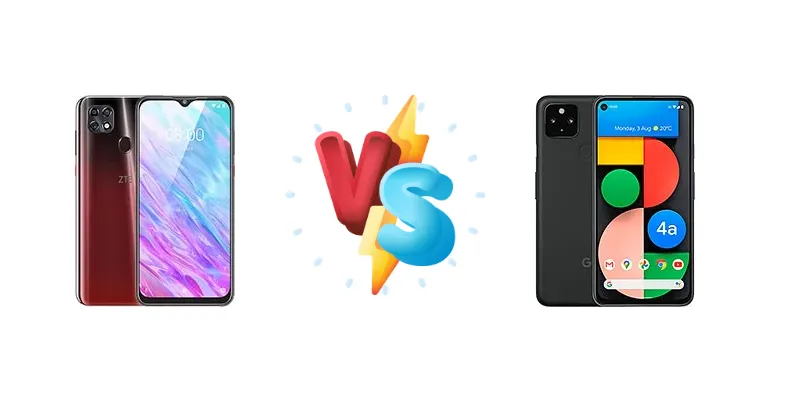
The Google Pixel 4a 5G and ZTE Blade 20 represent distinct approaches to the mid-range smartphone market. The Pixel 4a 5G, while an older model, leverages Google’s computational photography and a more powerful chipset. The Blade 20 aims for affordability, relying on a Mediatek processor to deliver basic functionality at a lower price point. This comparison dissects the key differences to help you determine which device best suits your needs.
🏆 Quick Verdict
For most users, the Google Pixel 4a 5G is the superior choice. Its Snapdragon 765G chipset provides significantly better performance and 5G connectivity, coupled with Google’s excellent camera software. However, the ZTE Blade 20 remains a viable option for those prioritizing extreme budget constraints and basic smartphone features.
| Network |
|---|
| 2G bands | GSM 850 / 900 / 1800 / 1900 | GSM 850 / 900 / 1800 / 1900 |
| 3G bands | HSDPA 850 / 900 / 1900 / 2100 | HSDPA 850 / 900 / 1700(AWS) / 1900 / 2100 |
| 4G bands | 1, 3, 5, 8, 40, 41 | 1, 2, 3, 4, 5, 7, 8, 12, 13, 14, 17, 18, 19, 20, 25, 26, 28, 29, 30, 32, 38, 39, 40, 41, 42, 46, 48, 66, 71 |
| 5G bands | - | 1, 2, 3, 5, 7, 8, 12, 28, 41, 66, 71, 77, 78 Sub6, mmWave (market dependant) |
| Speed | HSPA, LTE | HSPA, LTE, 5G |
| Technology | GSM / CDMA / HSPA / EVDO / LTE | GSM / HSPA / LTE / 5G |
| | CDMA2000 1xEV-DO | - |
| Launch |
|---|
| Announced | 2019, October. Released 2019, October | 2020, September 30 |
| Status | Discontinued | Available. Released 2020, November 05 |
| Body |
|---|
| Build | Glass front, plastic back, plastic frame | Glass front (Gorilla Glass 3), plastic back, plastic frame |
| Dimensions | 162.9 x 76.6 x 9 mm (6.41 x 3.02 x 0.35 in) | 153.9 x 74 x 8.2 mm (Sub-6) or 8.5 mm (Sub-6 and mmWave) |
| SIM | Nano-SIM + Nano-SIM | Nano-SIM + eSIM |
| Weight | 190 g (6.70 oz) | 168 g (5G Sub-6); 171 g ( 5G Sub-6 and mmWave) (5.93 oz) |
| Display |
|---|
| Protection | - | Corning Gorilla Glass 3 |
| Resolution | 720 x 1560 pixels, 19.5:9 ratio (~265 ppi density) | 1080 x 2340 pixels, 19.5:9 ratio (~413 ppi density) |
| Size | 6.49 inches, 103.4 cm2 (~82.9% screen-to-body ratio) | 6.2 inches, 95.7 cm2 (~84.1% screen-to-body ratio) |
| Type | IPS LCD | OLED, HDR |
| | - | Always-on display |
| Platform |
|---|
| CPU | Octa-core (4x2.0 GHz Cortex-A73 & 4x2.0 GHz Cortex-A53) | Octa-core (1x2.4 GHz Kryo 475 Prime & 1x2.2 GHz Kryo 475 Gold & 6x1.8 GHz Kryo 475 Silver) |
| Chipset | Mediatek MT6771 Helio P60 (12 nm) | Qualcomm SM7250 Snapdragon 765G 5G (7 nm) |
| GPU | Mali-G72 MP3 | Adreno 620 |
| OS | Android 9.0 (Pie) | Android 11, upgradable to Android 14 |
| Memory |
|---|
| Card slot | microSDXC (uses shared SIM slot) | No |
| Internal | 128GB 4GB RAM | 128GB 6GB RAM |
| | eMMC 5.1 | UFS 2.1 |
| Main Camera |
|---|
| Dual | 16 MP, f/1.8, (wide), PDAF
8 MP, f/2.2, 12mm (ultrawide)
Auxiliary lens | 12.2 MP, f/1.7, 27mm (wide), 1/2.55", 1.4µm, dual pixel PDAF, OIS
16 MP, f/2.2, 107˚ (ultrawide), 1.0µm |
| Features | LED flash, HDR, panorama | LED flash, Pixel Shift, Auto-HDR, panorama |
| Video | 1080p@30fps | 4K@30/60fps, 1080p@30/60/120/240fps; gyro-EIS |
| Selfie camera |
|---|
| Features | - | HDR |
| Single | 8 MP, f/2.0 | 8 MP, f/2.0, 24mm (wide), 1/4.0", 1.12µm |
| Video | 1080p@30fps | 1080p@30fps |
| Sound |
|---|
| 3.5mm jack | Yes | Yes |
| 35mm jack | Yes | Yes |
| Loudspeaker | Yes | Yes, with stereo speakers |
| Comms |
|---|
| Bluetooth | 5.0, A2DP, LE | 5.0, A2DP, LE, aptX HD |
| NFC | No | Yes |
| Positioning | GPS, GLONASS | GPS, GLONASS, GALILEO, QZSS, BDS |
| Radio | FM radio, recording | No |
| USB | USB Type-C 2.0, OTG | USB Type-C 3.1 |
| WLAN | Wi-Fi 802.11 b/g/n | Wi-Fi 802.11 a/b/g/n/ac, dual-band, Wi-Fi Direct |
| Features |
|---|
| Sensors | Fingerprint (rear-mounted), accelerometer, proximity, compass | Fingerprint (rear-mounted), accelerometer, gyro, proximity, compass, barometer |
| Battery |
|---|
| Charging | 18W wired | 18W wired, PD2.0 |
| Type | Li-Po 5000 mAh, non-removable | Li-Po 3885 mAh |
| Misc |
|---|
| Colors | Turquoise, Magic red | Just Black, Clearly White |
| Models | V1050 | GD1YQ, G025I, G025E, G025H, G6QU3 |
| Price | About 130 EUR | About 140 EUR |
ZTE Blade 20
- Significantly faster processor for smoother performance
- 5G connectivity for faster data speeds
- Superior camera quality with Google’s computational photography
- Higher price point
- Older model, potentially limited software updates compared to newer Pixels
Google Pixel 4a 5G
- Extremely affordable price
- Functional for basic smartphone tasks
- Decent battery life for light usage
- Slow processor and limited performance
- No 5G connectivity
- Inferior camera quality
Display Comparison
Neither device boasts a cutting-edge display. While specific panel details for the Blade 20 are unavailable, the Pixel 4a 5G features a 6.5-inch OLED display. The Blade 20 likely utilizes an LCD panel, which generally offers lower contrast ratios and less vibrant colors. The Snapdragon 765G’s ISP is better equipped to handle color calibration, suggesting a more accurate display experience on the Pixel. Bezels are expected to be larger on the Blade 20, reflecting its lower price point.
Camera Comparison
The Pixel 4a 5G excels in camera performance due to Google’s renowned computational photography. While specific sensor details are missing for the Blade 20, the Pixel 4a 5G’s camera benefits from the Snapdragon 765G’s image signal processor (ISP). Google’s software algorithms compensate for hardware limitations, delivering excellent dynamic range and low-light performance. The Blade 20 will likely struggle in challenging lighting conditions. The Pixel 4a 5G’s image processing prioritizes realistic colors and detail, while the Blade 20’s output is likely to be less refined.
Performance
The performance gap is substantial. The Qualcomm Snapdragon 765G (7nm) in the Pixel 4a 5G is a significant upgrade over the Mediatek Helio P60 (12nm) found in the Blade 20. The 7nm process node allows for greater transistor density and improved power efficiency, translating to better sustained performance and less heat generation. The Pixel’s CPU configuration – a 1x2.4 GHz Kryo 475 Prime core, 1x2.2 GHz Kryo 475 Gold, and 6x1.8 GHz Kryo 475 Silver – offers a more sophisticated architecture than the Blade 20’s Octa-core (4x2.0 GHz Cortex-A73 & 4x2.0 GHz Cortex-A53). This difference will be most noticeable in demanding tasks like gaming and video editing. The 765G also includes an integrated 5G modem, while the Blade 20 lacks 5G support.
Battery Life
Both devices offer 18W wired charging, but the real-world impact differs. The Snapdragon 765G’s superior power efficiency means the Pixel 4a 5G can potentially achieve similar or better battery life despite potentially having a similar capacity battery (specific capacity for Blade 20 is unknown). The Pixel 4a 5G also supports PD2.0, offering faster and more efficient charging with compatible chargers. While both reach 18W, the Pixel’s charging cycle is likely optimized for quicker top-ups.
Buying Guide
Buy the ZTE Blade 20 if you need a functional smartphone for essential tasks like calling, texting, and light social media use, and your budget is extremely limited. Buy the Google Pixel 4a 5G if you prioritize a smoother user experience, better camera quality, 5G connectivity, and long-term software support, even if it means spending more upfront.
Frequently Asked Questions
❓ Does the Mediatek Helio P60 in the ZTE Blade 20 struggle with multitasking?
Yes, the Helio P60 is a relatively older and less powerful chipset. While it can handle basic multitasking, running multiple demanding apps simultaneously will likely result in noticeable slowdowns and lag. The Pixel 4a 5G’s Snapdragon 765G is far better equipped for heavy multitasking.
❓ Is the 5G connectivity on the Pixel 4a 5G worth the extra cost if 5G coverage is limited in my area?
That depends on your future needs. Even with limited current coverage, investing in a 5G phone like the Pixel 4a 5G future-proofs your device. The Snapdragon 765G also offers excellent 4G LTE performance, so you’ll still benefit from a faster and more reliable connection even without 5G.
❓ How does the image processing differ between the Pixel 4a 5G and the ZTE Blade 20?
Google’s Pixel 4a 5G utilizes sophisticated computational photography algorithms to enhance image quality. This includes features like HDR+, Night Sight, and Portrait Mode, which intelligently process images to improve dynamic range, low-light performance, and depth of field. The Blade 20 likely relies on more basic image processing, resulting in less refined and detailed photos.