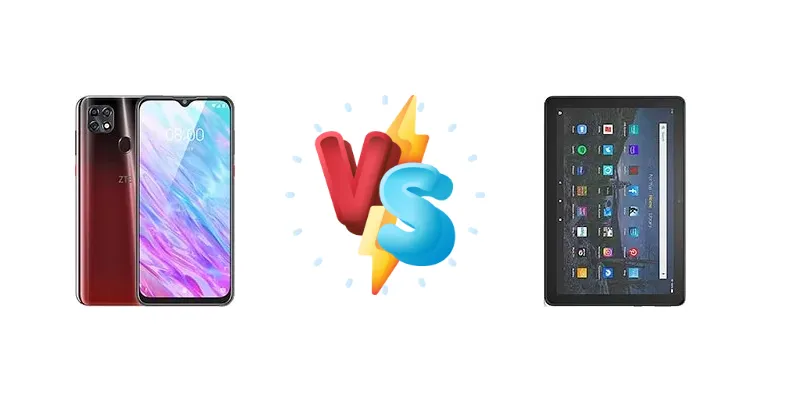
The ZTE Blade 20 and Amazon Fire HD 10 Plus (2021) represent distinct approaches to the budget tablet market. The Blade 20 aims for a standard Android experience, while the Fire HD 10 Plus prioritizes Amazon’s ecosystem and content consumption. Both devices utilize Mediatek’s Helio P60 series, but subtle variations and software choices create a surprisingly nuanced comparison.
🏆 Quick Verdict
For users deeply embedded in the Amazon ecosystem, the Fire HD 10 Plus (2021) is the clear winner, thanks to its wireless charging and optimized Fire OS experience. However, the ZTE Blade 20 offers a more versatile Android experience and potentially better performance for non-Amazon tasks, making it ideal for those seeking a general-purpose tablet.
| Network |
|---|
| 2G bands | GSM 850 / 900 / 1800 / 1900 | N/A |
| 3G bands | HSDPA 850 / 900 / 1900 / 2100 | - |
| 4G bands | 1, 3, 5, 8, 40, 41 | - |
| EDGE | - | No |
| GPRS | - | No |
| Speed | HSPA, LTE | - |
| Technology | GSM / CDMA / HSPA / EVDO / LTE | No cellular connectivity |
| | CDMA2000 1xEV-DO | - |
| Launch |
|---|
| Announced | 2019, October. Released 2019, October | 2021, April 27. Released 2021, May 26 |
| Status | Discontinued | Discontinued |
| Body |
|---|
| Build | Glass front, plastic back, plastic frame | - |
| Dimensions | 162.9 x 76.6 x 9 mm (6.41 x 3.02 x 0.35 in) | 247 x 166 x 9.2 mm (9.72 x 6.54 x 0.36 in) |
| SIM | Nano-SIM + Nano-SIM | No |
| Weight | 190 g (6.70 oz) | 468 g (1.03 lb) |
| Display |
|---|
| Protection | - | Aluminosilicate glass |
| Resolution | 720 x 1560 pixels, 19.5:9 ratio (~265 ppi density) | 1920 x 1200 pixels, 16:10 ratio (~224 ppi density) |
| Size | 6.49 inches, 103.4 cm2 (~82.9% screen-to-body ratio) | 10.1 inches, 295.8 cm2 (~72.1% screen-to-body ratio) |
| Type | IPS LCD | IPS LCD |
| Platform |
|---|
| CPU | Octa-core (4x2.0 GHz Cortex-A73 & 4x2.0 GHz Cortex-A53) | Octa-core (4x2.0 GHz Cortex-A73 & 4x2.0 GHz Cortex-A53) |
| Chipset | Mediatek MT6771 Helio P60 (12 nm) | Mediatek MT8183 Helio P60T (12 nm) |
| GPU | Mali-G72 MP3 | Mali-G72 MP3 |
| OS | Android 9.0 (Pie) | Android 9.0 (Pie), Fire OS 7 |
| Memory |
|---|
| Card slot | microSDXC (uses shared SIM slot) | microSDXC (dedicated slot) |
| Internal | 128GB 4GB RAM | 32GB 4GB RAM, 64GB 4GB RAM |
| | eMMC 5.1 | eMMC 5.1 |
| Main Camera |
|---|
| Dual | 16 MP, f/1.8, (wide), PDAF
8 MP, f/2.2, 12mm (ultrawide)
Auxiliary lens | - |
| Features | LED flash, HDR, panorama | - |
| Single | - | 5 MP |
| Video | 1080p@30fps | 720p |
| Selfie camera |
|---|
| Single | 8 MP, f/2.0 | 2 MP |
| Video | 1080p@30fps | 720p |
| Sound |
|---|
| 3.5mm jack | Yes | Yes |
| 35mm jack | Yes | Yes |
| Loudspeaker | Yes | Yes, with stereo speakers |
| Comms |
|---|
| Bluetooth | 5.0, A2DP, LE | 5.0, A2DP, LE |
| NFC | No | No |
| Positioning | GPS, GLONASS | No |
| Radio | FM radio, recording | No |
| USB | USB Type-C 2.0, OTG | USB Type-C 2.0, OTG |
| WLAN | Wi-Fi 802.11 b/g/n | Wi-Fi 802.11 a/b/g/n/ac, dual-band |
| Features |
|---|
| Sensors | Fingerprint (rear-mounted), accelerometer, proximity, compass | Accelerometer |
| | - | Text-to-Speech English-language content reader |
| Battery |
|---|
| Charging | 18W wired | Wireless |
| Type | Li-Po 5000 mAh, non-removable | Li-Ion |
| Misc |
|---|
| Colors | Turquoise, Magic red | Slate |
| Models | V1050 | T76N2P |
| Price | About 130 EUR | About 150 EUR |
ZTE Blade 20
- Standard Android OS offers greater app compatibility.
- Potentially better performance for non-Amazon tasks.
- Wired charging is still a reliable option.
- Lacks wireless charging convenience.
- May require more manual software updates.
Amazon Fire HD 10 Plus (2021)
- Wireless charging for added convenience.
- Fire OS optimized for Amazon content consumption.
- Alexa integration for voice control.
- Fire OS is a heavily customized experience, limiting app choices.
- Reliance on the Amazon ecosystem.
Display Comparison
While both tablets likely feature 10.1-inch displays, detailed display specs (resolution, panel type, brightness) are unavailable. However, the Fire HD 10 Plus benefits from Amazon’s software optimizations for content viewing. The Blade 20, running standard Android, will offer a more customizable display experience, but potentially less vibrant colors out of the box. The absence of detailed specs makes a definitive brightness or color accuracy comparison impossible.
Camera Comparison
Camera performance is unlikely to be a key strength for either device. Given the target market, both likely feature basic camera setups. Without specific sensor details, it’s difficult to assess image quality. Focusing on the chipset, the Helio P60’s ISP (Image Signal Processor) is capable of decent image processing, but limitations in sensor quality will likely be the bottleneck. We can assume both will struggle in low-light conditions.
Performance
Both the ZTE Blade 20 and the Amazon Fire HD 10 Plus (2021) are powered by Mediatek’s Helio P60 chipset, featuring an octa-core CPU with the same core configuration (4x2.0 GHz Cortex-A73 & 4x2.0 GHz Cortex-A53). However, the Fire HD 10 Plus utilizes the Helio P60T variant. The 'T' designation typically indicates a slightly higher clock speed or optimized power efficiency, but the practical performance difference will be minimal for most users. The real differentiator is software; Fire OS is heavily customized and optimized for media consumption, potentially leading to smoother video playback, while the Blade 20’s Android experience will be more responsive for general app usage.
Battery Life
Battery capacity is not specified for either device. However, the Amazon Fire HD 10 Plus (2021) gains a significant advantage with its support for wireless charging. This adds convenience, especially for users who frequently use the tablet for extended periods. The ZTE Blade 20 relies on 18W wired charging, which is adequate but lacks the flexibility of wireless charging. Real-world battery life will depend heavily on usage patterns, but the Fire HD 10 Plus’s wireless charging capability provides a clear usability benefit.
Buying Guide
Buy the ZTE Blade 20 if you need a tablet running standard Android with access to the Google Play Store and a wider range of apps. It’s best for users who want a flexible device for productivity, browsing, and light gaming. Buy the Amazon Fire HD 10 Plus (2021) if you primarily consume Amazon content (Prime Video, Kindle books, music) and value the convenience of Alexa integration and wireless charging. It’s a dedicated media consumption device.
Frequently Asked Questions
❓ Does the Fire OS on the Amazon Fire HD 10 Plus (2021) limit my app choices compared to the ZTE Blade 20?
Yes, Fire OS is based on Android but lacks full Google Play Store support. While Amazon’s Appstore offers a selection of apps, it’s significantly smaller than the Google Play Store. The ZTE Blade 20, running standard Android, provides access to the full Google Play Store ecosystem.
❓ Is the slightly different Helio P60T chipset in the Fire HD 10 Plus (2021) noticeably faster than the Helio P60 in the ZTE Blade 20?
The difference between the Helio P60 and Helio P60T is typically marginal. The 'T' variant may offer a slight clock speed boost or power efficiency improvement, but this won’t translate into a dramatic performance difference in everyday use. Software optimization plays a larger role in perceived speed.
❓ Can I easily sideload apps onto the Amazon Fire HD 10 Plus (2021) if they aren't available in the Amazon Appstore?
Yes, sideloading apps onto the Fire HD 10 Plus is possible, but it requires enabling developer options and manually installing APK files. This process is more complex than simply downloading from the Google Play Store and is not officially supported by Amazon.