
ZTE Blade 20 Pro 5G vs. Google Pixel 4a 5G: A Deep Dive into Identical Chipsets, Different Experiences
| Phones Images | |||||
|---|---|---|---|---|---|
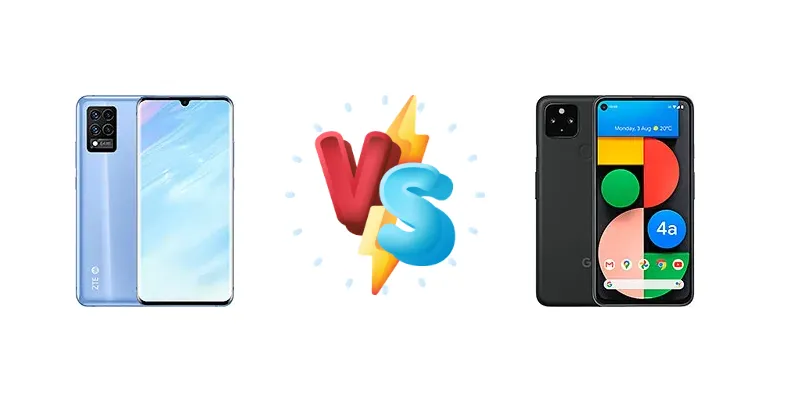
|
🏆 Quick Verdict
For the average user prioritizing software support and camera quality, the Google Pixel 4a 5G is the superior choice. While the ZTE Blade 20 Pro 5G offers a competitive feature set, Google’s software optimization and image processing provide a more refined and consistent experience. However, the ZTE is a strong contender for budget-conscious users.
| PHONES | ||
|---|---|---|
| Phone Names | ZTE Blade 20 Pro 5G | Google Pixel 4a 5G |
| Network | ||
|---|---|---|
| 2G bands | GSM 850 / 900 / 1800 / 1900 | GSM 850 / 900 / 1800 / 1900 |
| 3G bands | HSDPA 850 / 900 / 1700(AWS) / 1900 / 2100 | HSDPA 850 / 900 / 1700(AWS) / 1900 / 2100 |
| 4G bands | 1, 3, 4, 5, 7, 8, 12, 17, 20, 34, 38, 39, 40, 41 | 1, 2, 3, 4, 5, 7, 8, 12, 13, 14, 17, 18, 19, 20, 25, 26, 28, 29, 30, 32, 38, 39, 40, 41, 42, 46, 48, 66, 71 |
| 5G bands | 1, 3, 41, 78, 79 SA/NSA | 1, 2, 3, 5, 7, 8, 12, 28, 41, 66, 71, 77, 78 Sub6, mmWave (market dependant) |
| Speed | HSPA, LTE, 5G | HSPA, LTE, 5G |
| Technology | GSM / CDMA / HSPA / LTE / 5G | GSM / HSPA / LTE / 5G |
| CDMA 800 | - | |
| Launch | ||
|---|---|---|
| Announced | 2020, November 30. Released 2021, January 04 | 2020, September 30 |
| Status | Discontinued | Available. Released 2020, November 05 |
| Body | ||
|---|---|---|
| Build | - | Glass front (Gorilla Glass 3), plastic back, plastic frame |
| Dimensions | 159.2 x 73.4 x 7.9 mm (6.27 x 2.89 x 0.31 in) | 153.9 x 74 x 8.2 mm (Sub-6) or 8.5 mm (Sub-6 and mmWave) |
| SIM | Nano-SIM + Nano-SIM | Nano-SIM + eSIM |
| Weight | 168 g (5.93 oz) | 168 g (5G Sub-6); 171 g ( 5G Sub-6 and mmWave) (5.93 oz) |
| Display | ||
|---|---|---|
| Protection | - | Corning Gorilla Glass 3 |
| Resolution | 1080 x 2340 pixels, 19.5:9 ratio (~398 ppi density) | 1080 x 2340 pixels, 19.5:9 ratio (~413 ppi density) |
| Size | 6.47 inches, 102.8 cm2 (~87.9% screen-to-body ratio) | 6.2 inches, 95.7 cm2 (~84.1% screen-to-body ratio) |
| Type | AMOLED | OLED, HDR |
| - | Always-on display | |
| Platform | ||
|---|---|---|
| CPU | Octa-core (1x2.4 GHz Kryo 475 Prime & 1x2.2 GHz Kryo 475 Gold & 6x1.8 GHz Kryo 475 Silver) | Octa-core (1x2.4 GHz Kryo 475 Prime & 1x2.2 GHz Kryo 475 Gold & 6x1.8 GHz Kryo 475 Silver) |
| Chipset | Qualcomm SM7250 Snapdragon 765G 5G (7 nm) | Qualcomm SM7250 Snapdragon 765G 5G (7 nm) |
| GPU | Adreno 620 | Adreno 620 |
| OS | Android 10, MiFavor 10 | Android 11, upgradable to Android 14 |
| Memory | ||
|---|---|---|
| Card slot | microSDXC (uses shared SIM slot) | No |
| Internal | 128GB 8GB RAM | 128GB 6GB RAM |
| - | UFS 2.1 | |
| Main Camera | ||
|---|---|---|
| Dual | - | 12.2 MP, f/1.7, 27mm (wide), 1/2.55", 1.4µm, dual pixel PDAF, OIS 16 MP, f/2.2, 107˚ (ultrawide), 1.0µm |
| Features | LED flash, panorama, HDR | LED flash, Pixel Shift, Auto-HDR, panorama |
| Quad | 64 MP, f/1.9, 25mm (wide), 1/1.72", 0.8µm, PDAF 8 MP, f/2.2, 120˚, 16mm (ultrawide) 2 MP (macro) Auxiliary lens | - |
| Video | 4K@30/60fps, 1080p@30fps; gyro-EIS | 4K@30/60fps, 1080p@30/60/120/240fps; gyro-EIS |
| Selfie camera | ||
|---|---|---|
| Features | HDR | HDR |
| Single | 20 MP, f/2.0, (wide), 1/2.8", 1.0µm | 8 MP, f/2.0, 24mm (wide), 1/4.0", 1.12µm |
| Video | 1080p@30fps | 1080p@30fps |
| Sound | ||
|---|---|---|
| 3.5mm jack | No | Yes |
| 35mm jack | No | Yes |
| Loudspeaker | Yes | Yes, with stereo speakers |
| 24-bit/192kHz audio | - | |
| Comms | ||
|---|---|---|
| Bluetooth | 5.1, A2DP, LE | 5.0, A2DP, LE, aptX HD |
| NFC | Yes | Yes |
| Positioning | GPS, GLONASS, GALILEO, BDS | GPS, GLONASS, GALILEO, QZSS, BDS |
| Radio | No | No |
| USB | USB Type-C 3.1 | USB Type-C 3.1 |
| WLAN | Wi-Fi 802.11 a/b/g/n/ac, dual-band, Wi-Fi Direct | Wi-Fi 802.11 a/b/g/n/ac, dual-band, Wi-Fi Direct |
| Features | ||
|---|---|---|
| Sensors | Fingerprint (under display, optical), accelerometer, gyro, proximity, compass | Fingerprint (rear-mounted), accelerometer, gyro, proximity, compass, barometer |
| Battery | ||
|---|---|---|
| Charging | 18W wired, QC4 | 18W wired, PD2.0 |
| Type | Li-Ion 4000 mAh | Li-Po 3885 mAh |
| Misc | ||
|---|---|---|
| Colors | Blue | Just Black, Clearly White |
| Models | - | GD1YQ, G025I, G025E, G025H, G6QU3 |
| Price | About 350 EUR | About 140 EUR |
ZTE Blade 20 Pro 5G
- Potentially faster charging with Quick Charge 4.0
- Likely more affordable price point
- Potentially better thermal management due to larger chassis
- Less refined software experience
- Inferior camera image processing compared to Pixel
- Uncertainty regarding long-term software support
Google Pixel 4a 5G
- Clean and optimized Android experience
- Guaranteed software updates from Google
- Excellent camera performance with computational photography
- Slightly higher price
- May charge slightly slower than ZTE with QC4
- Potentially more susceptible to thermal throttling
Display Comparison
Both devices lack detailed display specifications in the provided data. However, given their market positioning, we can infer that both likely utilize LCD panels. The absence of information regarding refresh rates suggests a standard 60Hz experience on both. The real-world difference will likely come down to color calibration and peak brightness, areas where Google typically excels with its display tuning. Bezels are likely comparable, reflecting the mid-range nature of both devices.
Camera Comparison
Without detailed sensor information, a direct camera comparison is difficult. However, Google’s computational photography prowess is a significant advantage. The Pixel 4a 5G’s image processing algorithms are renowned for their dynamic range and detail preservation, even in challenging lighting conditions. While the ZTE Blade 20 Pro 5G may have a higher megapixel count on some sensors, the Pixel’s software optimization will likely result in superior image quality. The absence of OIS information suggests neither phone prioritizes optical image stabilization.
Performance
The core of both phones is the Qualcomm SM7250 Snapdragon 765G, featuring an octa-core CPU configuration (1x2.4 GHz Kryo 475 Prime, 1x2.2 GHz Kryo 475 Gold, and 6x1.8 GHz Kryo 475 Silver). This means CPU performance will be virtually identical. The GPU performance will also be nearly indistinguishable. The key differentiator will be thermal management. ZTE’s larger chassis *could* allow for slightly better heat dissipation, potentially preventing throttling during extended gaming sessions, but this is speculative without testing. Both devices likely utilize LPDDR4X RAM, standard for this chipset.
Battery Life
Both phones support 18W wired charging, but utilize different standards: ZTE employs Quick Charge 4.0 (QC4), while Google opts for Power Delivery 2.0 (PD2.0). While the wattage is the same, QC4 is often more efficient, potentially leading to slightly faster charging times with a compatible charger. The actual 0-100% charge time will depend on the battery capacity of each device (not provided), but the difference is unlikely to be substantial. The real-world battery life will depend on software optimization and user habits.
Buying Guide
Buy the ZTE Blade 20 Pro 5G if you need a feature-rich 5G phone at the lowest possible price and are comfortable with a less polished software experience. You'll benefit from potentially faster charging speeds with Quick Charge 4.0 compatibility. Buy the Google Pixel 4a 5G if you prioritize a clean Android experience, guaranteed software updates, and a consistently excellent camera, even if it means paying a slight premium.