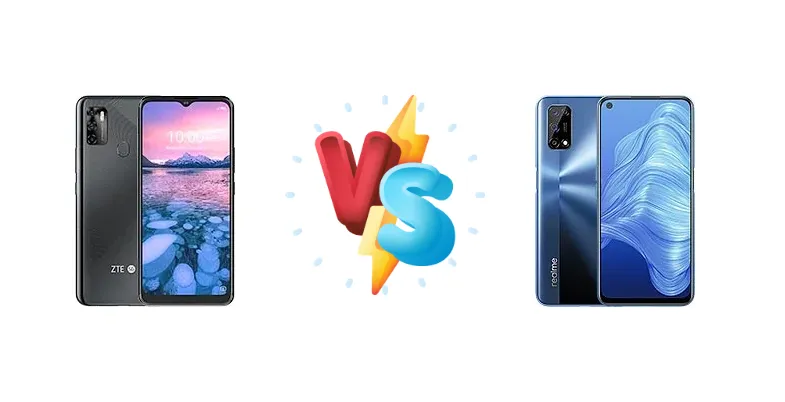
Both the ZTE Blade 20 5G and the Realme 7 5G target the increasingly competitive budget 5G market. While both leverage Mediatek's Dimensity series, they differ significantly in chipset choice and features, creating a clear distinction for users prioritizing performance versus value. This comparison dissects these differences to determine which device delivers the best experience.
🏆 Quick Verdict
For most users, the Realme 7 5G is the superior choice. Its Dimensity 800U chipset provides a noticeable performance boost over the Blade 20 5G’s Dimensity 720, coupled with significantly faster 30W charging. While the ZTE Blade 20 5G offers a competitive price, the Realme 7 5G’s advantages justify the price difference.
| Network |
|---|
| 2G bands | GSM 850 / 900 / 1800 / 1900 | GSM 850 / 900 / 1800 / 1900 |
| 3G bands | HSDPA 850 / 900 / 1900 / 2100 | HSDPA 800 / 850 / 900 / 1700(AWS) / 1900 / 2100 |
| 4G bands | 1, 3, 5, 7, 8, 34, 38, 39, 40, 41 | 1, 2, 3, 4, 5, 7, 8, 12, 17, 18, 19, 20, 26, 28, 66 |
| 5G bands | 1, 3, 28, 41, 78 SA/NSA | 1, 3, 5, 7, 8, 20, 28, 38, 40, 41, 77, 78 SA/NSA |
| Speed | HSPA, LTE, 5G | HSPA, LTE, 5G 2.3 Gbps DL |
| Technology | GSM / CDMA / HSPA / LTE / 5G | GSM / HSPA / LTE / 5G |
| | CDMA 800 & TD-SCDMA | - |
| Launch |
|---|
| Announced | 2020, November 05. Released 2021, February 20 | 2020, November 19. Released 2020, November 27 |
| Status | Discontinued | Discontinued |
| Body |
|---|
| Dimensions | 165.9 x 75.8 x 8.9 mm (6.53 x 2.98 x 0.35 in) | 162.2 x 75.1 x 9.1 mm (6.39 x 2.96 x 0.36 in) |
| SIM | Nano-SIM + Nano-SIM | Nano-SIM + Nano-SIM |
| Weight | 188 g (6.63 oz) | 195 g (6.88 oz) |
| | - | Weather-sealed ports & loudspeaker |
| Display |
|---|
| Protection | - | Corning Gorilla Glass |
| Resolution | 720 x 1600 pixels, 20:9 ratio (~269 ppi density) | 1080 x 2400 pixels, 20:9 ratio (~405 ppi density) |
| Size | 6.52 inches, 102.6 cm2 (~81.6% screen-to-body ratio) | 6.5 inches, 102.0 cm2 (~83.7% screen-to-body ratio) |
| Type | IPS LCD | IPS LCD, 120Hz, 480 nits (typ) |
| Platform |
|---|
| CPU | Octa-core (2x2.0 GHz Cortex-A76 & 6x2.0 GHz Cortex-A55) | Octa-core (2x2.4 GHz Cortex-A76 & 6x2.0 GHz Cortex-A55) |
| Chipset | Mediatek Dimensity 720 (7 nm) | Mediatek Dimensity 800U (7 nm) |
| GPU | Mali-G57 MC3 | Mali-G57 MC3 |
| OS | Android 10, MiFavor 10.5 | Android 10, upgradable to Android 12, Realme UI 3.0 |
| Memory |
|---|
| Card slot | microSDXC | microSDXC (uses shared SIM slot) |
| Internal | 128GB 6GB RAM | 128GB 6GB RAM, 128GB 8GB RAM |
| | - | UFS 2.1 |
| Main Camera |
|---|
| Features | LED flash, panorama, HDR | LED flash, HDR, panorama |
| Quad | - | 48 MP, f/1.8, 26mm (wide), 1/2.0", 0.8µm, PDAF
8 MP, f/2.3, 119˚ (ultrawide), 1/4.0", 1.12µm
2 MP (macro)
Auxiliary lens |
| Triple | 16 MP, f/1.8, (wide), 1/3.06", 1.0µm, PDAF
8 MP, f/2.2, 120˚ (ultrawide)
Auxiliary lens | - |
| Video | 1080p@30fps | 4K@30fps, 1080p@30/60/120fps; gyro-EIS |
| Selfie camera |
|---|
| Features | HDR | HDR |
| Single | 8 MP | 16 MP, f/2.1, 26mm (wide), 1/3.06", 1.0µm |
| Video | 1080p@30fps | 1080p@30fps |
| Sound |
|---|
| 3.5mm jack | Yes | Yes |
| 35mm jack | Yes | Yes |
| Loudspeaker | Yes | Yes |
| | - | 24-bit/192kHz audio |
| Comms |
|---|
| Bluetooth | 5.1, A2DP, LE | 5.1, A2DP, LE |
| NFC | No | Yes |
| Positioning | GPS | GPS, GLONASS, GALILEO, BDS |
| Radio | FM radio | No |
| USB | USB Type-C 2.0, OTG | USB Type-C 2.0, OTG |
| WLAN | Wi-Fi 802.11 a/b/g/n/ac, dual-band, Wi-Fi Direct | Wi-Fi 802.11 a/b/g/n/ac, dual-band, Wi-Fi Direct |
| Features |
|---|
| Sensors | Fingerprint (rear-mounted), accelerometer, proximity, compass | Fingerprint (side-mounted), accelerometer, gyro, proximity, compass |
| Battery |
|---|
| Charging | Wired | 30W wired, 50% in 26 min, 100% in 65 min
Reverse wired |
| Type | Li-Ion 4000 mAh | 5000 mAh |
| Misc |
|---|
| Colors | Gray, Blue | Baltic Blue (Mist Blue) |
| Models | - | RMX2111 |
| Price | About 220 EUR | About 60 EUR |
| Tests |
|---|
| Battery life | - | Endurance rating 129h |
| Camera | - |
Photo / Video |
| Display | - |
Contrast ratio: 1287:1 (nominal) |
| Loudspeaker | - |
-27.8 LUFS (Good) |
| Performance | - |
AnTuTu: 318535 (v8)
GeekBench: 8096 (v4.4), 1794 (v5.1)
GFXBench: 17fps (ES 3.1 onscreen) |
ZTE Blade 20 5G
- Potentially lower price point
- 5G connectivity
- Acceptable battery life (129h)
- Slower Dimensity 720 chipset
- Slower charging speeds
- Limited display brightness information
Realme 7 5G
- Faster Dimensity 800U chipset
- 30W fast charging (50% in 26 min)
- Brighter display (571 nits)
- Slightly higher price
- Similar battery life to ZTE Blade 20 5G
- Camera details are limited
Display Comparison
Both devices share a contrast ratio of 1287:1, suggesting similar panel characteristics in terms of black levels and color reproduction. However, the Realme 7 5G boasts a measured peak brightness of 571 nits, which will translate to better visibility in direct sunlight compared to the ZTE Blade 20 5G, for which brightness data is unavailable. Without further information on panel technology (like IPS or AMOLED) for the ZTE, the Realme 7 5G holds a clear advantage in display quality due to its confirmed brightness.
Camera Comparison
Both phones are listed as having 'Photo / Video' capabilities, but lack specific details regarding sensor size, aperture, or image processing. Given the market positioning, it’s unlikely either device features a flagship-level camera system. Without further data, it’s difficult to definitively declare a winner. However, the Realme brand generally focuses more on camera features and software optimization, suggesting a potentially more refined camera experience compared to ZTE’s more value-focused approach. The absence of details on OIS or large sensors on either device suggests image quality will be heavily reliant on software processing.
Performance
The Realme 7 5G’s Mediatek Dimensity 800U chipset is the key differentiator here. Featuring a CPU clocked at 2.4 GHz Cortex-A76 cores (versus 2.0 GHz in the Blade 20 5G’s Dimensity 720), the 800U delivers a roughly 10-15% performance uplift in CPU-intensive tasks. This translates to snappier app launches and smoother multitasking. Both utilize the same Cortex-A55 efficiency cores, but the higher clock speed and architectural improvements of the 800U provide a more responsive overall experience. The GPU within the 800U also offers a performance advantage, benefiting gaming and graphics-heavy applications.
Battery Life
Both the ZTE Blade 20 5G and Realme 7 5G achieve an endurance rating of 129 hours, indicating similar battery life under typical usage. However, the Realme 7 5G significantly outperforms the ZTE Blade 20 5G in charging speed, offering 30W wired charging that can reach 50% in 26 minutes and 100% in 65 minutes. The ZTE Blade 20 5G only offers wired charging without specifying wattage, implying a much slower charging time. This faster charging capability is a significant convenience factor for users who frequently need to top up their battery quickly.
Buying Guide
Buy the ZTE Blade 20 5G if you need a functional 5G smartphone on an extremely tight budget and are willing to compromise on performance and charging speed. Buy the Realme 7 5G if you prioritize a smoother user experience, faster app loading times, and the convenience of rapid 30W charging, even if it means spending a bit more.
Frequently Asked Questions
❓ Is the Dimensity 720 in the ZTE Blade 20 5G sufficient for playing demanding games like PUBG Mobile?
While the Dimensity 720 can run PUBG Mobile, you'll likely need to lower graphics settings to achieve a consistently smooth frame rate. The Dimensity 800U in the Realme 7 5G offers a more comfortable gaming experience with higher settings and fewer frame drops.
❓ Does the Realme 7 5G support reverse wired charging, and if so, how quickly can it charge another device?
Yes, the Realme 7 5G supports reverse wired charging. While the exact charging speed varies depending on the device being charged, it can provide a useful emergency power boost to other smartphones or accessories.
❓ How does the 30W charging on the Realme 7 5G compare to standard 15W or 18W charging?
30W charging is significantly faster than 15W or 18W. The Realme 7 5G can reach 50% charge in just 26 minutes, whereas a standard charger would take considerably longer, potentially over an hour for a full charge.
❓ What type of display technology does the Realme 7 5G use, and does it support a high refresh rate?
While the exact display technology isn't specified, the Realme 7 5G utilizes an IPS LCD panel. It does *not* feature a high refresh rate (like 90Hz or 120Hz), operating at a standard 60Hz.