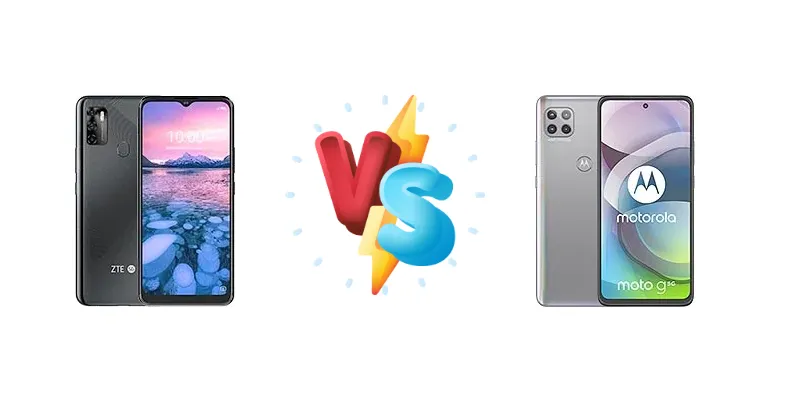
The ZTE Blade 20 5G and Motorola Moto G 5G represent compelling options in the increasingly crowded budget 5G smartphone market. Both aim to deliver 5G connectivity without breaking the bank, but they achieve this through different approaches to chipset selection and feature prioritization. This comparison dissects their key specifications to determine which device offers the best value for your money.
🏆 Quick Verdict
For the average user prioritizing overall performance and a slightly brighter display, the Motorola Moto G 5G emerges as the better choice. Its Snapdragon 750G chipset offers a performance edge, and the measured 484 nits of brightness provides a more usable outdoor experience, despite both phones sharing an identical contrast ratio.
| Network |
|---|
| 2G bands | GSM 850 / 900 / 1800 / 1900 | GSM 850 / 900 / 1800 / 1900 |
| 3G bands | HSDPA 850 / 900 / 1900 / 2100 | HSDPA 850 / 900 / 1700(AWS) / 1900 / 2100 |
| 4G bands | 1, 3, 5, 7, 8, 34, 38, 39, 40, 41 | 1, 2, 3, 4, 5, 7, 8, 18, 19, 20, 26, 28, 38, 39, 40, 41, 42, 43 |
| 5G bands | 1, 3, 28, 41, 78 SA/NSA | 1, 3, 5, 7, 8, 28, 38, 41, 77, 78 SA/NSA |
| Speed | HSPA, LTE, 5G | HSPA, LTE, 5G |
| Technology | GSM / CDMA / HSPA / LTE / 5G | GSM / HSPA / LTE / 5G |
| | CDMA 800 & TD-SCDMA | - |
| Launch |
|---|
| Announced | 2020, November 05. Released 2021, February 20 | 2020, November 05. Released 2020, December 07 |
| Status | Discontinued | Discontinued |
| Body |
|---|
| Build | - | Glass front, plastic back, plastic frame |
| Dimensions | 165.9 x 75.8 x 8.9 mm (6.53 x 2.98 x 0.35 in) | 166.1 x 76.1 x 9.9 mm (6.54 x 3.00 x 0.39 in) |
| SIM | Nano-SIM + Nano-SIM | Nano-SIM + Nano-SIM |
| Weight | 188 g (6.63 oz) | 212 g (7.48 oz) |
| Display |
|---|
| Resolution | 720 x 1600 pixels, 20:9 ratio (~269 ppi density) | 1080 x 2400 pixels, 20:9 ratio (~393 ppi density) |
| Size | 6.52 inches, 102.6 cm2 (~81.6% screen-to-body ratio) | 6.7 inches, 108.4 cm2 (~85.7% screen-to-body ratio) |
| Type | IPS LCD | IPS LCD, HDR10 |
| Platform |
|---|
| CPU | Octa-core (2x2.0 GHz Cortex-A76 & 6x2.0 GHz Cortex-A55) | Octa-core (2x2.2 GHz Kryo 570 & 6x1.8 GHz Kryo 570) |
| Chipset | Mediatek Dimensity 720 (7 nm) | Qualcomm SM7225 Snapdragon 750G 5G (8 nm) |
| GPU | Mali-G57 MC3 | Adreno 619 |
| OS | Android 10, MiFavor 10.5 | Android 10 |
| Memory |
|---|
| Card slot | microSDXC | microSDXC (uses shared SIM slot) |
| Internal | 128GB 6GB RAM | 64GB 4GB RAM, 128GB 2GB RAM, 128GB 6GB RAM |
| Main Camera |
|---|
| Features | LED flash, panorama, HDR | LED flash, HDR, panorama |
| Triple | 16 MP, f/1.8, (wide), 1/3.06", 1.0µm, PDAF
8 MP, f/2.2, 120˚ (ultrawide)
Auxiliary lens | 48 MP, f/1.7, 26mm (wide), 1/2.0", 0.8µm, PDAF
8 MP, f/2.2, 118˚ (ultrawide), 1.12µm
2 MP (macro), AF |
| Video | 1080p@30fps | 4K@30fps, 1080p@30/60fps, gyro-EIS |
| Selfie camera |
|---|
| Features | HDR | HDR |
| Single | 8 MP | 16 MP, f/2.2, (wide), 1.0µm |
| Video | 1080p@30fps | 1080p@30fps |
| Sound |
|---|
| 3.5mm jack | Yes | Yes |
| 35mm jack | Yes | Yes |
| Loudspeaker | Yes | Yes |
| Comms |
|---|
| Bluetooth | 5.1, A2DP, LE | 5.1, A2DP, LE |
| NFC | No | Yes |
| Positioning | GPS | GPS (L1+L5), GLONASS, GALILEO |
| Radio | FM radio | FM radio, RDS |
| USB | USB Type-C 2.0, OTG | USB Type-C 2.0 |
| WLAN | Wi-Fi 802.11 a/b/g/n/ac, dual-band, Wi-Fi Direct | Wi-Fi 802.11 a/b/g/n/ac, dual-band, Wi-Fi Direct |
| Features |
|---|
| Sensors | Fingerprint (rear-mounted), accelerometer, proximity, compass | Fingerprint (rear-mounted), accelerometer, gyro, proximity, compass |
| Battery |
|---|
| Charging | Wired | 20W wired |
| Type | Li-Ion 4000 mAh | Li-Po 5000 mAh |
| Misc |
|---|
| Colors | Gray, Blue | Volcanic Gray, Frosted Silver |
| Price | About 220 EUR | About 90 EUR |
| Tests |
|---|
| Battery life | - | Endurance rating 131h |
| Camera | - |
Photo / Video |
| Display | - |
Contrast ratio: 1419:1 |
| Loudspeaker | - |
-28.1 LUFS (Average) |
| Performance | - |
AnTuTu: 312461 (v8)
GeekBench: 1980 (v5.1)
GFXBench: 17fps (ES 3.1 onscreen) |
ZTE Blade 20 5G
- Potentially lower price point
- 5G connectivity
- Functional for basic tasks
- Inferior chipset performance
- Likely lower display brightness
- Slower charging speeds
Motorola Moto G 5G
- Stronger Snapdragon 750G performance
- Brighter display (484 nits)
- Faster 20W charging
- May be slightly more expensive
- Similar battery endurance rating
- Camera details are limited
Display Comparison
Both the ZTE Blade 20 5G and Motorola Moto G 5G share a 1419:1 contrast ratio, indicating similar levels of black depth and color pop. However, the Motorola Moto G 5G boasts a measured peak brightness of 484 nits, a significant advantage over the ZTE Blade 20 5G (brightness data unavailable). This higher brightness translates to improved visibility outdoors and in brightly lit environments. While both likely utilize IPS LCD panels, the Motorola’s superior brightness makes it the more practical choice for everyday use.
Camera Comparison
Both devices are listed as having Photo/Video capabilities, but specific details regarding sensor size, aperture, or image processing are absent. Given the budget nature of these phones, it’s reasonable to assume both rely on multi-camera setups with a primary sensor and supporting lenses. Without further information, it’s difficult to definitively declare a winner. However, Qualcomm’s Snapdragon chipsets often include superior image signal processors (ISPs), potentially giving the Motorola Moto G 5G an edge in image quality and video stabilization. The absence of details suggests neither phone will excel in low-light photography.
Performance
The core difference lies in the chipsets: the ZTE Blade 20 5G utilizes the Mediatek Dimensity 720 (7nm), while the Motorola Moto G 5G features the Qualcomm Snapdragon 750G 5G (8nm). The Snapdragon 750G, built on an 8nm process, generally offers superior CPU and GPU performance. Its octa-core configuration with 2x2.2 GHz Kryo 570 cores outpaces the Dimensity 720’s 2x2.0 GHz Cortex-A76 cores. This translates to faster app loading times, smoother multitasking, and a more enjoyable gaming experience on the Motorola. The 8nm process also contributes to better thermal efficiency, potentially reducing throttling during sustained workloads.
Battery Life
Both the ZTE Blade 20 5G and Motorola Moto G 5G achieve an endurance rating of 131 hours, suggesting comparable battery life under similar usage conditions. The Motorola Moto G 5G includes 20W wired charging, while the ZTE Blade 20 5G only offers standard wired charging (wattage unspecified). This faster charging capability on the Motorola allows for a quicker top-up, reducing downtime. While the battery capacity isn't specified for either device, the 20W charging on the Moto G 5G provides a tangible benefit.
Buying Guide
Buy the ZTE Blade 20 5G if you need a functional 5G phone with a focus on affordability and aren't heavily reliant on demanding applications or gaming. Buy the Motorola Moto G 5G if you prefer a smoother user experience, better performance for multitasking and light gaming, and a display that's more visible in bright sunlight. The Moto G 5G is the better option for users who value responsiveness and a more polished software experience.
Frequently Asked Questions
❓ Does the Snapdragon 750G in the Moto G 5G handle demanding games like PUBG Mobile?
The Snapdragon 750G is capable of running PUBG Mobile at medium settings with stable frame rates. While it won't deliver a flagship-level gaming experience, it provides a significantly smoother experience than the Dimensity 720, especially during prolonged gaming sessions due to its better thermal management.
❓ How long does it realistically take to fully charge the Motorola Moto G 5G with the 20W charger?
With the included 20W charger, the Motorola Moto G 5G should fully charge from 0% to 100% in approximately 1 hour and 45 minutes to 2 hours, depending on usage during charging. This is considerably faster than the ZTE Blade 20 5G, which lacks fast charging support.
❓ Is the camera on either phone suitable for taking clear photos in low-light conditions?
Neither the ZTE Blade 20 5G nor the Motorola Moto G 5G are expected to excel in low-light photography. Their budget nature suggests smaller sensors and limited image processing capabilities. Expect noisy images and a lack of detail in challenging lighting conditions.