
ZTE Blade 20 5G vs Google Pixel 4a 5G: Which 5G Phone Delivers the Best Value?
| Phones Images | |||||
|---|---|---|---|---|---|
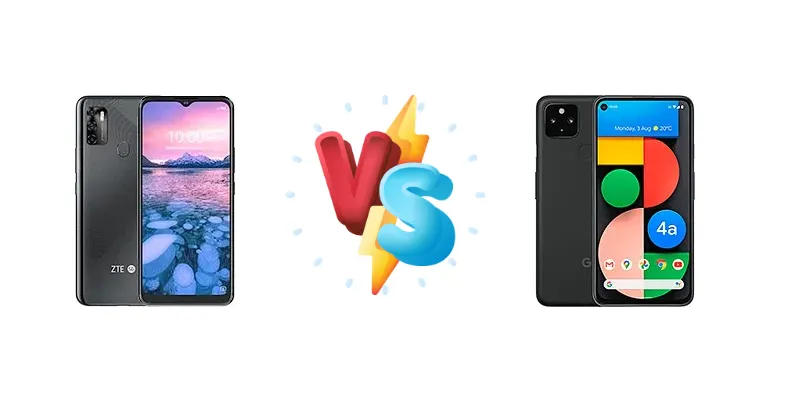
|
🏆 Quick Verdict
For the average user prioritizing camera quality and a refined software experience, the Google Pixel 4a 5G is the clear winner. Its Snapdragon 765G chipset and Google's computational photography deliver superior image quality and smoother performance, justifying the price premium over the ZTE Blade 20 5G.
| PHONES | ||
|---|---|---|
| Phone Names | ZTE Blade 20 5G | Google Pixel 4a 5G |
| Network | ||
|---|---|---|
| 2G bands | GSM 850 / 900 / 1800 / 1900 | GSM 850 / 900 / 1800 / 1900 |
| 3G bands | HSDPA 850 / 900 / 1900 / 2100 | HSDPA 850 / 900 / 1700(AWS) / 1900 / 2100 |
| 4G bands | 1, 3, 5, 7, 8, 34, 38, 39, 40, 41 | 1, 2, 3, 4, 5, 7, 8, 12, 13, 14, 17, 18, 19, 20, 25, 26, 28, 29, 30, 32, 38, 39, 40, 41, 42, 46, 48, 66, 71 |
| 5G bands | 1, 3, 28, 41, 78 SA/NSA | 1, 2, 3, 5, 7, 8, 12, 28, 41, 66, 71, 77, 78 Sub6, mmWave (market dependant) |
| Speed | HSPA, LTE, 5G | HSPA, LTE, 5G |
| Technology | GSM / CDMA / HSPA / LTE / 5G | GSM / HSPA / LTE / 5G |
| CDMA 800 & TD-SCDMA | - | |
| Launch | ||
|---|---|---|
| Announced | 2020, November 05. Released 2021, February 20 | 2020, September 30 |
| Status | Discontinued | Available. Released 2020, November 05 |
| Body | ||
|---|---|---|
| Build | - | Glass front (Gorilla Glass 3), plastic back, plastic frame |
| Dimensions | 165.9 x 75.8 x 8.9 mm (6.53 x 2.98 x 0.35 in) | 153.9 x 74 x 8.2 mm (Sub-6) or 8.5 mm (Sub-6 and mmWave) |
| SIM | Nano-SIM + Nano-SIM | Nano-SIM + eSIM |
| Weight | 188 g (6.63 oz) | 168 g (5G Sub-6); 171 g ( 5G Sub-6 and mmWave) (5.93 oz) |
| Display | ||
|---|---|---|
| Protection | - | Corning Gorilla Glass 3 |
| Resolution | 720 x 1600 pixels, 20:9 ratio (~269 ppi density) | 1080 x 2340 pixels, 19.5:9 ratio (~413 ppi density) |
| Size | 6.52 inches, 102.6 cm2 (~81.6% screen-to-body ratio) | 6.2 inches, 95.7 cm2 (~84.1% screen-to-body ratio) |
| Type | IPS LCD | OLED, HDR |
| - | Always-on display | |
| Platform | ||
|---|---|---|
| CPU | Octa-core (2x2.0 GHz Cortex-A76 & 6x2.0 GHz Cortex-A55) | Octa-core (1x2.4 GHz Kryo 475 Prime & 1x2.2 GHz Kryo 475 Gold & 6x1.8 GHz Kryo 475 Silver) |
| Chipset | Mediatek Dimensity 720 (7 nm) | Qualcomm SM7250 Snapdragon 765G 5G (7 nm) |
| GPU | Mali-G57 MC3 | Adreno 620 |
| OS | Android 10, MiFavor 10.5 | Android 11, upgradable to Android 14 |
| Memory | ||
|---|---|---|
| Card slot | microSDXC | No |
| Internal | 128GB 6GB RAM | 128GB 6GB RAM |
| - | UFS 2.1 | |
| Main Camera | ||
|---|---|---|
| Dual | - | 12.2 MP, f/1.7, 27mm (wide), 1/2.55", 1.4µm, dual pixel PDAF, OIS 16 MP, f/2.2, 107˚ (ultrawide), 1.0µm |
| Features | LED flash, panorama, HDR | LED flash, Pixel Shift, Auto-HDR, panorama |
| Triple | 16 MP, f/1.8, (wide), 1/3.06", 1.0µm, PDAF 8 MP, f/2.2, 120˚ (ultrawide) Auxiliary lens | - |
| Video | 1080p@30fps | 4K@30/60fps, 1080p@30/60/120/240fps; gyro-EIS |
| Selfie camera | ||
|---|---|---|
| Features | HDR | HDR |
| Single | 8 MP | 8 MP, f/2.0, 24mm (wide), 1/4.0", 1.12µm |
| Video | 1080p@30fps | 1080p@30fps |
| Sound | ||
|---|---|---|
| 3.5mm jack | Yes | Yes |
| 35mm jack | Yes | Yes |
| Loudspeaker | Yes | Yes, with stereo speakers |
| Comms | ||
|---|---|---|
| Bluetooth | 5.1, A2DP, LE | 5.0, A2DP, LE, aptX HD |
| NFC | No | Yes |
| Positioning | GPS | GPS, GLONASS, GALILEO, QZSS, BDS |
| Radio | FM radio | No |
| USB | USB Type-C 2.0, OTG | USB Type-C 3.1 |
| WLAN | Wi-Fi 802.11 a/b/g/n/ac, dual-band, Wi-Fi Direct | Wi-Fi 802.11 a/b/g/n/ac, dual-band, Wi-Fi Direct |
| Features | ||
|---|---|---|
| Sensors | Fingerprint (rear-mounted), accelerometer, proximity, compass | Fingerprint (rear-mounted), accelerometer, gyro, proximity, compass, barometer |
| Battery | ||
|---|---|---|
| Charging | Wired | 18W wired, PD2.0 |
| Type | Li-Ion 4000 mAh | Li-Po 3885 mAh |
| Misc | ||
|---|---|---|
| Colors | Gray, Blue | Just Black, Clearly White |
| Models | - | GD1YQ, G025I, G025E, G025H, G6QU3 |
| Price | About 220 EUR | About 140 EUR |
ZTE Blade 20 5G
- Potentially lower price point
- 5G connectivity
- Likely larger battery capacity (spec unknown)
- Inferior camera performance
- Less refined software experience
- Potentially slower performance
Google Pixel 4a 5G
- Superior camera quality
- Smoother performance with Snapdragon 765G
- Faster charging with PD2.0
- Higher price
- Smaller battery capacity compared to potential ZTE Blade 20 5G
- No expandable storage
Display Comparison
Neither device boasts a standout display. Both likely utilize IPS LCD panels, common in this price bracket. The key difference lies in the processing power driving them. While specific display specs (resolution, refresh rate) are missing for the ZTE Blade 20 5G, the Pixel 4a 5G’s 6.2-inch FHD+ display benefits from the Snapdragon 765G’s image signal processor, potentially resulting in more accurate color reproduction and better dynamic range. Bezels are likely comparable, typical of mid-range devices.
Camera Comparison
Google’s strength lies in its computational photography, and the Pixel 4a 5G leverages this with its single 12.2MP main sensor. The image processing algorithms are far more sophisticated than what’s likely found in the ZTE Blade 20 5G, resulting in superior dynamic range, detail, and low-light performance. While the ZTE Blade 20 5G may have a higher megapixel count in its main sensor (spec not provided), megapixel count isn’t everything; sensor size and image processing are crucial. The Pixel’s consistent image quality and excellent portrait mode are significant advantages. We can expect the ZTE to rely more on software enhancements to compensate for hardware limitations.
Performance
The chipset battle is central here. The Google Pixel 4a 5G’s Qualcomm Snapdragon 765G (7nm) features a Kryo 475 Prime core clocked at 2.4GHz, offering a performance advantage over the ZTE Blade 20 5G’s MediaTek Dimensity 720 (7nm). The Snapdragon’s architecture – with its Prime, Gold, and Silver cores – is designed for more efficient task allocation, leading to smoother multitasking and potentially better sustained performance in demanding applications. While both are 7nm chips, Qualcomm’s CPU design generally provides a performance edge. The Pixel 4a 5G also benefits from potentially faster RAM (likely LPDDR4X vs the Blade’s likely LPDDR4).
Battery Life
Battery life will likely be comparable, but the Pixel 4a 5G’s 18W charging with PD2.0 support offers a faster and more efficient charging experience than the ZTE Blade 20 5G’s wired charging (wattage unspecified). While the Pixel 4a 5G’s 3885mAh battery isn’t massive, the Snapdragon 765G’s power efficiency contributes to all-day battery life for moderate users. The ZTE Blade 20 5G’s battery capacity is unknown, but a larger capacity wouldn’t necessarily translate to longer runtime if the Dimensity 720 is less power-efficient.
Buying Guide
Buy the ZTE Blade 20 5G if you need a highly affordable 5G phone and prioritize maximizing value for your dollar, even if it means compromising on camera quality and software polish. Buy the Google Pixel 4a 5G if you prefer a streamlined Android experience, exceptional camera performance, and are willing to pay a bit more for a more refined overall package.