
ZTE Blade 20 5G vs. Apple iPhone SE (2020): A Detailed Comparison
| Phones Images | |||||
|---|---|---|---|---|---|
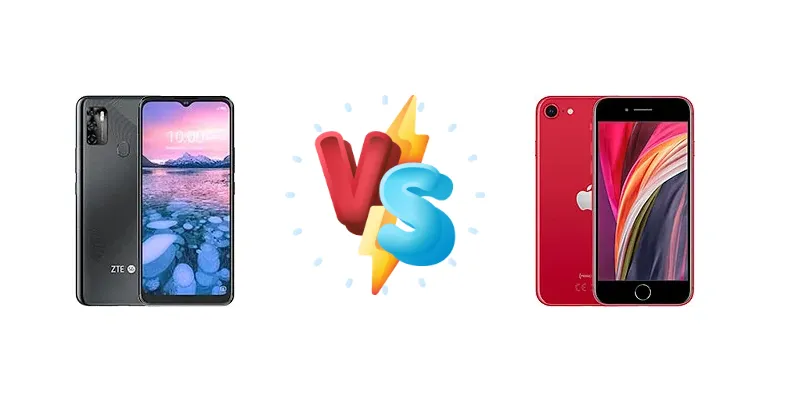
|
🏆 Quick Verdict
For the average user prioritizing raw performance and long-term software support, the Apple iPhone SE (2020) is the superior choice. Its A13 Bionic chip significantly outperforms the Dimensity 720, and the optimized iOS ecosystem delivers a smoother, more refined experience. However, the ZTE Blade 20 5G is a compelling option for those on a tight budget who need 5G connectivity.
| PHONES | ||
|---|---|---|
| Phone Names | ZTE Blade 20 5G | Apple iPhone SE (2020) |
| Network | ||
|---|---|---|
| 2G bands | GSM 850 / 900 / 1800 / 1900 | GSM 850 / 900 / 1800 / 1900 |
| 3G bands | HSDPA 850 / 900 / 1900 / 2100 | HSDPA 850 / 900 / 1700(AWS) / 1900 / 2100 |
| 4G bands | 1, 3, 5, 7, 8, 34, 38, 39, 40, 41 | 1, 2, 3, 4, 5, 7, 8, 11, 12, 13, 17, 18, 19, 20, 21, 25, 26, 28, 29, 30, 32, 34, 38, 39, 40, 41, 42, 46, 48, 66 - A2296 |
| 5G bands | 1, 3, 28, 41, 78 SA/NSA | - |
| Speed | HSPA, LTE, 5G | HSPA 42.2/5.76 Mbps, LTE (5CA) Cat16 1024/150 Mbps, EV-DO Rev.A 3.1 Mbps |
| Technology | GSM / CDMA / HSPA / LTE / 5G | GSM / CDMA / HSPA / EVDO / LTE |
| CDMA 800 & TD-SCDMA | 1, 2, 3, 4, 5, 7, 8, 12, 13, 14, 17, 18, 19, 20, 25, 26, 29, 30, 34, 38, 39, 40, 41, 42, 46, 48, 66, 71 - A2275, A2298 | |
| Launch | ||
|---|---|---|
| Announced | 2020, November 05. Released 2021, February 20 | 2020, April 15 |
| Status | Discontinued | Available. Released 2020, April 24 |
| Body | ||
|---|---|---|
| Build | - | Glass front, glass back, aluminum frame |
| Dimensions | 165.9 x 75.8 x 8.9 mm (6.53 x 2.98 x 0.35 in) | 138.4 x 67.3 x 7.3 mm (5.45 x 2.65 x 0.29 in) |
| SIM | Nano-SIM + Nano-SIM | Nano-SIM + eSIM |
| Weight | 188 g (6.63 oz) | 148 g (5.22 oz) |
| - | IP67 dust/water resistant (up to 1m for 30 min) Apple Pay (Visa, MasterCard, AMEX certified) | |
| Display | ||
|---|---|---|
| Protection | - | Ion-strengthened glass |
| Resolution | 720 x 1600 pixels, 20:9 ratio (~269 ppi density) | 750 x 1334 pixels, 16:9 ratio (~326 ppi density) |
| Size | 6.52 inches, 102.6 cm2 (~81.6% screen-to-body ratio) | 4.7 inches, 60.9 cm2 (~65.4% screen-to-body ratio) |
| Type | IPS LCD | Retina IPS LCD, 625 nits (typ) |
| Platform | ||
|---|---|---|
| CPU | Octa-core (2x2.0 GHz Cortex-A76 & 6x2.0 GHz Cortex-A55) | Hexa-core (2x2.65 GHz Lightning + 4x1.8 GHz Thunder) |
| Chipset | Mediatek Dimensity 720 (7 nm) | Apple A13 Bionic (7 nm+) |
| GPU | Mali-G57 MC3 | Apple GPU (4-core graphics) |
| OS | Android 10, MiFavor 10.5 | iOS 13, upgradable to iOS 26.1 |
| Memory | ||
|---|---|---|
| Card slot | microSDXC | No |
| Internal | 128GB 6GB RAM | 64GB 3GB RAM, 128GB 3GB RAM, 256GB 3GB RAM |
| - | NVMe | |
| Main Camera | ||
|---|---|---|
| Features | LED flash, panorama, HDR | Quad-LED dual-tone flash, HDR, panorama |
| Single | - | 12 MP, f/1.8 (wide), PDAF, OIS |
| Triple | 16 MP, f/1.8, (wide), 1/3.06", 1.0µm, PDAF 8 MP, f/2.2, 120˚ (ultrawide) Auxiliary lens | - |
| Video | 1080p@30fps | 4K@24/30/60fps, 1080p@30/60/120/240fps, HDR, OIS, stereo sound rec. |
| Selfie camera | ||
|---|---|---|
| Features | HDR | HDR |
| Single | 8 MP | 7 MP, f/2.2 |
| Video | 1080p@30fps | 1080p@30fps; gyro-EIS |
| Sound | ||
|---|---|---|
| 3.5mm jack | Yes | No |
| 35mm jack | Yes | No |
| Loudspeaker | Yes | Yes, with stereo speakers |
| Comms | ||
|---|---|---|
| Bluetooth | 5.1, A2DP, LE | 5.0, A2DP, LE |
| NFC | No | Yes |
| Positioning | GPS | GPS, GLONASS |
| Radio | FM radio | No |
| USB | USB Type-C 2.0, OTG | Lightning, USB 2.0 |
| WLAN | Wi-Fi 802.11 a/b/g/n/ac, dual-band, Wi-Fi Direct | Wi-Fi 802.11 a/b/g/n/ac/6, dual-band, hotspot |
| Features | ||
|---|---|---|
| Sensors | Fingerprint (rear-mounted), accelerometer, proximity, compass | Fingerprint (front-mounted), accelerometer, proximity, gyro, compass, barometer |
| Battery | ||
|---|---|---|
| Charging | Wired | 18W wired, 50% in 30 min 7.5W wireless (Qi) |
| Type | Li-Ion 4000 mAh | Li-Ion 1821 mAh (6.91 Wh) |
| Misc | ||
|---|---|---|
| Colors | Gray, Blue | Black, White, Red |
| Models | - | A2275, A2296, A2298, iPhone12,8 |
| Price | About 220 EUR | $ 120.00 / C$ 165.75 / £ 99.95 / € 130.89 |
| SAR | - | 1.17 W/kg (head) 1.16 W/kg (body) |
| SAR EU | - | 0.98 W/kg (head) 0.99 W/kg (body) |
| Tests | ||
|---|---|---|
| Battery life | - | Endurance rating 59h |
| Camera | - | Photo / Video |
| Display | - | Contrast ratio: 1544:1 (nominal) |
| Loudspeaker | - | -24.1 LUFS (Very good) |
| Performance | - | AnTuTu: 462253 (v8) GeekBench: 3237 (v5.1) |
ZTE Blade 20 5G
- Affordable 5G connectivity
- Potentially larger display size
- Wired charging support
- Inferior processor performance
- Likely lower camera quality
- Less refined software experience
Apple iPhone SE (2020)
- Exceptional processing power (A13 Bionic)
- Superior camera quality
- Long-term software support
- Smaller display size
- Higher price point
- Limited battery capacity (though efficient)
Display Comparison
Both devices feature a contrast ratio of 1544:1, suggesting similar panel characteristics in terms of black levels. However, the iPhone SE (2020) boasts a significantly brighter display at 670 nits, making it more legible outdoors under direct sunlight. While the ZTE Blade 20 5G’s display specifications aren’t provided, it’s likely to be dimmer, potentially impacting outdoor visibility. The iPhone’s smaller screen size (not specified in data, but known to be 4.7 inches) contributes to a higher pixel density, resulting in a sharper image compared to the likely larger display of the ZTE.
Camera Comparison
Both phones offer photo and video capabilities, but the iPhone SE (2020) is expected to deliver superior image quality due to Apple’s advanced image processing algorithms and potentially a larger sensor (specifications not provided). The ZTE Blade 20 5G’s camera performance is likely to be adequate for casual photography, but it will struggle in low-light conditions compared to the iPhone. Without detailed sensor information for the ZTE, it’s difficult to assess its capabilities beyond basic functionality. The iPhone’s computational photography features, such as Smart HDR, enhance dynamic range and detail in photos.
Performance
The Apple A13 Bionic (7nm+) chip in the iPhone SE (2020) is the clear performance leader. Its hexa-core CPU, with two high-performance 'Lightning' cores clocked at 2.65 GHz, delivers significantly faster processing speeds than the Mediatek Dimensity 720’s octa-core configuration (2x2.0 GHz Cortex-A76 & 6x2.0 GHz Cortex-A55). The A13 Bionic’s superior architecture and manufacturing process translate to faster app loading times, smoother multitasking, and a more responsive user experience. While the Dimensity 720 offers 5G connectivity, it cannot match the A13’s raw processing power. The iPhone SE’s performance advantage is particularly noticeable in demanding tasks like gaming and video editing.
Battery Life
The iPhone SE (2020) achieves an endurance rating of 59 hours, indicating respectable battery life despite its relatively small battery capacity. This is likely due to the efficiency of the A13 Bionic chip and iOS’s power management optimizations. The ZTE Blade 20 5G’s battery capacity is not specified, but its less efficient chipset and potentially larger display could result in shorter battery life. The iPhone SE (2020) also supports 18W wired charging (50% in 30 minutes) and 7.5W wireless charging (Qi), offering more convenient charging options than the ZTE’s wired-only charging.
Buying Guide
Buy the ZTE Blade 20 5G if you need affordable 5G access and aren't heavily invested in the Apple ecosystem. It's ideal for users who prioritize connectivity over peak performance and are comfortable with a less polished software experience. Buy the Apple iPhone SE (2020) if you prefer a compact phone with exceptional processing power, a premium camera experience, and guaranteed software updates for years to come. It’s best for users who value speed, simplicity, and integration with other Apple devices.