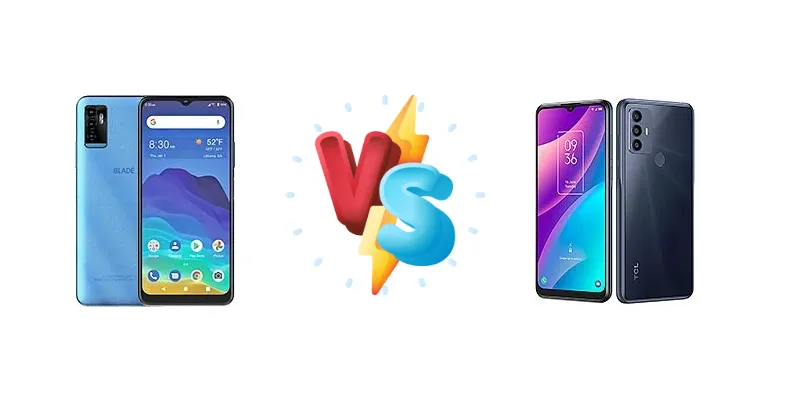
The ZTE Blade 11 Prime and TCL 30 SE represent the fiercely competitive sub-$150 smartphone market. While both aim to deliver essential smartphone functionality at an accessible price, they diverge in key areas like chipset architecture and charging capabilities. This comparison dissects these differences to determine which device offers the best balance of features and performance for budget-conscious consumers.
🏆 Quick Verdict
For users prioritizing convenience and wireless charging, the ZTE Blade 11 Prime is the better choice. However, the TCL 30 SE’s Helio G25 chipset, with its higher clocked cores, provides a slight edge in sustained performance, making it preferable for light gaming and multitasking.
| Network |
|---|
| 2G bands | GSM 850 / 900 / 1800 / 1900 | GSM 850 / 900 / 1800 / 1900 |
| 3G bands | HSDPA 850 / 1900 / 2100 | HSDPA 850 / 900 / 1900 / 2100 - EMEA/APAC |
| 4G bands | 2, 4, 5, 12, 13, 66 | 1, 3, 5, 7, 8, 20, 28, 38, 40, 41 - EMEA |
| Speed | HSPA 21.1/5.76 Mbps, LTE Cat6 300/50 Mbps | HSPA 42.2/11.5 Mbps, LTE Cat4 150/50 Mbps |
| Technology | GSM / HSPA / LTE | GSM / HSPA / LTE |
| | - | 2, 3, 4, 5, 7, 8, 12, 13, 17, 26, 28, 66 - LATAM |
| Launch |
|---|
| Announced | 2021, April 27 | 2022, February 27 |
| Status | Available. Released 2021, April 27 | Available. Released 2022, April 20 |
| Body |
|---|
| Build | Glass front, plastic frame, plastic back | Glass front, plastic frame, plastic back |
| Dimensions | 166 x 76 x 8.7 mm (6.54 x 2.99 x 0.34 in) | 165.2 x 75.5 x 8.9 mm (6.50 x 2.97 x 0.35 in) |
| SIM | Nano-SIM + Nano-SIM | · Nano-SIM· Nano-SIM + Nano-SIM |
| Weight | 190 g (6.70 oz) | 190 g (6.70 oz) |
| Display |
|---|
| Resolution | 720 x 1600 pixels, 20:9 ratio (~269 ppi density) | 720 x 1600 pixels, 20:9 ratio (~269 ppi density) |
| Size | 6.52 inches, 102.6 cm2 (~81.4% screen-to-body ratio) | 6.52 inches, 102.6 cm2 (~82.3% screen-to-body ratio) |
| Type | IPS LCD | IPS LCD, 450 nits (typ) |
| Platform |
|---|
| CPU | Octa-core 2.0 GHz Cortex-A53 | Octa-core (4x2.0 GHz Cortex-A53 & 4x1.5 GHz Cortex-A53) |
| Chipset | Mediatek MT6762 Helio P22 (12 nm) | Mediatek MT6762G Helio G25 (12 nm) |
| GPU | PowerVR GE8320 | PowerVR GE8320 |
| OS | Android 11 | Android 12, TCL UI 4.0 |
| Memory |
|---|
| Card slot | microSDXC | microSDXC (dedicated slot) |
| Internal | 64GB 4GB RAM | 64GB 4GB RAM, 128GB 4GB RAM |
| | eMMC 5.1 | eMMC 5.1 |
| Main Camera |
|---|
| Features | LED flash, HDR, panorama | LED flash, HDR, panorama |
| Single | 8 MP | 8 MP, f/2.0, 26mm (wide), 1/4", 1.12µm |
| Triple | 16 MP, (wide), AF
8 MP, f/2.2, 120˚, 16mm (ultrawide)
Auxiliary lens | 50 MP, f/1.9, 28mm (wide), 1/2.76", 0.64µm, PDAF
2 MP (macro)
Auxiliary lens |
| Video | 1080p@30fps | 1080p@30fps |
| Selfie camera |
|---|
| Features | - | HDR |
| Single | 8 MP | 8 MP, f/2.0, 26mm (wide), 1/4.0", 1.12µm |
| Video | 1080p@30fps | 1080p@30fps |
| Sound |
|---|
| 3.5mm jack | Yes | Yes |
| 35mm jack | Yes | Yes |
| Loudspeaker | Yes | Yes |
| Comms |
|---|
| Bluetooth | 5.1, A2DP, LE | 5.0, A2DP, LE |
| NFC | No | Yes (6165H/6165H1 only) |
| Positioning | GPS | GPS, GLONASS, GALILEO, BDS |
| Radio | No | Unspecified |
| USB | USB Type-C 2.0 | USB Type-C 2.0 |
| WLAN | Wi-Fi 802.11 a/b/g/n/ac, dual-band, Wi-Fi Direct | Wi-Fi 802.11 b/g/n, Wi-Fi Direct |
| Features |
|---|
| Sensors | Fingerprint (side-mounted), accelerometer, gyro, proximity | Fingerprint (rear-mounted), accelerometer, proximity, compass |
| Battery |
|---|
| Charging | Wireless
Reverse wired | 15W wired |
| Type | Li-Ion 4000 mAh | Li-Po 5000 mAh |
| Misc |
|---|
| Colors | Sky Blue | Atlantic Blue, Space Gray, Glacial Blue |
| Models | - | 6165H, 6156H1, 6165A, 6165A1, 6165S |
| Price | About 160 EUR | - |
ZTE Blade 11 Prime
- Wireless charging offers added convenience.
- Reverse wired charging can power accessories.
- Potentially lower SAR values due to less focus on gaming performance.
- Slower charging speeds compared to the TCL 30 SE.
- Helio P22 chipset may struggle with multitasking.
TCL 30 SE
- Helio G25 chipset offers a slight performance boost for gaming.
- Faster 15W wired charging.
- Potentially better thermal management due to optimized chipset.
- Lacks wireless charging functionality.
- Heterogeneous core configuration may not always translate to real-world benefits.
Display Comparison
Neither ZTE nor TCL provide display specifications beyond the basic resolution. Given the price point, both likely utilize LCD panels. The absence of details like peak brightness or color gamut suggests a focus on cost reduction. Bezels are expected to be substantial on both devices, impacting the overall screen-to-body ratio. Color accuracy is likely standard for this segment, prioritizing power efficiency over fidelity.
Camera Comparison
Detailed camera specifications are unavailable. Given the market segment, both devices likely feature a primary camera paired with depth or macro sensors of limited utility. Image processing will be heavily reliant on software algorithms to compensate for sensor limitations. Expect acceptable results in well-lit conditions, but significant noise and a lack of detail in low-light scenarios. The aperture of the main sensor will be the key differentiator, but without that data, it's difficult to assess which phone will perform better.
Performance
The core difference lies in the chipsets. The ZTE Blade 11 Prime features the Mediatek MT6762 Helio P22, an octa-core processor with all cores clocked at 2.0 GHz Cortex-A53. The TCL 30 SE utilizes the MT6762G Helio G25, also octa-core, but with a heterogeneous configuration: four cores at 2.0 GHz Cortex-A53 and four at 1.5 GHz Cortex-A53. This 'big.LITTLE' architecture in the G25 *can* improve efficiency by assigning less demanding tasks to the slower cores. However, the G25's GPU is likely a modest upgrade, offering a slight advantage in graphics-intensive tasks. Both phones will struggle with demanding 3D games, but the TCL 30 SE should exhibit fewer frame drops in less intensive titles.
Battery Life
Battery capacity is not specified for either device. However, the TCL 30 SE’s 15W wired charging is a clear advantage over the ZTE Blade 11 Prime’s wireless and reverse wired charging. While wireless charging offers convenience, it's significantly slower than wired charging. The 15W charging on the TCL 30 SE will likely deliver a 0-100% charge in under 2.5 hours, while the ZTE’s wireless charging could take upwards of 4-5 hours. The reverse wired charging on the ZTE is a niche feature, useful for topping up accessories but not a primary selling point.
Buying Guide
Buy the ZTE Blade 11 Prime if you need the convenience of wireless charging and reverse wired charging for accessories, and aren't heavily reliant on demanding mobile games. Buy the TCL 30 SE if you prioritize a slightly more responsive experience for casual gaming and everyday tasks, and are comfortable with a solely wired charging solution.
Frequently Asked Questions
❓ Does the TCL 30 SE's Helio G25 chipset handle popular games like PUBG Mobile?
The Helio G25 can run PUBG Mobile, but expect to play at lower graphics settings and frame rates to maintain a stable experience. It's suitable for casual gaming, but not ideal for demanding gamers. The G25's GPU is a modest upgrade over the P22, offering a slight advantage in frame stability.
❓ How practical is the wireless charging on the ZTE Blade 11 Prime in everyday use?
Wireless charging on the ZTE Blade 11 Prime is convenient for topping up the battery overnight or in situations where a cable isn't readily available. However, it's significantly slower than wired charging, so it's not a substitute for quickly replenishing the battery when it's low. The reverse wired charging is a niche feature, best suited for charging small accessories like earbuds.
❓ Which phone is better for streaming videos and browsing the web?
Both phones are adequate for streaming videos and browsing the web. The TCL 30 SE's slightly more powerful chipset might result in marginally smoother scrolling and faster page loading times, but the difference will likely be imperceptible for most users. The experience will largely depend on network connectivity.