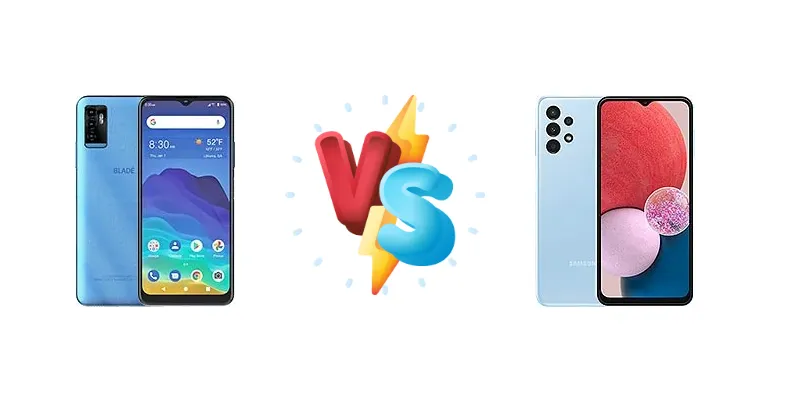
The ZTE Blade 11 Prime and Samsung Galaxy A13 represent two compelling options in the ultra-budget smartphone space. While both aim to deliver essential smartphone functionality at a low price point, they diverge significantly in their internal hardware, particularly in chipset choice and charging capabilities. This comparison dissects these differences to help you determine which device best suits your needs.
🏆 Quick Verdict
For most users, the Samsung Galaxy A13 (SM-A137) is the better choice. Its Mediatek Helio G80 chipset, featuring Cortex-A75 performance cores, provides a noticeable performance uplift over the ZTE Blade 11 Prime’s Helio P22, making it more responsive for everyday tasks and light gaming. While the Blade 11 Prime offers wireless charging, the A13’s superior processing power delivers a smoother user experience.
| Network |
|---|
| 2G bands | GSM 850 / 900 / 1800 / 1900 | GSM 850 / 900 / 1800 / 1900 |
| 3G bands | HSDPA 850 / 1900 / 2100 | HSDPA 850 / 900 / 2100 |
| 4G bands | 2, 4, 5, 12, 13, 66 | 1, 3, 5, 7, 8, 20, 28, 38, 40, 41 |
| Speed | HSPA 21.1/5.76 Mbps, LTE Cat6 300/50 Mbps | HSPA, LTE |
| Technology | GSM / HSPA / LTE | GSM / HSPA / LTE |
| Launch |
|---|
| Announced | 2021, April 27 | 2022, June |
| Status | Available. Released 2021, April 27 | Available. Released 2022, July |
| Body |
|---|
| Build | Glass front, plastic frame, plastic back | Glass front (Gorilla Glass 5), plastic frame, plastic back |
| Dimensions | 166 x 76 x 8.7 mm (6.54 x 2.99 x 0.34 in) | 165.1 x 76.4 x 8.8 mm (6.5 x 3.01 x 0.35 in) |
| SIM | Nano-SIM + Nano-SIM | · Nano-SIM· Nano-SIM + Nano-SIM |
| Weight | 190 g (6.70 oz) | 195 g (6.88 oz) |
| Display |
|---|
| Protection | - | Corning Gorilla Glass 5 |
| Resolution | 720 x 1600 pixels, 20:9 ratio (~269 ppi density) | 1080 x 2408 pixels, 20:9 ratio (~400 ppi density) |
| Size | 6.52 inches, 102.6 cm2 (~81.4% screen-to-body ratio) | 6.6 inches, 104.9 cm2 (~83.2% screen-to-body ratio) |
| Type | IPS LCD | PLS LCD |
| Platform |
|---|
| CPU | Octa-core 2.0 GHz Cortex-A53 | Octa-core (2x2.0 GHz Cortex-A75 & 6x1.8 GHz Cortex-A55) |
| Chipset | Mediatek MT6762 Helio P22 (12 nm) | Mediatek MT6769V/CU Helio G80 (12 nm) |
| GPU | PowerVR GE8320 | Mali-G52 MC2 |
| OS | Android 11 | Android 12, upgradable to Android 14, One UI 6.1 |
| Memory |
|---|
| Card slot | microSDXC | microSDXC (dedicated slot) |
| Internal | 64GB 4GB RAM | 32GB 3GB RAM, 32GB 4GB RAM, 64GB 4GB RAM, 128GB 4GB RAM |
| | eMMC 5.1 | eMMC 5.1 |
| Main Camera |
|---|
| Features | LED flash, HDR, panorama | LED flash, panorama, HDR |
| Quad | - | 50 MP, f/1.8, (wide), PDAF
5 MP, f/2.2, 123˚ (ultrawide), 1/5.0", 1.12µm
2 MP (macro)
Auxiliary lens |
| Single | 8 MP | 8 MP, f/2.2, (wide) |
| Triple | 16 MP, (wide), AF
8 MP, f/2.2, 120˚, 16mm (ultrawide)
Auxiliary lens | - |
| Video | 1080p@30fps | 1080p@30fps |
| Selfie camera |
|---|
| Single | 8 MP | 8 MP, f/2.2, (wide) |
| Video | 1080p@30fps | 1080p@30fps |
| Sound |
|---|
| 3.5mm jack | Yes | Yes |
| 35mm jack | Yes | Yes |
| Loudspeaker | Yes | Yes |
| Comms |
|---|
| Bluetooth | 5.1, A2DP, LE | 5.2, A2DP, LE |
| NFC | No | Yes |
| Positioning | GPS | GPS, GLONASS, GALILEO, BDS |
| Radio | No | No |
| USB | USB Type-C 2.0 | USB Type-C 2.0, OTG |
| WLAN | Wi-Fi 802.11 a/b/g/n/ac, dual-band, Wi-Fi Direct | Wi-Fi 802.11 a/b/g/n/ac, dual-band, Wi-Fi Direct |
| Features |
|---|
| Sensors | Fingerprint (side-mounted), accelerometer, gyro, proximity | Fingerprint (side-mounted), accelerometer, compass |
| | - | Virtual proximity sensing |
| Battery |
|---|
| Charging | Wireless
Reverse wired | 15W wired |
| Type | Li-Ion 4000 mAh | Li-Po 5000 mAh |
| Misc |
|---|
| Colors | Sky Blue | Black, White, Blue |
| Models | - | SM-A137F, SM-A137F/DSN, SM-A137F/DS |
| Price | About 160 EUR | About 180 EUR |
| SAR EU | - | 0.35 W/kg (head) 1.22 W/kg (body) |
ZTE Blade 11 Prime
- Wireless charging capability
- Reverse wired charging for emergency power sharing
- Potentially lower price point
- Significantly weaker processor performance
- Less responsive user experience
- Likely inferior gaming performance
Samsung Galaxy A13 (SM-A137)
- More powerful Mediatek Helio G80 processor
- Smoother multitasking and app performance
- Better gaming capabilities
- Faster charging (15W)
- No wireless charging
- Potentially slightly higher price
Display Comparison
Neither device boasts a standout display. Both utilize 12nm chipsets, suggesting a focus on cost reduction over premium display features. While specific display specs (resolution, panel type) are missing, the focus here is on performance. The absence of high refresh rates or advanced panel technologies like LTPO on either device is typical for this price bracket. Bezels are likely to be substantial on both, impacting the overall screen-to-body ratio.
Camera Comparison
Without detailed camera specifications, a direct comparison is difficult. However, it’s safe to assume both phones feature budget-oriented camera systems. The presence of a 2MP macro camera on the A13 is a common, but often underwhelming, feature in this segment. The larger sensor size (if any) on the A13’s main camera, coupled with a wider aperture, would be the primary determinant of image quality. Image processing algorithms will also play a role, and Samsung generally offers more refined software processing than ZTE in this price range. Expect similar performance in good lighting conditions, but the A13 is likely to perform better in low-light scenarios.
Performance
The core difference lies in the chipsets. The Samsung Galaxy A13’s Mediatek Helio G80 (MT6769V/CU) is a significant step up from the ZTE Blade 11 Prime’s Helio P22 (MT6762). The G80 utilizes a dual-cluster configuration with 2x 2.0 GHz Cortex-A75 cores and 6x 1.8 GHz Cortex-A55 cores, offering considerably better sustained performance than the P22’s homogenous octa-core 2.0 GHz Cortex-A53 setup. The A75 cores provide a boost in single-core performance, crucial for app launch speeds and general responsiveness. While both are built on a 12nm process, the architectural improvements in the G80 translate to a smoother experience, particularly when multitasking or running demanding applications. The A13 will likely exhibit less lag and stuttering.
Battery Life
Battery capacity is not specified for either device, but both likely fall in the 4000-5000 mAh range, typical for this class. The key difference is charging speed. The Samsung Galaxy A13 supports 15W wired charging, while the ZTE Blade 11 Prime offers both wireless charging *and* reverse wired charging. While 15W isn’t fast, it’s a standard speed. The Blade 11 Prime’s wireless charging is a unique selling point, but it will be significantly slower than wired charging. Reverse wired charging allows the Blade 11 Prime to act as a power bank for other devices, a niche but potentially useful feature.
Buying Guide
Buy the ZTE Blade 11 Prime if wireless charging is a non-negotiable feature and you primarily use your phone for basic tasks like calls, texts, and light social media. Buy the Samsung Galaxy A13 (SM-A137) if you prioritize a more responsive user experience, smoother multitasking, and slightly better gaming performance, even if it means sacrificing wireless charging convenience.
Frequently Asked Questions
❓ Will the Samsung Galaxy A13 struggle with demanding games like PUBG Mobile?
While the Helio G80 isn't a gaming powerhouse, it's capable of running PUBG Mobile at medium settings with reasonable frame rates. Expect some occasional stuttering, but it's a significantly better gaming experience than the ZTE Blade 11 Prime's Helio P22.
❓ How slow is the wireless charging on the ZTE Blade 11 Prime?
Wireless charging on the ZTE Blade 11 Prime will be considerably slower than the 15W wired charging on the Samsung Galaxy A13. Expect a full charge to take several hours, making it more suitable for overnight charging rather than quick top-ups.
❓ Is the difference in processor performance between the Helio P22 and Helio G80 noticeable in everyday use?
Yes, the difference is quite noticeable. The Helio G80's Cortex-A75 cores provide a significant boost in responsiveness, resulting in faster app launch times, smoother scrolling, and less lag when switching between applications. The Blade 11 Prime will feel sluggish in comparison.
❓ Does the Samsung Galaxy A13 support expandable storage?
Yes, the Samsung Galaxy A13 (SM-A137) supports microSD card expansion, allowing you to increase storage capacity beyond the internal storage options. This is a crucial feature for users who plan to store a lot of photos, videos, or apps.