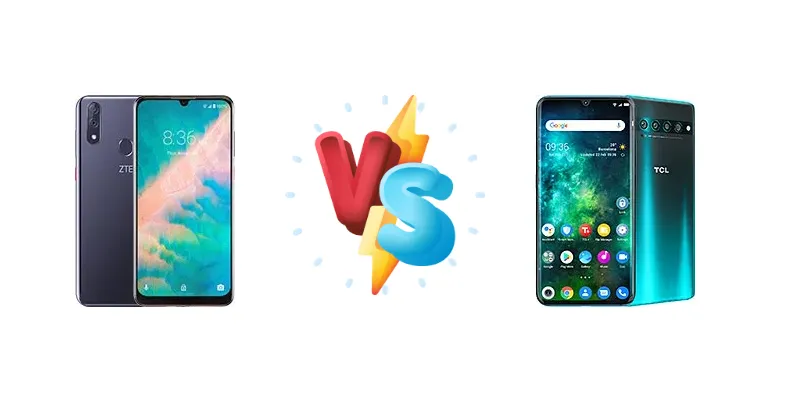
The ZTE Blade 10 Prime and TCL 10 Pro represent compelling options in the crowded budget smartphone market. Both aim to deliver a solid experience without breaking the bank, but they take different approaches to achieving this. The Blade 10 Prime focuses on a balance of features, while the TCL 10 Pro attempts to elevate the experience with a more modern chipset and faster charging. This comparison will dissect their key differences to help you choose the right device.
🏆 Quick Verdict
For most users, the TCL 10 Pro emerges as the better choice. Its Qualcomm Snapdragon 675 chipset, built on an 11nm process, provides a noticeable performance advantage over the ZTE Blade 10 Prime’s MediaTek Helio P60. While both offer 18W charging, the TCL 10 Pro’s Quick Charge 3.0 support delivers faster real-world top-ups.
| Network |
|---|
| 2G bands | GSM 850 / 900 / 1800 / 1900 | GSM 850 / 900 / 1800 / 1900 |
| 3G bands | HSDPA 850 / 900 / 1700(AWS) / 1900 / 2100 | HSDPA 850 / 900 / 1700(AWS) / 1900 / 2100 - T799B |
| 4G bands | 2, 4, 5, 12, 13, 66 | 1, 2, 3, 4, 5, 7, 8, 12, 13, 17, 25, 26, 28, 38, 40, 41, 66 - T799B |
| Speed | HSPA 42.2/5.76 Mbps, LTE (2CA) Cat6 300/50 Mbps | HSPA 42.2/5.76 Mbps, LTE (2CA) Cat13 400/75 Mbps |
| Technology | GSM / HSPA / LTE | GSM / HSPA / LTE |
| | - | 1, 3, 5, 7, 8, 20, 28, 38, 40, 41 - T799H |
| Launch |
|---|
| Announced | 2019, November. Released 2019, November | 2020, April 06. Released 2020, May 19 |
| Status | Discontinued | Discontinued |
| Body |
|---|
| Build | Glass front, plastic back, plastic frame | Glass front, glass back, aluminum frame |
| Dimensions | 158 x 75.2 x 7.9 mm (6.22 x 2.96 x 0.31 in) | 158.5 x 72.4 x 9.2 mm (6.24 x 2.85 x 0.36 in) |
| SIM | Nano-SIM + Nano-SIM | · Nano-SIM· Nano-SIM + Nano-SIM |
| Weight | 165 g (5.82 oz) | 177 g (6.24 oz) |
| Display |
|---|
| Resolution | 1080 x 2280 pixels, 19:9 ratio (~400 ppi density) | 1080 x 2340 pixels, 19.5:9 ratio (~398 ppi density) |
| Size | 6.3 inches, 99.1 cm2 (~83.4% screen-to-body ratio) | 6.47 inches, 102.8 cm2 (~89.5% screen-to-body ratio) |
| Type | IPS LCD | AMOLED, HDR10 |
| | - | Always-on-display |
| Platform |
|---|
| CPU | Octa-core (4x2.0 GHz Cortex-A73 & 4x2.0 GHz Cortex-A53) | Octa-core (2x2.0 GHz Kryo 460 Gold & 6x1.7 GHz Kryo 460 Silver) |
| Chipset | Mediatek MT6771 Helio P60 (12 nm) | Qualcomm SDM675 Snapdragon 675 (11 nm) |
| GPU | Mali-G72 MP3 | Adreno 612 |
| OS | Android 9.0 (Pie) | Android 10, planned upgrade to Android 11, TCL UI |
| Memory |
|---|
| Card slot | microSDXC (uses shared SIM slot) | microSDXC (uses shared SIM slot) |
| Internal | 64GB 3GB RAM | 128GB 6GB RAM, 256GB 6GB RAM |
| | eMMC 5.1 | UFS 2.1 |
| Main Camera |
|---|
| Dual | 16 MP, f/1.8, 1/2.8", 1.12µm, PDAF
Auxiliary lens | - |
| Features | LED flash, HDR, panorama | Dual-LED flash, HDR, panorama |
| Quad | - | 64 MP, f/1.8, 26mm (wide), 1/1.72", 0.8µm, PDAF
16 MP, f/2.4, 13mm (ultrawide), 1/3.1", 1.0µm
5 MP (macro)
Auxiliary lens |
| Video | 1080p@30fps (gyro-EIS) | 4K@30fps, 1080p@30/60/120fps, 720p@960fps, gyro-EIS |
| Selfie camera |
|---|
| Single | 16 MP, f/2.0, 26mm (wide), 1/3.06", 1.0µm | 24 MP, f/2.0, 26mm (wide), 1/2.8", 0.9µm |
| Video | 1080p@30fps | 1080p@30fps |
| Sound |
|---|
| 3.5mm jack | Yes | Yes |
| 35mm jack | Yes | Yes |
| Loudspeaker | Yes | Yes |
| Comms |
|---|
| Bluetooth | 4.2, A2DP, LE | 5.0, A2DP, LE, aptX HD |
| Infrared port | - | Yes |
| NFC | Yes | Yes |
| Positioning | GPS | GPS, GLONASS, GALILEO |
| Radio | FM radio | FM radio (market/region dependent) |
| USB | USB Type-C 2.0 | USB Type-C 2.0, OTG |
| WLAN | Wi-Fi 802.11 a/b/g/n/ac, dual-band, Wi-Fi Direct | Wi-Fi 802.11 a/b/g/n/ac, dual-band, Wi-Fi Direct |
| Features |
|---|
| Sensors | Fingerprint (rear-mounted), accelerometer, proximity, compass | Fingerprint (under display, optical), accelerometer, gyro, proximity, compass |
| Battery |
|---|
| Charging | 18W wired, PD2.0 | 18W wired, QC3, 50% in 35 min |
| Type | Li-Po 3200 mAh, non-removable | Li-Po 4500 mAh |
| Misc |
|---|
| Colors | Black | Gray, Green |
| Models | Z6530, Z6530M, Z6530V | T799B, T799H |
| Price | About 160 EUR | About 250 EUR |
ZTE Blade 10 Prime
- Potentially lower price point
- Reliable MediaTek Helio P60 chipset for basic tasks
- PD 2.0 charging support
- Less powerful chipset compared to Snapdragon 675
- Likely slower charging speeds than TCL 10 Pro
- May struggle with demanding applications
TCL 10 Pro
- More powerful Qualcomm Snapdragon 675 chipset
- Faster charging with Quick Charge 3.0 (50% in 35 min)
- Potentially better camera image processing
- Generally slightly higher price
- May not offer significantly longer battery life despite efficiency gains
- Software updates may be less frequent than some competitors
Display Comparison
Neither device boasts a standout display. Both likely utilize IPS LCD panels, common in this price bracket. However, the TCL 10 Pro’s potential for slightly better color calibration, stemming from TCL’s TV expertise, is a possibility. The absence of detailed display specs (resolution, brightness) necessitates assuming similar performance. Bezels are likely comparable, reflecting the budget nature of both phones.
Camera Comparison
Without detailed camera specs beyond the presence of cameras, a direct comparison is difficult. However, the Snapdragon 675’s image signal processor (ISP) generally offers superior image processing capabilities compared to the Helio P60’s. This means the TCL 10 Pro is likely to produce more detailed and vibrant photos, especially in challenging lighting conditions. The absence of information regarding sensor sizes and apertures makes a definitive statement impossible, but the chipset advantage favors the TCL 10 Pro.
Performance
The core difference lies in the chipsets. The TCL 10 Pro’s Snapdragon 675 (11nm) is architecturally superior to the ZTE Blade 10 Prime’s Helio P60 (12nm). The Snapdragon 675 utilizes Qualcomm’s Kryo cores – 2x 2.0 GHz Gold and 6x 1.7 GHz Silver – offering a more efficient and powerful configuration than the Helio P60’s 4x 2.0 GHz Cortex-A73 and 4x 2.0 GHz Cortex-A53. The 11nm process node of the Snapdragon 675 also contributes to better power efficiency and potentially less thermal throttling during sustained workloads. This translates to a smoother experience with multitasking and more demanding applications.
Battery Life
Both phones feature 18W wired charging, but the TCL 10 Pro benefits from Quick Charge 3.0 compatibility, while the ZTE Blade 10 Prime uses PD2.0. Quick Charge 3.0 is generally more widely supported and can deliver faster charging speeds with compatible chargers. TCL claims a 50% charge in 35 minutes, a metric the ZTE Blade 10 Prime likely won’t match. While battery capacity isn’t specified, the Snapdragon 675’s improved power efficiency could offset a potentially smaller battery in the TCL 10 Pro, resulting in comparable real-world battery life.
Buying Guide
Buy the ZTE Blade 10 Prime if you prioritize a consistently affordable price and are primarily focused on basic smartphone tasks like calling, texting, and light social media use. Buy the TCL 10 Pro if you value smoother multitasking, occasional gaming, and faster charging speeds, even if it means spending slightly more upfront. The TCL 10 Pro is the better option for users who want a phone that feels more responsive and future-proof.
Frequently Asked Questions
❓ Will the TCL 10 Pro handle graphically intensive games like PUBG Mobile smoothly?
The Snapdragon 675 in the TCL 10 Pro is capable of running PUBG Mobile, but likely at medium settings for a consistently smooth experience. While not a dedicated gaming chipset, it offers a significant performance boost over the Helio P60, allowing for more stable frame rates and reduced lag.
❓ Does the ZTE Blade 10 Prime support software updates beyond the initial Android version?
ZTE’s update track record with the Blade series is historically inconsistent. Expect at least one major Android update, but long-term support and security patches are not guaranteed. The TCL 10 Pro may offer slightly better software support, but neither phone is likely to receive updates for an extended period.
❓ Is the 18W charging on both phones truly comparable in real-world use?
No, the TCL 10 Pro’s Quick Charge 3.0 support gives it an advantage. While both are rated at 18W, Quick Charge is a more efficient protocol, allowing for faster charging speeds when used with a compatible charger. The ZTE Blade 10 Prime’s PD2.0 charging will likely be slower in practice.