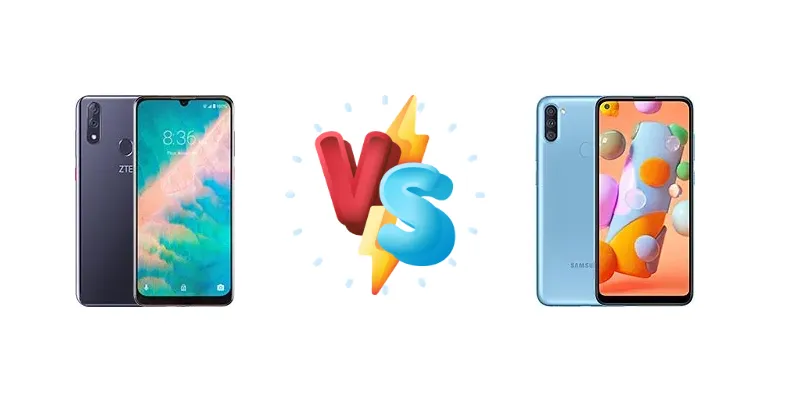
The ZTE Blade 10 Prime and Samsung Galaxy A11 represent the lower end of the smartphone spectrum, targeting users prioritizing affordability. However, beneath the similar price points lie significant differences in chipset architecture and charging capabilities. This comparison dissects these distinctions to determine which device delivers the most compelling experience for the budget-conscious consumer.
🏆 Quick Verdict
For most users, the ZTE Blade 10 Prime emerges as the better choice. Its Mediatek Helio P60 chipset, built on a more efficient 12nm process, offers a noticeable performance advantage over the Samsung Galaxy A11’s Snapdragon 450. The inclusion of 18W PD2.0 charging further sweetens the deal, providing faster top-ups than the A11’s 15W charging.
| Network |
|---|
| 2G bands | GSM 850 / 900 / 1800 / 1900 | GSM 850 / 900 / 1800 / 1900 |
| 3G bands | HSDPA 850 / 900 / 1700(AWS) / 1900 / 2100 | HSDPA 850 / 900 / 1900 / 2100 |
| 4G bands | 2, 4, 5, 12, 13, 66 | 1, 2, 3, 5, 7, 8, 20, 28, 38, 40, 41 |
| Speed | HSPA 42.2/5.76 Mbps, LTE (2CA) Cat6 300/50 Mbps | HSPA 42.2/5.76 Mbps, LTE Cat4 150/50 Mbps |
| Technology | GSM / HSPA / LTE | GSM / HSPA / LTE |
| | - | 1, 2, 3, 4, 5, 7, 8, 12, 13, 17, 20, 25, 26, 28, 38, 39, 40, 41, 66, 71 - SM-A115U |
| Launch |
|---|
| Announced | 2019, November. Released 2019, November | 2020, March 13. Released 2020, May 01 |
| Status | Discontinued | Discontinued |
| Body |
|---|
| Build | Glass front, plastic back, plastic frame | Glass front, plastic back, plastic frame |
| Dimensions | 158 x 75.2 x 7.9 mm (6.22 x 2.96 x 0.31 in) | 161.4 x 76.3 x 8 mm (6.35 x 3.00 x 0.31 in) |
| SIM | Nano-SIM + Nano-SIM | · Nano-SIM· Nano-SIM + Nano-SIM |
| Weight | 165 g (5.82 oz) | 177 g (6.24 oz) |
| Display |
|---|
| Resolution | 1080 x 2280 pixels, 19:9 ratio (~400 ppi density) | 720 x 1560 pixels, 19.5:9 ratio (~268 ppi density) |
| Size | 6.3 inches, 99.1 cm2 (~83.4% screen-to-body ratio) | 6.4 inches, 100.5 cm2 (~81.6% screen-to-body ratio) |
| Type | IPS LCD | PLS LCD |
| Platform |
|---|
| CPU | Octa-core (4x2.0 GHz Cortex-A73 & 4x2.0 GHz Cortex-A53) | Octa-core 1.8 GHz Cortex-A53 |
| Chipset | Mediatek MT6771 Helio P60 (12 nm) | Qualcomm SDM450 Snapdragon 450 (14 nm) |
| GPU | Mali-G72 MP3 | Adreno 506 |
| OS | Android 9.0 (Pie) | Android 10, upgradable to Android 12, One UI Core 4.1 |
| Memory |
|---|
| Card slot | microSDXC (uses shared SIM slot) | microSDXC (dedicated slot) |
| Internal | 64GB 3GB RAM | 32GB 2GB RAM, 32GB 3GB RAM, 64GB 3GB RAM, 64GB 4GB RAM |
| | eMMC 5.1 | eMMC 5.1 |
| Main Camera |
|---|
| Dual | 16 MP, f/1.8, 1/2.8", 1.12µm, PDAF
Auxiliary lens | - |
| Features | LED flash, HDR, panorama | LED flash, panorama, HDR |
| Triple | - | 13 MP, f/1.8, 27mm (wide), AF
5 MP, f/2.2, 115˚ (ultrawide)
Auxiliary lens |
| Video | 1080p@30fps (gyro-EIS) | 1080p@30fps |
| Selfie camera |
|---|
| Single | 16 MP, f/2.0, 26mm (wide), 1/3.06", 1.0µm | 8 MP, f/2.0 |
| Video | 1080p@30fps | 1080p@30fps |
| Sound |
|---|
| 3.5mm jack | Yes | Yes |
| 35mm jack | Yes | Yes |
| Loudspeaker | Yes | Yes |
| Comms |
|---|
| Bluetooth | 4.2, A2DP, LE | 4.2, A2DP, LE |
| NFC | Yes | No |
| Positioning | GPS | GPS, GLONASS, GALILEO, BDS |
| Radio | FM radio | FM radio |
| USB | USB Type-C 2.0 | USB Type-C 2.0 |
| WLAN | Wi-Fi 802.11 a/b/g/n/ac, dual-band, Wi-Fi Direct | Wi-Fi 802.11 b/g/n, Wi-Fi Direct |
| Features |
|---|
| Sensors | Fingerprint (rear-mounted), accelerometer, proximity, compass | Fingerprint (rear-mounted), accelerometer, proximity |
| Battery |
|---|
| Charging | 18W wired, PD2.0 | 15W wired |
| Type | Li-Po 3200 mAh, non-removable | Li-Po 4000 mAh |
| Misc |
|---|
| Colors | Black | Black, White, Blue, Red |
| Models | Z6530, Z6530M, Z6530V | SM-A115F/DS, SM-A115F, SM-A115M, SM-A115M/DS, SM-A115U, SM-A115A, SM-A115AZ, SM-A115U1, SM-A115W, SM-A115AP, SM-S115DL |
| Price | About 160 EUR | About 160 EUR |
| SAR EU | - | 0.52 W/kg (head) 0.99 W/kg (body) |
ZTE Blade 10 Prime
- Faster processor (Helio P60)
- More efficient 12nm process
- Faster 18W PD2.0 charging
- ZTE brand recognition is lower than Samsung
- Software updates may be less frequent
Samsung Galaxy A11
- Stronger brand reputation (Samsung)
- Potentially more streamlined software experience
- Wider availability in some regions
- Slower processor (Snapdragon 450)
- Less efficient 14nm process
- Slower 15W charging
Display Comparison
Neither device boasts a standout display. Both likely utilize LCD panels, common in this price bracket. However, detailed specs are missing. The focus here is on internal components. The display quality will likely be similar, with neither offering high brightness or color accuracy. Bezels are expected to be substantial on both models, reflecting their budget positioning.
Camera Comparison
Without detailed camera sensor information, a direct comparison is difficult. However, it’s safe to assume both phones feature basic camera setups geared towards casual photography. The presence of a 2MP macro lens on the A11 is likely a marketing gimmick, offering limited practical benefit. Image processing will likely differ, with Samsung typically favoring more saturated colors. The Helio P60’s ISP (Image Signal Processor) may offer slightly better processing capabilities, but the overall image quality will heavily depend on the main sensor resolution and lens aperture – specs not provided.
Performance
The core difference lies in the chipsets. The ZTE Blade 10 Prime’s Mediatek Helio P60 (12nm) utilizes a more modern architecture – Cortex-A73 cores alongside A53 cores – compared to the Samsung Galaxy A11’s Qualcomm Snapdragon 450 (14nm). This translates to a significant performance advantage for the Blade 10 Prime, particularly in CPU-intensive tasks. The Snapdragon 450’s all-Cortex-A53 configuration, while efficient, lacks the performance headroom of the Helio P60. The 12nm process node of the Helio P60 also contributes to better thermal efficiency, potentially reducing throttling during sustained workloads. This benefits users who engage in light gaming or prolonged app usage.
Battery Life
While battery capacity isn’t specified, the charging speeds are. The ZTE Blade 10 Prime’s 18W wired charging with PD2.0 support is a clear advantage over the Samsung Galaxy A11’s 15W charging. PD2.0 allows for more efficient power delivery, potentially reducing charging times. Even with a similar battery capacity, the faster charging of the Blade 10 Prime translates to less downtime. Users who frequently find themselves needing to quickly top up their phone will appreciate this difference.
Buying Guide
Buy the ZTE Blade 10 Prime if you need a phone capable of handling moderate multitasking and occasional gaming without significant slowdowns, and if faster charging is a priority. Buy the Samsung Galaxy A11 if you prioritize brand recognition and a potentially more streamlined software experience, accepting a trade-off in raw processing power and charging speed. The A11 may also appeal to those who prefer a simpler, less feature-rich interface.
Frequently Asked Questions
❓ Will the ZTE Blade 10 Prime struggle with demanding apps like TikTok or Instagram?
While not a powerhouse, the Helio P60 in the Blade 10 Prime is capable of running apps like TikTok and Instagram smoothly for most users. The Cortex-A73 cores provide a performance boost over the Snapdragon 450, minimizing lag during scrolling and video playback. However, expect some slowdowns with multiple apps open simultaneously.
❓ Is the 15W charging on the Samsung Galaxy A11 slow compared to modern smartphones?
Yes, 15W charging is relatively slow by today's standards. It will take significantly longer to fully charge the Galaxy A11 compared to the ZTE Blade 10 Prime’s 18W PD2.0 charging. Expect a 0-100% charge to take well over two hours, potentially closer to three, depending on usage during charging.
❓ Can the ZTE Blade 10 Prime handle basic mobile games?
The ZTE Blade 10 Prime can handle basic mobile games like Candy Crush or Angry Birds without issue. More demanding titles like PUBG Mobile may be playable at lower settings to maintain a stable frame rate. The Snapdragon 450 in the Galaxy A11 will likely struggle more with these games.