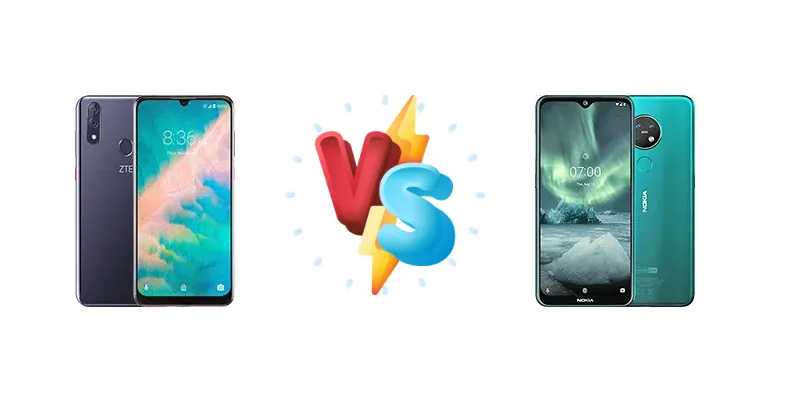
The ZTE Blade 10 Prime and Nokia 7.2 represent compelling options in the sub-$200 smartphone market. While both aim to deliver a solid Android experience without breaking the bank, they take different approaches to achieving this goal, primarily diverging in their chipset choices and display characteristics. This comparison dissects these differences to determine which device offers the best value.
🏆 Quick Verdict
For the average user prioritizing a slightly better display and potentially smoother software experience, the Nokia 7.2 is the stronger choice. However, the ZTE Blade 10 Prime’s faster 18W charging offers a convenience advantage, making it suitable for users who frequently need a quick power boost.
| Network |
|---|
| 2G bands | GSM 850 / 900 / 1800 / 1900 | GSM 850 / 900 / 1800 / 1900 |
| 3G bands | HSDPA 850 / 900 / 1700(AWS) / 1900 / 2100 | HSDPA 850 / 900 / 2100 - ROW |
| 4G bands | 2, 4, 5, 12, 13, 66 | 1, 3, 5, 7, 8, 20, 28, 38, 40, 41 - ROW |
| Speed | HSPA 42.2/5.76 Mbps, LTE (2CA) Cat6 300/50 Mbps | HSPA 42.2/5.76 Mbps, LTE (2CA) Cat6 300/50 Mbps or LTE Cat4 150/50 Mbps |
| Technology | GSM / HSPA / LTE | GSM / HSPA / LTE |
| | - | 1, 3, 5, 8, 40, 41 - IN |
| Launch |
|---|
| Announced | 2019, November. Released 2019, November | 2019, September 05. Released 2019, September 23 |
| Status | Discontinued | Discontinued |
| Body |
|---|
| Build | Glass front, plastic back, plastic frame | Glass front (Gorilla Glass 3), glass back (Gorilla Glass 3), plastic frame |
| Dimensions | 158 x 75.2 x 7.9 mm (6.22 x 2.96 x 0.31 in) | 159.9 x 75.2 x 8.3 mm (6.30 x 2.96 x 0.33 in) |
| SIM | Nano-SIM + Nano-SIM | · Nano-SIM· Nano-SIM + Nano-SIM |
| Weight | 165 g (5.82 oz) | 180 g (6.35 oz) |
| Display |
|---|
| Protection | - | Corning Gorilla Glass 3 |
| Resolution | 1080 x 2280 pixels, 19:9 ratio (~400 ppi density) | 1080 x 2280 pixels, 19:9 ratio (~400 ppi density) |
| Size | 6.3 inches, 99.1 cm2 (~83.4% screen-to-body ratio) | 6.3 inches, 99.1 cm2 (~82.4% screen-to-body ratio) |
| Type | IPS LCD | IPS LCD, HDR10 |
| Platform |
|---|
| CPU | Octa-core (4x2.0 GHz Cortex-A73 & 4x2.0 GHz Cortex-A53) | Octa-core (4x2.2 GHz Kryo 260 Gold & 4x1.8 GHz Kryo 260 Silver) |
| Chipset | Mediatek MT6771 Helio P60 (12 nm) | Qualcomm SDM660 Snapdragon 660 (14 nm) |
| GPU | Mali-G72 MP3 | Adreno 512 |
| OS | Android 9.0 (Pie) | Android 9.0 (Pie), upgradable to Android 11, Android One |
| Memory |
|---|
| Card slot | microSDXC (uses shared SIM slot) | microSDXC (dedicated slot) |
| Internal | 64GB 3GB RAM | 64GB 4GB RAM, 64GB 6GB RAM, 128GB 4GB RAM, 128GB 6GB RAM |
| | eMMC 5.1 | eMMC 5.1 |
| Main Camera |
|---|
| Dual | 16 MP, f/1.8, 1/2.8", 1.12µm, PDAF
Auxiliary lens | - |
| Features | LED flash, HDR, panorama | Zeiss optics, LED flash, panorama, HDR |
| Triple | - | 48 MP, f/1.8, (wide), 1/2.0", 0.8µm, PDAF
8 MP, f/2.2, 13mm (ultrawide), 1/4.0", 1.12µm
Auxiliary lens |
| Video | 1080p@30fps (gyro-EIS) | 4K@30fps, 1080p@30fps (gyro-EIS) |
| Selfie camera |
|---|
| Features | - | Zeiss optics, HDR |
| Single | 16 MP, f/2.0, 26mm (wide), 1/3.06", 1.0µm | 20 MP, f/2.0, (wide), 1/3", 0.9µm |
| Video | 1080p@30fps | 1080p@30fps |
| Sound |
|---|
| 3.5mm jack | Yes | Yes |
| 35mm jack | Yes | Yes |
| Loudspeaker | Yes | Yes |
| Comms |
|---|
| Bluetooth | 4.2, A2DP, LE | 5.0, A2DP, EDR, LE, aptX |
| NFC | Yes | Yes (excl. India) |
| Positioning | GPS | GPS, GLONASS, GALILEO, BDS |
| Radio | FM radio | FM radio |
| USB | USB Type-C 2.0 | USB Type-C 2.0, OTG |
| WLAN | Wi-Fi 802.11 a/b/g/n/ac, dual-band, Wi-Fi Direct | Wi-Fi 802.11 b/g/n/ac, dual-band, Wi-Fi Direct |
| Features |
|---|
| Sensors | Fingerprint (rear-mounted), accelerometer, proximity, compass | Fingerprint (rear-mounted), accelerometer, gyro, proximity, compass |
| Battery |
|---|
| Charging | 18W wired, PD2.0 | 10W wired |
| Type | Li-Po 3200 mAh, non-removable | Li-Po 3500 mAh, non-removable |
| Misc |
|---|
| Colors | Black | Cyan Green, Charcoal, Ice |
| Models | Z6530, Z6530M, Z6530V | TA-1193, TA-1178, TA-1196, TA-1181 |
| Price | About 160 EUR | About 240 EUR |
| SAR | - | 1.15 W/kg (head) 0.90 W/kg (body) |
| SAR EU | - | 0.99 W/kg (head) 1.44 W/kg (body) |
| Tests |
|---|
| Audio quality | - |
Noise -93.0dB / Crosstalk -93.4dB |
| Battery life | - |
Endurance rating 69h
|
| Camera | - |
Photo / Video |
| Display | - |
Contrast ratio: 1342:1 (nominal) |
| Loudspeaker | - |
-29.6 LUFS (Average)
|
| Performance | - |
AnTuTu: 139495 (v7), 164484 (v8)
GeekBench: 5440 (v4.4), 1398 (v5.1)
GFXBench: 8.1fps (ES 3.1 onscreen) |
ZTE Blade 10 Prime
- Faster 18W charging with PD2.0
- Potentially more efficient chipset (12nm)
- Likely more software customization options
- Potentially less refined software experience
- Likely inferior display quality compared to Nokia 7.2
Nokia 7.2
- Brighter and higher contrast display (585 nits, 1342:1)
- Slightly more powerful Snapdragon 660 chipset
- Cleaner, near-stock Android experience
- Slower 10W charging
- Less efficient chipset (14nm)
Display Comparison
The Nokia 7.2 boasts a demonstrably superior display, achieving a measured peak brightness of 585 nits and a 1342:1 contrast ratio. While the Blade 10 Prime’s display specifications are not provided, these figures suggest a more vibrant and readable experience on the Nokia, particularly outdoors. The identical contrast ratio suggests similar panel technology, but the brightness difference is key. This benefits users who consume a lot of media or work outdoors.
Camera Comparison
Both devices are listed as having Photo/Video capabilities, but lack specific details. Without sensor size or aperture information, a direct comparison is difficult. However, given the Nokia 7.2’s positioning, it likely benefits from Qualcomm’s image signal processing (ISP), potentially resulting in better dynamic range and low-light performance. The ZTE Blade 10 Prime’s camera performance is likely more reliant on software optimization. The absence of details suggests neither phone will excel in challenging photographic conditions.
Performance
The core difference lies in the chipsets: the ZTE Blade 10 Prime utilizes the Mediatek Helio P60 (12nm), while the Nokia 7.2 features the Qualcomm Snapdragon 660 (14nm). Although both are octa-core CPUs, the Snapdragon 660’s Kryo 260 cores, clocked at 2.2 GHz, offer a slight performance edge over the Helio P60’s Cortex-A73 cores at 2.0 GHz. The 14nm process of the Snapdragon 660 is less efficient than the 12nm process of the Helio P60, but the architectural advantages of the Kryo cores likely offset this. This translates to slightly smoother multitasking and app loading on the Nokia 7.2.
Battery Life
Both phones share an endurance rating of 69 hours, indicating similar overall battery life. However, the ZTE Blade 10 Prime’s 18W wired charging with PD2.0 support is a significant advantage over the Nokia 7.2’s slower 10W charging. This means the Blade 10 Prime can replenish its battery much faster, reducing downtime. While battery capacity isn’t specified, the faster charging speed is a tangible benefit for users who need to quickly top up their device.
Buying Guide
Buy the ZTE Blade 10 Prime if you prioritize fast charging and are comfortable with potentially more software customization. Its 18W PD2.0 charging is a significant advantage for those constantly on the go. Buy the Nokia 7.2 if you value a brighter, higher-contrast display and a cleaner, near-stock Android experience, even if it means slower charging speeds.
Frequently Asked Questions
❓ Does the ZTE Blade 10 Prime's 18W charging support Quick Charge or only PD2.0?
The specifications explicitly state PD2.0 support. While some PD chargers may be compatible with Quick Charge devices, it's not guaranteed. Using a PD-compatible charger is recommended to achieve the full 18W charging speed.
❓ Is the Snapdragon 660 in the Nokia 7.2 powerful enough for modern mobile games like PUBG or Call of Duty?
The Snapdragon 660 can handle PUBG and Call of Duty Mobile, but likely at medium graphics settings. Expect some frame drops during intense scenes. It's not a gaming powerhouse, but it provides a playable experience for casual gamers.
❓ How does the software experience differ between the ZTE Blade 10 Prime and Nokia 7.2?
The Nokia 7.2 is part of the Android One program, offering a clean, near-stock Android experience with guaranteed software updates. The ZTE Blade 10 Prime likely features a more customized Android skin, potentially with pre-installed apps and a different user interface.
❓ Given the similar endurance ratings, does that mean both phones have the same battery capacity?
Not necessarily. Endurance rating considers both battery capacity *and* power efficiency. While both phones last roughly the same on a single charge, the ZTE Blade 10 Prime's more efficient chipset (12nm) might allow it to achieve similar endurance with a slightly smaller battery.