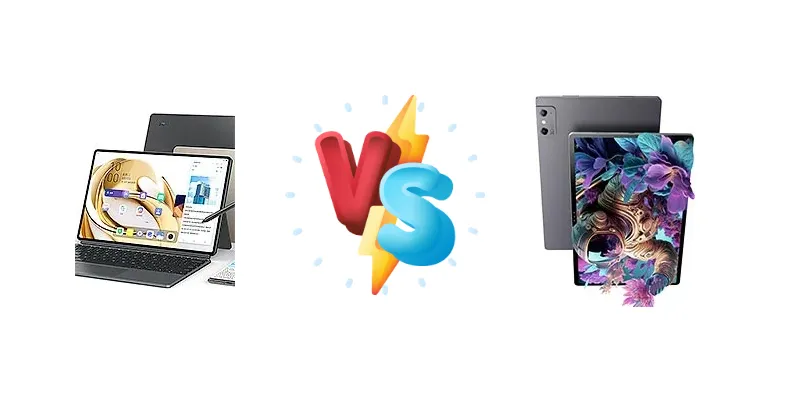
The tablet market is heating up, and ZTE is vying for a piece of the action. We're pitting two of their offerings, the Axon Pad and the Nubia Pad 3D, against each other. Both promise premium features, but which one delivers the best overall experience?
🏆 Quick Verdict
The ZTE Axon Pad takes the crown thanks to its significantly faster Snapdragon 8+ Gen 1 chipset and much quicker 80W charging. While the Nubia Pad 3D boasts a unique 3D display, the Axon Pad's raw power and charging speed make it the more compelling choice for most users.
| Network |
|---|
| 2G bands | GSM 850 / 900 / 1800 / 1900 | N/A |
| 3G bands | HSDPA 850 / 900 / 2100 | N/A |
| 4G bands | 1, 3, 5, 7, 8, 4, 12, 17, 20, 34, 38, 39, 40, 41 | N/A |
| 5G bands | 1, 5, 8, 28, 41, 78 SA/NSA | - |
| EDGE | - | No |
| GPRS | - | No |
| Speed | HSPA, LTE, 5G | - |
| Technology | GSM / HSPA / LTE / 5G | No cellular connectivity |
| Launch |
|---|
| Announced | 2023, April 12 | 2023, February 28 |
| Status | Available. Released 2023, May | Available. Released 2023, April 11 |
| Body |
|---|
| Build | - | Glass front, aluminum frame, aluminum back |
| Dimensions | 279 x 181 x 6.5 mm (10.98 x 7.13 x 0.26 in) | 285 x 190 x 8.5 mm (11.22 x 7.48 x 0.33 in) |
| SIM | Nano-SIM | No |
| Weight | 605 g (1.33 lb) | 780 g (1.72 lb) |
| Display |
|---|
| Protection | - | Corning Gorilla Glass |
| Resolution | 1600 x 2560 pixels, 16:10 ratio (~249 ppi density) | 1600 x 2560 pixels, 16:10 ratio (~243 ppi density) |
| Size | 12.1 inches, 424.5 cm2 (~84.1% screen-to-body ratio) | 12.4 inches, 445.8 cm2 (~82.3% screen-to-body ratio) |
| Type | IPS LCD, 1B colors, 120Hz | IPS LCD, 120Hz |
| | - | 3D lightfield display
Real-time 2D to 3D content conversion |
| Platform |
|---|
| CPU | Octa-core (1x3.0 GHz Cortex-X2 & 3x2.5 GHz Cortex-A710 & 4x1.8 GHz Cortex-A510) | Octa-core (1x2.84 GHz Cortex-X1 & 3x2.42 GHz Cortex-A78 & 4x1.80 GHz Cortex-A55) |
| Chipset | Qualcomm SM8475 Snapdragon 8+ Gen 1 (4 nm) | Qualcomm SM8350 Snapdragon 888 5G (5 nm) |
| GPU | Adreno 730 | Adreno 660 |
| OS | Android 13, MyOS 13 | Android 12L |
| Memory |
|---|
| Card slot | No | microSDXC (dedicated slot) |
| Internal | 256GB 8GB RAM, 512GB 12GB RAM | 128GB 8GB RAM, 256GB 8GB RAM |
| Main Camera |
|---|
| Dual | - | 16 MP, f/1.9, 27mm (wide), AF
16 MP, f/1.9, 27mm (wide), AF |
| Features | LED flash, HDR, panorama | LED flash, HDR, panorama, stereoscopic Al-powered 3D capture |
| Single | 13 MP, AF | - |
| Video | 1080p@30fps | 1200p@30fps |
| Selfie camera |
|---|
| Dual | - | 8 MP, f.2,2, 105˚ (ultrawide)
8 MP, f.2,2, 105˚ (ultrawide) |
| Features | - | Stereoscopic Al-powered 3D capture |
| Single | 16 MP | - |
| Video | 1080p@30fps | 1200p@30fps |
| Sound |
|---|
| 3.5mm jack | No | No |
| 35mm jack | No | No |
| Loudspeaker | Yes, with stereo speakers (4 speakers) | Yes, with stereo speakers (4 speakers) |
| Comms |
|---|
| Bluetooth | 5.2, A2DP, LE, aptX HD, aptX Adaptive, aptX Lossless | 5.2, A2DP, LE |
| NFC | Yes | No |
| Positioning | GPS, GLONASS, GALILEO, BDS | GPS (L1+L5), BDS (B1I+B1c+B2a) |
| Radio | No | No |
| USB | USB Type-C 3.1, OTG, magnetic connector | USB Type-C 3.1, OTG, magnetic connector, video output |
| WLAN | Wi-Fi 802.11 a/b/g/n/ac/6, dual-band | Wi-Fi 802.11 a/b/g/n/ac/6, dual-band |
| Features |
|---|
| Sensors | Accelerometer, gyro, compass, proximity (accessories only) | Accelerometer, gyro, compass, proximity (accessories only) |
| Battery |
|---|
| Charging | 80W wired | 33W wired |
| Type | Li-Po 10000 mAh | 9070 mAh |
| Misc |
|---|
| Colors | Black, Gold | Gray |
| Price | About 460 EUR | About 1300 EUR |
ZTE Axon Pad
- Significantly faster performance (Snapdragon 8+ Gen 1)
- Much faster 80W charging
- Likely better display quality (higher resolution/refresh rate)
- Potentially larger battery
- 3D display absent
- Potentially higher price
ZTE nubia Pad 3D
- Unique 3D display (for compatible content)
- Potentially more affordable
- Decent performance for everyday tasks
- Slower performance (Snapdragon 888)
- Slower 33W charging
- Likely lower display quality
- 3D content availability limited
Display Comparison
The Nubia Pad 3D's standout feature is its 3D display, offering a unique visual experience for compatible content. However, it's a niche feature. The Axon Pad likely features a standard, high-quality LCD or OLED display (specifications are not fully available), potentially with a higher resolution and refresh rate, offering a more versatile viewing experience for general use. Both likely have similar size ranges (around 10-11 inches).
Camera Comparison
Camera specs are not readily available for either device. Both are likely to have decent front and rear cameras suitable for video calls and casual photography, but neither is expected to be a flagship-level camera system. Image quality will likely be comparable.
Performance
Here's where the Axon Pad truly shines. The Snapdragon 8+ Gen 1 is a substantial upgrade over the Snapdragon 888. Expect significantly faster app loading times, smoother multitasking, and better gaming performance on the Axon Pad. The Nubia Pad 3D will still be capable, but it won't match the Axon Pad's raw power.
Battery Life
Battery capacity is not explicitly stated for either device. However, the Axon Pad's 80W charging suggests a larger battery or at least a more efficient power management system. The Nubia Pad 3D's 33W charging is considerably slower, meaning longer charging times.
Buying Guide
The ZTE Axon Pad is ideal for power users, gamers, and anyone who demands top-tier performance in a tablet. The ZTE Nubia Pad 3D is a good option for those prioritizing a unique 3D viewing experience and a slightly more budget-friendly price, though performance will be noticeably slower.
Frequently Asked Questions
❓ What is the difference between the Snapdragon 8+ Gen 1 and the Snapdragon 888?
The Snapdragon 8+ Gen 1 is a significantly faster and more efficient chipset than the Snapdragon 888, offering improved performance and battery life.
❓ Is the Nubia Pad 3D's 3D display worth it?
The 3D display is a niche feature. It's only worthwhile if you frequently consume 3D content and appreciate the immersive experience. Content availability is a key factor.