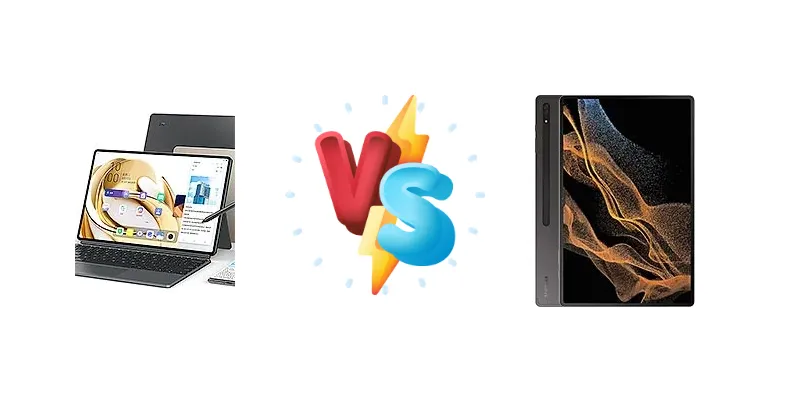
The Android tablet market is heating up, with the ZTE Axon Pad aiming to disrupt Samsung’s dominance. While the Samsung Galaxy Tab S8 Ultra has been the benchmark for premium large-screen tablets, the Axon Pad arrives with a newer generation Snapdragon processor and significantly faster charging. This comparison dissects the key differences to determine which tablet best suits your needs.
🏆 Quick Verdict
For most users, the ZTE Axon Pad offers a compelling value proposition. Its Snapdragon 8+ Gen 1 provides comparable performance to the Tab S8 Ultra’s Snapdragon 8 Gen 1, coupled with the advantage of 80W charging. While Samsung excels in ecosystem integration and potentially display quality, the Axon Pad delivers flagship-level performance at a potentially lower price.
| Network |
|---|
| 2G bands | GSM 850 / 900 / 1800 / 1900 | GSM 850 / 900 / 1800 / 1900 |
| 3G bands | HSDPA 850 / 900 / 2100 | HSDPA 850 / 900 / 1700(AWS) / 1900 / 2100 |
| 4G bands | 1, 3, 5, 7, 8, 4, 12, 17, 20, 34, 38, 39, 40, 41 | LTE |
| 5G bands | 1, 5, 8, 28, 41, 78 SA/NSA | SA/NSA |
| Speed | HSPA, LTE, 5G | HSPA, LTE, 5G - cellular model only |
| Technology | GSM / HSPA / LTE / 5G | GSM / HSPA / LTE / 5G |
| Launch |
|---|
| Announced | 2023, April 12 | 2022, February 09 |
| Status | Available. Released 2023, May | Available. Released 2022, April 30 |
| Body |
|---|
| Dimensions | 279 x 181 x 6.5 mm (10.98 x 7.13 x 0.26 in) | 326.4 x 208.6 x 5.5 mm (12.85 x 8.21 x 0.22 in) |
| SIM | Nano-SIM | Nano-SIM (cellular model only) |
| Weight | 605 g (1.33 lb) | 726 g (Wi-Fi), 728 g (5G) (1.60 lb) |
| | - | Stylus, 2.8ms latency (Bluetooth integration, accelerometer, gyro) |
| Display |
|---|
| Protection | - | Corning Gorilla Glass 5 |
| Resolution | 1600 x 2560 pixels, 16:10 ratio (~249 ppi density) | 1848 x 2960 pixels, 16:10 ratio (~240 ppi density) |
| Size | 12.1 inches, 424.5 cm2 (~84.1% screen-to-body ratio) | 14.6 inches, 612.6 cm2 (~90.0% screen-to-body ratio) |
| Type | IPS LCD, 1B colors, 120Hz | Super AMOLED, 120Hz, HDR10+ |
| Platform |
|---|
| CPU | Octa-core (1x3.0 GHz Cortex-X2 & 3x2.5 GHz Cortex-A710 & 4x1.8 GHz Cortex-A510) | Octa-core (1x3.00 GHz Cortex-X2 & 3x2.50 GHz Cortex-A710 & 4x1.80 GHz Cortex-A510) |
| Chipset | Qualcomm SM8475 Snapdragon 8+ Gen 1 (4 nm) | Qualcomm SM8450 Snapdragon 8 Gen 1 (4 nm) |
| GPU | Adreno 730 | Adreno 730 |
| OS | Android 13, MyOS 13 | Android 12, up to 4 major Android upgrades, One UI 6.1.1 |
| Memory |
|---|
| Card slot | No | microSDXC (dedicated slot) |
| Internal | 256GB 8GB RAM, 512GB 12GB RAM | 128GB 8GB RAM, 256GB 8GB RAM, 256GB 12GB RAM, 256GB 16GB RAM, 512GB 12GB RAM, 512GB 16GB RAM |
| | - | UFS |
| Main Camera |
|---|
| Dual | - | 13 MP, f/2.0, 26mm (wide), 1/3.4", 1.0µm, AF
6 MP, f/2.2, (ultrawide) |
| Features | LED flash, HDR, panorama | LED flash, HDR, panorama |
| Single | 13 MP, AF | - |
| Video | 1080p@30fps | 4K@30/60fps, 1080p@30fps |
| Selfie camera |
|---|
| Dual | - | 12 MP, f/2.2, 26mm (wide)
12 MP, f/2.4, 120˚ (ultrawide) |
| Features | - | HDR |
| Single | 16 MP | - |
| Video | 1080p@30fps | 4K@30/60fps, 1080p@30fps |
| Sound |
|---|
| 3.5mm jack | No | No |
| 35mm jack | No | No |
| Loudspeaker | Yes, with stereo speakers (4 speakers) | Yes, with stereo speakers (4 speakers) |
| | - | Tuned by AKG |
| Comms |
|---|
| Bluetooth | 5.2, A2DP, LE, aptX HD, aptX Adaptive, aptX Lossless | 5.2, A2DP, LE |
| NFC | Yes | No |
| Positioning | GPS, GLONASS, GALILEO, BDS | GPS, GLONASS, BDS, GALILEO - cellular model only |
| Radio | No | No |
| USB | USB Type-C 3.1, OTG, magnetic connector | USB Type-C 3.2, magnetic connector |
| WLAN | Wi-Fi 802.11 a/b/g/n/ac/6, dual-band | Wi-Fi 802.11 a/b/g/n/ac/6e, dual-band, Wi-Fi Direct |
| Features |
|---|
| Sensors | Accelerometer, gyro, compass, proximity (accessories only) | Fingerprint (under display, optical), accelerometer, gyro, proximity, compass |
| | - | Wireless Samsung DeX |
| Battery |
|---|
| Charging | 80W wired | 45W wired, 100% in 82 min |
| Type | Li-Po 10000 mAh | Li-Po 11200 mAh |
| Misc |
|---|
| Colors | Black, Gold | Graphite |
| Models | - | SM-X900, SM-X906, SM-X906B, SM-X906U, SM-X906N |
| Price | About 460 EUR | About 1150 EUR |
| SAR EU | - | 0.69 W/kg (body) |
ZTE Axon Pad
- Faster 80W charging for quicker top-ups
- Potentially better sustained performance with Snapdragon 8+ Gen 1
- Likely more competitive price point
- Missing display specifications limit assessment of visual experience
- Camera details are currently unknown
Samsung Galaxy Tab S8 Ultra
- Premium Super AMOLED display with potential LTPO support
- Established Samsung ecosystem integration
- S Pen support for enhanced productivity
- Slower 45W charging compared to the Axon Pad
- Snapdragon 8 Gen 1 may throttle more under sustained load
- Higher price point
Display Comparison
While both tablets feature large displays, specific details like panel type and resolution are missing for the Axon Pad. The Tab S8 Ultra boasts a 14.6-inch Super AMOLED display, likely with LTPO technology for adaptive refresh rates up to 120Hz, contributing to power efficiency. The Samsung’s display is expected to achieve higher peak brightness levels, enhancing outdoor visibility. The Axon Pad’s display quality will be a key factor in determining its overall value, but without further specs, it’s difficult to assess its competitiveness against Samsung’s established display prowess.
Camera Comparison
Detailed camera specifications for the ZTE Axon Pad are currently unavailable. The Samsung Galaxy Tab S8 Ultra features a 13MP main camera and a 6MP ultrawide camera. Given the tablet form factor, camera quality isn’t a primary concern for most users. However, the Tab S8 Ultra’s larger sensor and potentially superior image processing algorithms will likely deliver better results in challenging lighting conditions. The absence of detailed camera information for the Axon Pad makes a direct comparison difficult.
Performance
The ZTE Axon Pad utilizes the Qualcomm SM8475 Snapdragon 8+ Gen 1 (4nm), while the Samsung Galaxy Tab S8 Ultra features the SM8450 Snapdragon 8 Gen 1 (4nm). Although both are 4nm chips, the ‘+’ variant in the Axon Pad generally indicates improved thermal efficiency and sustained performance. Both CPUs share the same core configuration – 1x3.0 GHz Cortex-X2, 3x2.5 GHz Cortex-A710, and 4x1.8 GHz Cortex-A510 – suggesting similar multi-core performance. However, the Axon Pad’s potentially better thermal management could translate to less throttling during extended gaming sessions. Both tablets likely utilize LPDDR5X RAM, but the specific speed and capacity will influence multitasking capabilities.
Battery Life
Battery capacity details for the Axon Pad are missing. The Samsung Galaxy Tab S8 Ultra packs an 11,200mAh battery and supports 45W wired charging, taking approximately 82 minutes for a full charge. The ZTE Axon Pad’s 80W wired charging is a significant advantage, promising substantially faster charging times. Even if the Axon Pad has a slightly smaller battery capacity, the faster charging could mitigate concerns about battery life, offering more convenient top-ups throughout the day.
Buying Guide
Buy the ZTE Axon Pad if you prioritize raw performance for gaming and multitasking, and demand incredibly fast charging speeds. It’s ideal for users who want a powerful tablet without the premium Samsung price tag. Buy the Samsung Galaxy Tab S8 Ultra if you’re deeply invested in the Samsung ecosystem, require the S Pen’s advanced features, and value a potentially superior display experience with features like LTPO and a higher peak brightness.
Frequently Asked Questions
❓ Does the Snapdragon 8+ Gen 1 in the Axon Pad offer a noticeable performance difference over the Snapdragon 8 Gen 1 in the Tab S8 Ultra during demanding games?
While both chips are powerful, the Snapdragon 8+ Gen 1 generally exhibits better thermal efficiency. This means the Axon Pad is less likely to experience significant performance throttling during prolonged gaming sessions, potentially leading to more consistent frame rates and a smoother overall experience.
❓ How much faster is the 80W charging on the ZTE Axon Pad compared to the 45W charging on the Samsung Tab S8 Ultra in real-world usage?
The 80W charging on the Axon Pad can potentially reduce charging times by over 40% compared to the Tab S8 Ultra. While Samsung claims 82 minutes for a full charge, the Axon Pad could achieve a full charge in under an hour, offering a significant convenience factor for users who frequently need to top up their battery.
❓ Is the lack of S Pen support on the ZTE Axon Pad a significant drawback for users who rely on stylus input for note-taking or creative tasks?
For users heavily invested in stylus-based workflows, the absence of S Pen support on the Axon Pad is a notable limitation. The Samsung Galaxy Tab S8 Ultra’s S Pen offers low latency and advanced features, making it a compelling option for artists, designers, and note-takers.