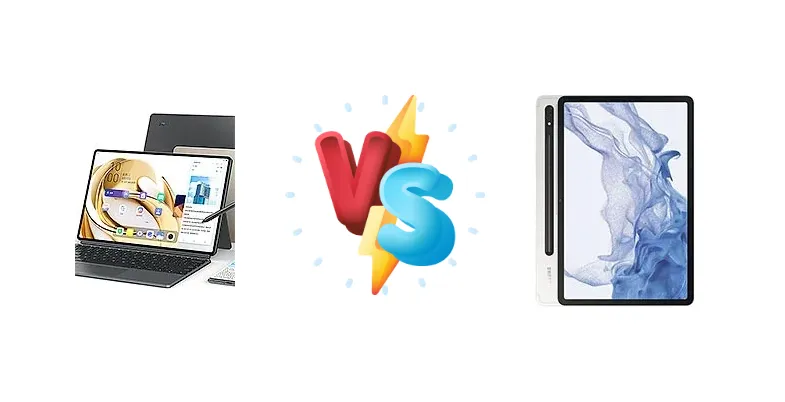
The tablet market is heating up, and two contenders are vying for your attention: the ZTE Axon Pad and the Samsung Galaxy Tab S8. Both offer premium features and powerful performance, but which one truly delivers the best experience? Let's dive into a comprehensive comparison to help you decide.
🏆 Quick Verdict
The Samsung Galaxy Tab S8 edges out the ZTE Axon Pad thanks to its superior display, refined software experience, and established ecosystem. While the Axon Pad boasts a faster charging speed and a slightly more powerful chipset, Samsung's overall polish and features make it the better choice for most users.
| Network |
|---|
| 2G bands | GSM 850 / 900 / 1800 / 1900 | GSM 850 / 900 / 1800 / 1900 |
| 3G bands | HSDPA 850 / 900 / 2100 | HSDPA 850 / 900 / 1700(AWS) / 1900 / 2100 |
| 4G bands | 1, 3, 5, 7, 8, 4, 12, 17, 20, 34, 38, 39, 40, 41 | LTE |
| 5G bands | 1, 5, 8, 28, 41, 78 SA/NSA | SA/NSA |
| Speed | HSPA, LTE, 5G | HSPA, LTE, 5G - cellular model only |
| Technology | GSM / HSPA / LTE / 5G | GSM / HSPA / LTE / 5G |
| Launch |
|---|
| Announced | 2023, April 12 | 2022, February 09 |
| Status | Available. Released 2023, May | Available. Released 2022, March 22 |
| Body |
|---|
| Dimensions | 279 x 181 x 6.5 mm (10.98 x 7.13 x 0.26 in) | 253.8 x 165.3 x 6.3 mm (9.99 x 6.51 x 0.25 in) |
| SIM | Nano-SIM | Nano-SIM (cellular model only) |
| Weight | 605 g (1.33 lb) | 503 g (Wi-Fi), 507 g (5G) (1.11 lb) |
| | - | Stylus, 6.2ms latency (Bluetooth integration, accelerometer, gyro) |
| Display |
|---|
| Protection | - | Corning Gorilla Glass 5 |
| Resolution | 1600 x 2560 pixels, 16:10 ratio (~249 ppi density) | 1600 x 2560 pixels, 16:10 ratio (~274 ppi density) |
| Size | 12.1 inches, 424.5 cm2 (~84.1% screen-to-body ratio) | 11.0 inches, 350.9 cm2 (~83.6% screen-to-body ratio) |
| Type | IPS LCD, 1B colors, 120Hz | TFT LCD, 120Hz |
| Platform |
|---|
| CPU | Octa-core (1x3.0 GHz Cortex-X2 & 3x2.5 GHz Cortex-A710 & 4x1.8 GHz Cortex-A510) | Octa-core (1x3.00 GHz Cortex-X2 & 3x2.50 GHz Cortex-A710 & 4x1.80 GHz Cortex-A510) |
| Chipset | Qualcomm SM8475 Snapdragon 8+ Gen 1 (4 nm) | Qualcomm SM8450 Snapdragon 8 Gen 1 (4 nm) |
| GPU | Adreno 730 | Adreno 730 |
| OS | Android 13, MyOS 13 | Android 12, up to 4 major Android upgrades, One UI 6.1.1 |
| Memory |
|---|
| Card slot | No | microSDXC (dedicated slot) |
| Internal | 256GB 8GB RAM, 512GB 12GB RAM | 128GB 8GB RAM, 256GB 8GB RAM, 256GB 12GB RAM |
| | - | UFS |
| Main Camera |
|---|
| Dual | - | 13 MP, f/2.0, 26mm (wide), 1/3.4", 1.0µm, AF
6 MP, f/2.2, (ultrawide) |
| Features | LED flash, HDR, panorama | LED flash, HDR, panorama |
| Single | 13 MP, AF | - |
| Video | 1080p@30fps | 4K@30/60fps, 1080p@30fps |
| Selfie camera |
|---|
| Dual | - | 12 MP, f/2.4, 120˚ (ultrawide) |
| Features | - | HDR |
| Single | 16 MP | - |
| Video | 1080p@30fps | 4K@30/60fps, 1080p@30fps |
| Sound |
|---|
| 3.5mm jack | No | No |
| 35mm jack | No | No |
| Loudspeaker | Yes, with stereo speakers (4 speakers) | Yes, with stereo speakers (4 speakers) |
| | - | Tuned by AKG |
| Comms |
|---|
| Bluetooth | 5.2, A2DP, LE, aptX HD, aptX Adaptive, aptX Lossless | 5.2, A2DP, LE |
| NFC | Yes | No |
| Positioning | GPS, GLONASS, GALILEO, BDS | GPS, GLONASS, BDS, GALILEO - cellular model only |
| Radio | No | No |
| USB | USB Type-C 3.1, OTG, magnetic connector | USB Type-C 3.2, magnetic connector |
| WLAN | Wi-Fi 802.11 a/b/g/n/ac/6, dual-band | Wi-Fi 802.11 a/b/g/n/ac/6e, dual-band, Wi-Fi Direct |
| Features |
|---|
| Sensors | Accelerometer, gyro, compass, proximity (accessories only) | Fingerprint (side-mounted), accelerometer, gyro, proximity, compass |
| | - | Wireless Samsung DeX |
| Battery |
|---|
| Charging | 80W wired | 45W wired, 100% in 80 min |
| Type | Li-Po 10000 mAh | Li-Po 8000 mAh |
| Misc |
|---|
| Colors | Black, Gold | Graphite, Silver, Pink Gold |
| Models | - | SM-X700, SM-X706, SM-X706B, SM-X706U, SM-X706N |
| Price | About 460 EUR | About 350 EUR |
| SAR EU | - | 0.87 W/kg (body) |
ZTE Axon Pad
- Faster Charging (80W)
- Slightly More Powerful Chipset (Snapdragon 8+ Gen 1)
- Potentially More Affordable
- Less Refined Software
- Unknown Display Quality
- Less Established Ecosystem
- Camera Performance Lags Behind
Samsung Galaxy Tab S8
- Superior Display (LCD, 120Hz)
- Optimized Software Experience (One UI)
- Robust Ecosystem & Accessories
- Better Camera System
- Slower Charging (45W)
- Higher Price Point
- Snapdragon 8 Gen 1 (slightly less powerful)
Display Comparison
The Samsung Galaxy Tab S8 features a stunning 11-inch LCD display with a 120Hz refresh rate, delivering vibrant colors and smooth visuals. The Axon Pad also has an 11-inch display, but details on its panel type and refresh rate are less prominent, suggesting a potentially less impressive visual experience. Samsung's display is generally considered superior.
Camera Comparison
The Samsung Galaxy Tab S8 boasts a more versatile camera system with a wider range of features and generally better image quality. The Axon Pad's camera setup is adequate but doesn't match the Tab S8's capabilities. Samsung's image processing is also superior.
Performance
Both tablets are powered by Snapdragon 8-series chips, but the ZTE Axon Pad utilizes the Snapdragon 8+ Gen 1, offering a slight edge in raw processing power. However, Samsung's optimized software and efficient thermal management often result in comparable real-world performance. Gaming performance should be excellent on both.
Battery Life
The Samsung Galaxy Tab S8 has a 10,000 mAh battery, providing excellent battery life. The Axon Pad's battery capacity is unknown, but its 80W charging speed significantly outperforms the Tab S8's 45W charging, allowing for quicker top-ups.
Buying Guide
Who should buy the ZTE Axon Pad? Gamers and power users seeking raw performance and fast charging on a budget. Who should buy the Samsung Galaxy Tab S8? Users prioritizing a premium display, seamless software integration, and a robust ecosystem of accessories and services.
Frequently Asked Questions
❓ Is the ZTE Axon Pad good for gaming?
Yes, the Axon Pad's Snapdragon 8+ Gen 1 chipset makes it capable of handling demanding games, but thermal management could be a factor during extended gaming sessions.
❓ Does the Samsung Galaxy Tab S8 support the S Pen?
Yes, the Galaxy Tab S8 includes an S Pen, offering a natural writing and drawing experience. The Axon Pad does not have S Pen support.