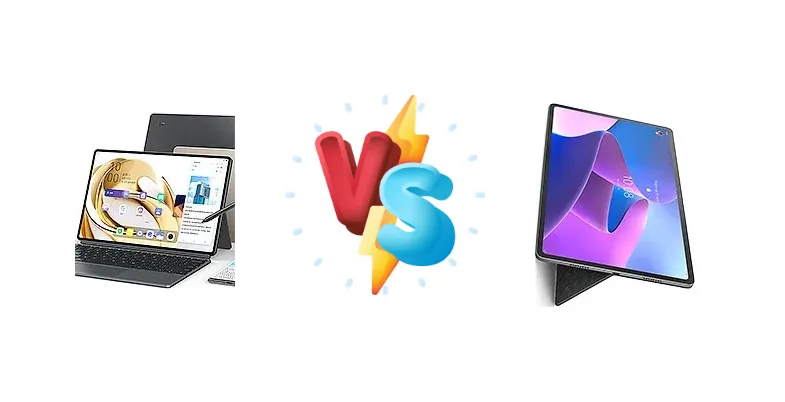
The tablet market is heating up, and these two contenders – the ZTE Axon Pad and the Lenovo Tab P12 Pro – are vying for your attention. Both offer premium features and powerful performance, but which one truly delivers the best experience? Let's dive into a comprehensive comparison to help you decide.
🏆 Quick Verdict
The ZTE Axon Pad boasts a significantly faster Snapdragon 8+ Gen 1 chipset and faster charging, making it the performance champion. However, the Lenovo Tab P12 Pro offers a more refined software experience and potentially better display quality. It depends on your priorities: raw power or overall polish.
| Network |
|---|
| 2G bands | GSM 850 / 900 / 1800 / 1900 | GSM 850 / 900 / 1800 / 1900 |
| 3G bands | HSDPA 850 / 900 / 2100 | HSDPA 850 / 900 / 1900 / 2100 |
| 4G bands | 1, 3, 5, 7, 8, 4, 12, 17, 20, 34, 38, 39, 40, 41 | 1, 2, 3, 4, 5, 7, 8, 19, 20, 26, 28, 34, 38, 39, 40, 41 |
| 5G bands | 1, 5, 8, 28, 41, 78 SA/NSA | 1, 3, 7, 8, 20, 28, 38, 41, 77, 78 SA/NSA/Sub6 |
| Speed | HSPA, LTE, 5G | HSPA, LTE, 5G - cellular model only |
| Technology | GSM / HSPA / LTE / 5G | GSM / HSPA / LTE / 5G |
| Launch |
|---|
| Announced | 2023, April 12 | 2021, September 08 |
| Status | Available. Released 2023, May | Available. Released 2021, November 19 |
| Body |
|---|
| Dimensions | 279 x 181 x 6.5 mm (10.98 x 7.13 x 0.26 in) | 285.6 x 184.5 x 5.6 mm (11.24 x 7.26 x 0.22 in) |
| SIM | Nano-SIM | Nano-SIM (cellular model only) |
| Weight | 605 g (1.33 lb) | 565 g (1.25 lb) |
| | - | Stylus support |
| Display |
|---|
| Resolution | 1600 x 2560 pixels, 16:10 ratio (~249 ppi density) | 1600 x 2560 pixels, 16:10 ratio (~240 ppi density) |
| Size | 12.1 inches, 424.5 cm2 (~84.1% screen-to-body ratio) | 12.6 inches, 460.3 cm2 (~87.4% screen-to-body ratio) |
| Type | IPS LCD, 1B colors, 120Hz | AMOLED, 120Hz, HDR10+, Dolby Vision, 600 nits (HBM) |
| Platform |
|---|
| CPU | Octa-core (1x3.0 GHz Cortex-X2 & 3x2.5 GHz Cortex-A710 & 4x1.8 GHz Cortex-A510) | Octa-core (1x3.2 GHz Kryo 585 & 3x2.42 GHz Kryo 585 & 4x1.80 GHz Kryo 585) |
| Chipset | Qualcomm SM8475 Snapdragon 8+ Gen 1 (4 nm) | Qualcomm SM8250-AC Snapdragon 870 5G (7 nm) |
| GPU | Adreno 730 | Adreno 650 |
| OS | Android 13, MyOS 13 | Android 11 |
| Memory |
|---|
| Card slot | No | microSDXC (dedicated slot) |
| Internal | 256GB 8GB RAM, 512GB 12GB RAM | 128GB 6GB RAM, 256GB 8GB RAM |
| Main Camera |
|---|
| Dual | - | 13 MP, (wide), AF
5 MP, (ultrawide) |
| Features | LED flash, HDR, panorama | - |
| Single | 13 MP, AF | - |
| Video | 1080p@30fps | 4K@30fps, 1080p@30fps |
| Selfie camera |
|---|
| Single | 16 MP | 8 MP, (wide)
8 MP, IR TOF 3D, (biometrics sensor only) |
| Video | 1080p@30fps | 1080p@30fps |
| Sound |
|---|
| 3.5mm jack | No | No |
| 35mm jack | No | No |
| Loudspeaker | Yes, with stereo speakers (4 speakers) | Yes, with stereo speakers (4 speakers) |
| | - | JBL speakers |
| Comms |
|---|
| Bluetooth | 5.2, A2DP, LE, aptX HD, aptX Adaptive, aptX Lossless | 5.2, A2DP, LE |
| NFC | Yes | Yes (wireless charging and data transfer only) |
| Positioning | GPS, GLONASS, GALILEO, BDS | GPS, GLONASS, BDS - cellular model only |
| Radio | No | Unspecified |
| USB | USB Type-C 3.1, OTG, magnetic connector | USB Type-C 3.1 |
| WLAN | Wi-Fi 802.11 a/b/g/n/ac/6, dual-band | Wi-Fi 802.11 a/b/g/n/ac/6, dual-band, Wi-Fi Direct |
| Features |
|---|
| Sensors | Accelerometer, gyro, compass, proximity (accessories only) | Fingerprint (side-mounted), accelerometer, gyro, proximity |
| Battery |
|---|
| Charging | 80W wired | 45W wired, QC4 |
| Type | Li-Po 10000 mAh | Li-Po 10200 mAh |
| Misc |
|---|
| Colors | Black, Gold | Storm Grey |
| Models | - | TB-Q706Z, TB-Q706F |
| Price | About 460 EUR | About 520 EUR |
ZTE Axon Pad
- Blazing-fast Snapdragon 8+ Gen 1
- 80W Fast Charging
- Large Display
- Competitive Price
- Software may lack polish
- Camera performance not top-tier
- Potential for overheating under heavy load
Lenovo Tab P12 Pro
- Refined Android Experience
- Potentially better display quality
- Good Camera System
- Premium Build Quality
- Slower Charging (45W)
- Less Powerful Processor
- Higher Price
Display Comparison
Both tablets feature stunning 120Hz LCD displays, but the Lenovo Tab P12 Pro is rumored to have slightly better color accuracy and brightness. The Axon Pad's display is large and vibrant, but the P12 Pro's display is often praised for its overall quality. Resolution is similar, around 2560x1600.
Camera Comparison
The Lenovo Tab P12 Pro generally has a better camera system, with a higher resolution main sensor and potentially better image processing. While neither tablet is a photography powerhouse, the P12 Pro's cameras are typically considered more capable. The Axon Pad's camera is adequate for basic use.
Performance
The ZTE Axon Pad's Snapdragon 8+ Gen 1 is a clear winner here. It's a newer and more powerful chipset than the Lenovo Tab P12 Pro's Snapdragon 870. Expect smoother multitasking, faster app loading times, and significantly better gaming performance on the Axon Pad.
Battery Life
Both tablets have large batteries (around 10,000 mAh), but the ZTE Axon Pad's 80W charging gives it a significant advantage in charging speed. Expect a full charge in under an hour for the Axon Pad, compared to several hours for the P12 Pro.
Buying Guide
The ZTE Axon Pad is ideal for gamers, power users, and those who prioritize raw processing power. The Lenovo Tab P12 Pro is a great choice for media consumption, productivity, and users who appreciate a well-rounded and polished Android experience.
Frequently Asked Questions
❓ Is the ZTE Axon Pad good for gaming?
Yes, the Axon Pad's Snapdragon 8+ Gen 1 chipset makes it an excellent choice for mobile gaming, handling demanding titles with ease.
❓ Which tablet has better software support?
The Lenovo Tab P12 Pro typically receives more frequent and longer-term software updates from Lenovo.
❓ What is the difference in display quality?
While both have excellent displays, the Lenovo Tab P12 Pro is often praised for slightly better color accuracy and brightness, though both are 120Hz LCD panels.