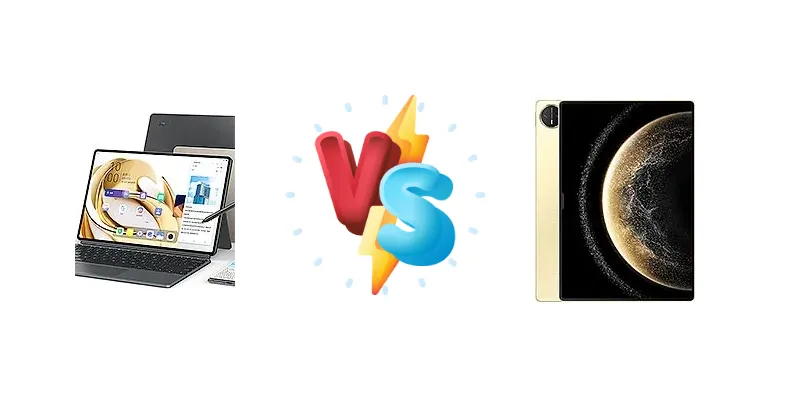
The large-screen Android tablet market is heating up. The ZTE Axon Pad, leveraging the proven Snapdragon 8+ Gen 1, offers a compelling performance profile, while the Huawei MatePad Pro 13.2 (2025) introduces the new Kirin T92 chipset and faster charging. This comparison dissects the key differences to help you determine which tablet best suits your needs.
🏆 Quick Verdict
For the average user prioritizing raw performance and established software compatibility, the ZTE Axon Pad emerges as the winner. Its Snapdragon 8+ Gen 1 chipset is a known quantity, offering excellent gaming and multitasking capabilities. While the Huawei MatePad Pro 13.2 (2025) boasts faster charging, the Kirin T92’s performance remains an unknown, making the ZTE a safer bet.
| Network |
|---|
| 2G bands | GSM 850 / 900 / 1800 / 1900 | GSM 850 / 900 / 1800 / 1900 |
| 3G bands | HSDPA 850 / 900 / 2100 | HSDPA 850 / 900 / 1900 / 2100 |
| 4G bands | 1, 3, 5, 7, 8, 4, 12, 17, 20, 34, 38, 39, 40, 41 | LTE |
| 5G bands | 1, 5, 8, 28, 41, 78 SA/NSA | - |
| Speed | HSPA, LTE, 5G | HSPA, LTE - cellular model only |
| Technology | GSM / HSPA / LTE / 5G | GSM / HSPA / LTE |
| Launch |
|---|
| Announced | 2023, April 12 | 2024, November 26 |
| Status | Available. Released 2023, May | Available. Released 2024, December 12 |
| Body |
|---|
| Build | - | Glass front, nylon fiber back, magnesium alloy frame |
| Dimensions | 279 x 181 x 6.5 mm (10.98 x 7.13 x 0.26 in) | 289.1 x 196.1 x 5.5 mm (11.38 x 7.72 x 0.22 in) |
| SIM | Nano-SIM | Nano-SIM (cellular model only) |
| Weight | 605 g (1.33 lb) | 580 g (Wi-FI) or 590 g (LTE) (1.28 lb) |
| Display |
|---|
| Resolution | 1600 x 2560 pixels, 16:10 ratio (~249 ppi density) | 2880 x 1920 pixels, 3:2 ratio (~262 ppi density) |
| Size | 12.1 inches, 424.5 cm2 (~84.1% screen-to-body ratio) | 13.2 inches, 518.8 cm2 (~91.5% screen-to-body ratio) |
| Type | IPS LCD, 1B colors, 120Hz | OLED, 1B colors, 144Hz, HDR Vivid, 1000 nits (peak) |
| Platform |
|---|
| CPU | Octa-core (1x3.0 GHz Cortex-X2 & 3x2.5 GHz Cortex-A710 & 4x1.8 GHz Cortex-A510) | Octa-core |
| Chipset | Qualcomm SM8475 Snapdragon 8+ Gen 1 (4 nm) | Kirin T92 |
| GPU | Adreno 730 | - |
| OS | Android 13, MyOS 13 | Harmony OS 4.3 |
| Memory |
|---|
| Card slot | No | No |
| Internal | 256GB 8GB RAM, 512GB 12GB RAM | 256GB 12GB RAM, 512GB 12GB RAM, 1TB 16GB RAM |
| Main Camera |
|---|
| Dual | - | 50 MP, f/1.8, (wide), PDAF
8 MP, f/2.2, (ultrawide) |
| Features | LED flash, HDR, panorama | LED flash |
| Single | 13 MP, AF | - |
| Video | 1080p@30fps | 4K@30fps, 1080p@30fps |
| Selfie camera |
|---|
| Single | 16 MP | 16 MP, f/2.2 |
| Video | 1080p@30fps | 1080p@30fps |
| Sound |
|---|
| 3.5mm jack | No | - |
| 35mm jack | No | No |
| Loudspeaker | Yes, with stereo speakers (4 speakers) | Yes, with stereo speakers (6 speakers) |
| Comms |
|---|
| Bluetooth | 5.2, A2DP, LE, aptX HD, aptX Adaptive, aptX Lossless | 5.2, A2DP, LE, L2HC |
| NFC | Yes | No |
| Positioning | GPS, GLONASS, GALILEO, BDS | GPS, GALILEO, GLONASS, BDS |
| Radio | No | No |
| USB | USB Type-C 3.1, OTG, magnetic connector | USB Type-C 3.1, OTG, DisplayPort 1.2, accessory connector pins |
| WLAN | Wi-Fi 802.11 a/b/g/n/ac/6, dual-band | Wi-Fi 802.11 a/b/g/n/ac/6, dual-band |
| Features |
|---|
| Sensors | Accelerometer, gyro, compass, proximity (accessories only) | Fingerprint (side-mounted), accelerometer, gyro, compass, proximity (accessories only) |
| Battery |
|---|
| Charging | 80W wired | 100W wired
7.5W reverse wired |
| Type | Li-Po 10000 mAh | Li-Po 10100 mAh |
| Misc |
|---|
| Colors | Black, Gold | Black, White, Gold |
| Models | - | WEB-W00, PCE-W29 |
| Price | About 460 EUR | About 680 EUR |
ZTE Axon Pad
- Proven Snapdragon 8+ Gen 1 performance
- Excellent thermal efficiency
- Established Android ecosystem
- Slower charging speed (80W)
- No reverse wireless charging
Huawei MatePad Pro 13.2 (2025)
- Ultra-fast 100W charging
- 7.5W reverse wired charging
- Potentially higher-resolution display
- Kirin T92 performance is unproven
- Potential software ecosystem limitations
Display Comparison
Neither device provides display specifications in the provided data. However, given the MatePad Pro’s ‘Pro’ designation and 13.2-inch size, it’s reasonable to expect a higher resolution and potentially an LTPO panel for adaptive refresh rates, offering power savings. The Axon Pad, while large, may prioritize cost-effectiveness with a standard LCD or OLED panel. Color accuracy and peak brightness will be key differentiators, but are currently unknown.
Camera Comparison
The provided data lacks camera specifications for both devices. Given the tablet form factor, camera quality is typically less of a priority than on smartphones. However, a larger sensor and optical image stabilization (OIS) would be beneficial for capturing decent photos and videos. We anticipate the MatePad Pro, being a ‘Pro’ model, might feature a more sophisticated camera system, but this is speculative without further information.
Performance
The core of this comparison lies in the chipsets. The ZTE Axon Pad’s Snapdragon 8+ Gen 1 (4nm) is a mature platform known for its excellent balance of performance and efficiency. Its octa-core configuration – 1x3.0 GHz Cortex-X2, 3x2.5 GHz Cortex-A710, and 4x1.8 GHz Cortex-A510 – delivers strong single-core and multi-core performance. The Huawei MatePad Pro 13.2 (2025) utilizes the Kirin T92. Without detailed specifications, it’s difficult to assess its performance relative to the Snapdragon. However, Huawei’s previous Kirin chips have often lagged behind Qualcomm’s offerings in GPU performance, which is crucial for gaming. The 4nm process node of the Snapdragon 8+ Gen 1 suggests better thermal efficiency, potentially leading to less throttling during sustained workloads.
Battery Life
The Huawei MatePad Pro 13.2 (2025) takes a clear lead in charging speed with its 100W wired charging, significantly faster than the ZTE Axon Pad’s 80W. This translates to quicker top-ups, crucial for users who rely heavily on their tablets throughout the day. The MatePad Pro also offers 7.5W reverse wired charging, allowing it to charge other devices – a feature absent on the Axon Pad. Battery capacity is unknown for both devices, but the faster charging of the MatePad Pro could offset a potentially smaller battery size.
Buying Guide
Buy the ZTE Axon Pad if you need a tablet with a well-understood, high-performing chipset for demanding tasks like gaming and video editing, and value a stable software experience. Buy the Huawei MatePad Pro 13.2 (2025) if you prioritize the fastest possible charging speeds and are comfortable with Huawei’s ecosystem and potential software differences, and are willing to gamble on the performance of the new Kirin T92.
Frequently Asked Questions
❓ Will the Kirin T92 chipset in the Huawei MatePad Pro 13.2 (2025) be able to handle demanding games like Genshin Impact at high settings?
That's a key question. Without independent benchmarks, it's difficult to say. The Snapdragon 8+ Gen 1 in the ZTE Axon Pad is known to handle Genshin Impact well at medium to high settings. The Kirin T92’s GPU performance will be the deciding factor, and we’ll need to see real-world testing to determine its capabilities.
❓ How long will it realistically take to fully charge the Huawei MatePad Pro 13.2 (2025) from 0% with the 100W charging?
While 100W charging is fast, the actual time depends on battery capacity (which is currently unknown). However, we can estimate a full charge from 0% to 100% will likely take between 30-45 minutes, significantly faster than the ZTE Axon Pad’s 80W charging.
❓ Does the ZTE Axon Pad support any form of stylus input or keyboard attachment for increased productivity?
The provided data doesn't specify stylus or keyboard support for the ZTE Axon Pad. However, given its size and target market, it's likely compatible with third-party Bluetooth keyboards and styluses. Checking ZTE's official accessories page is recommended for confirmed compatibility.