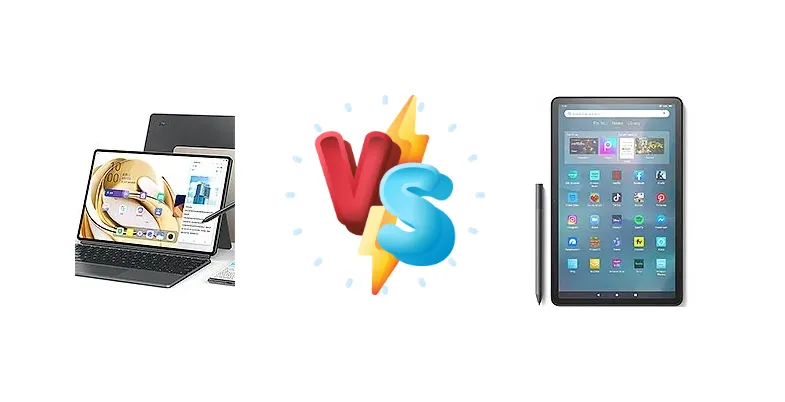
The Android tablet market offers a spectrum of choices, from premium flagships to budget-friendly options. The ZTE Axon Pad enters as a performance-focused contender with a high-end Snapdragon processor, while the Amazon Fire Max 11 aims to deliver a solid experience at a significantly lower price point. This comparison dissects their key differences to determine which tablet best suits your needs.
🏆 Quick Verdict
For users prioritizing raw performance and fast charging, the ZTE Axon Pad is the clear winner. Its Snapdragon 8+ Gen 1 chipset delivers a significantly smoother experience for demanding tasks. However, the Amazon Fire Max 11 provides excellent value for casual users focused on media consumption and light productivity.
| Network |
|---|
| 2G bands | GSM 850 / 900 / 1800 / 1900 | N/A |
| 3G bands | HSDPA 850 / 900 / 2100 | - |
| 4G bands | 1, 3, 5, 7, 8, 4, 12, 17, 20, 34, 38, 39, 40, 41 | - |
| 5G bands | 1, 5, 8, 28, 41, 78 SA/NSA | - |
| EDGE | - | No |
| GPRS | - | No |
| Speed | HSPA, LTE, 5G | - |
| Technology | GSM / HSPA / LTE / 5G | No cellular connectivity |
| Launch |
|---|
| Announced | 2023, April 12 | 2023, May 23 |
| Status | Available. Released 2023, May | Available. Released 2023, May 23 |
| Body |
|---|
| Dimensions | 279 x 181 x 6.5 mm (10.98 x 7.13 x 0.26 in) | 259.1 x 163.7 x 7.5 mm (10.20 x 6.44 x 0.30 in) |
| SIM | Nano-SIM | No |
| Weight | 605 g (1.33 lb) | 490 g (1.08 lb) |
| Display |
|---|
| Resolution | 1600 x 2560 pixels, 16:10 ratio (~249 ppi density) | 2000 x 1200 pixels, 5:3 ratio (~212 ppi density) |
| Size | 12.1 inches, 424.5 cm2 (~84.1% screen-to-body ratio) | 11.0 inches, 344.4 cm2 (~81.2% screen-to-body ratio) |
| Type | IPS LCD, 1B colors, 120Hz | IPS LCD |
| Platform |
|---|
| CPU | Octa-core (1x3.0 GHz Cortex-X2 & 3x2.5 GHz Cortex-A710 & 4x1.8 GHz Cortex-A510) | Octa-core (2x2.2 GHz Cortex-A78 & 6x2.0 GHz Cortex-A55) |
| Chipset | Qualcomm SM8475 Snapdragon 8+ Gen 1 (4 nm) | Mediatek MT8188J |
| GPU | Adreno 730 | Mali-G57 MC2 |
| OS | Android 13, MyOS 13 | Android 11, Fire OS 8 |
| Memory |
|---|
| Card slot | No | microSDXC (dedicated slot) |
| Internal | 256GB 8GB RAM, 512GB 12GB RAM | 64GB 4GB RAM, 128GB 4GB RAM |
| Main Camera |
|---|
| Features | LED flash, HDR, panorama | - |
| Single | 13 MP, AF | 8 MP, AF |
| Video | 1080p@30fps | 1080p |
| Selfie camera |
|---|
| Single | 16 MP | 8 MP |
| Video | 1080p@30fps | 1080p |
| Sound |
|---|
| 3.5mm jack | No | - |
| 35mm jack | No | No |
| Loudspeaker | Yes, with stereo speakers (4 speakers) | Yes, with stereo speakers |
| Comms |
|---|
| Bluetooth | 5.2, A2DP, LE, aptX HD, aptX Adaptive, aptX Lossless | 5.3, A2DP, LE |
| NFC | Yes | No |
| Positioning | GPS, GLONASS, GALILEO, BDS | No |
| Radio | No | No |
| USB | USB Type-C 3.1, OTG, magnetic connector | USB Type-C 2.0, OTG, magnetic accessory connector |
| WLAN | Wi-Fi 802.11 a/b/g/n/ac/6, dual-band | Wi-Fi 802.11 a/b/g/n/ac/6, dual-band |
| Features |
|---|
| Sensors | Accelerometer, gyro, compass, proximity (accessories only) | Fingerprint (side-mounted), accelerometer, proximity (accessories only) |
| Battery |
|---|
| Charging | 80W wired | 15W wired |
| Type | Li-Po 10000 mAh | Li-Ion |
| Misc |
|---|
| Colors | Black, Gold | Gray |
| Models | - | KFSNWI |
| Price | About 460 EUR | About 270 EUR |
ZTE Axon Pad
- Flagship Snapdragon 8+ Gen 1 performance
- Ultra-fast 80W charging
- Potentially superior camera capabilities
- Likely higher price point
- Potential for higher heat output under sustained load
Amazon Fire Max 11
- Significantly more affordable
- Amazon ecosystem integration
- Good for basic media consumption
- Lower performance compared to the Axon Pad
- Slow 15W charging
- Limited app ecosystem outside of Amazon Appstore
Display Comparison
While display specifications are missing for both devices, the Fire Max 11's 11-inch screen suggests a focus on media consumption. The Axon Pad, likely targeting a similar size, benefits from the Snapdragon 8+ Gen 1's image signal processor, potentially enabling superior display calibration and HDR performance. The absence of LTPO technology in either device suggests standard refresh rates, but the Axon Pad's more powerful chipset could drive more sophisticated display processing algorithms.
Camera Comparison
Camera details are sparse, but the Axon Pad’s Snapdragon 8+ Gen 1 includes a powerful ISP capable of handling more complex image processing. This suggests potentially better image quality, especially in low-light conditions. Without specific sensor information, it’s difficult to make a definitive judgment, but the Axon Pad’s chipset provides a foundation for a more capable camera system. The Fire Max 11 likely prioritizes cost savings in this area, resulting in a more basic camera experience.
Performance
The core difference lies in the chipsets. The ZTE Axon Pad’s Qualcomm SM8475 Snapdragon 8+ Gen 1 (4nm) is a flagship-level processor featuring an octa-core configuration with a Cortex-X2 prime core clocked at 3.0 GHz. This architecture, built on a 4nm process, provides substantial performance and efficiency gains over the Amazon Fire Max 11’s MediaTek MT8188J. The MT8188J, with its octa-core setup of 2x2.2 GHz Cortex-A78 and 6x2.0 GHz Cortex-A55 cores, is geared towards everyday tasks. The Snapdragon 8+ Gen 1’s superior CPU and GPU will translate to significantly faster app loading times, smoother multitasking, and a much better gaming experience. The 4nm process also means better thermal management, reducing the likelihood of performance throttling during extended use.
Battery Life
Battery capacity is not specified for either device. However, the charging speeds are drastically different. The ZTE Axon Pad’s 80W wired charging is a significant advantage, allowing for a full charge in a fraction of the time compared to the Amazon Fire Max 11’s 15W charging. While a larger battery capacity on the Fire Max 11 could offset the slower charging, the Axon Pad’s rapid charging capability provides a more convenient user experience, especially for those who frequently use their tablet on the go.
Buying Guide
Buy the ZTE Axon Pad if you need a tablet capable of handling demanding games, video editing, or multitasking without slowdowns, and if 80W fast charging is a priority. Buy the Amazon Fire Max 11 if you prefer a more affordable tablet for streaming video, browsing the web, reading ebooks, and basic productivity tasks, and are comfortable within the Amazon ecosystem.
Frequently Asked Questions
❓ Will the MediaTek MT8188J in the Fire Max 11 struggle with demanding games like Genshin Impact?
Yes, the MediaTek MT8188J is not designed for high-end gaming. While it can handle less demanding titles, Genshin Impact and similar games will likely experience significant frame rate drops and stuttering, even on low settings. The ZTE Axon Pad’s Snapdragon 8+ Gen 1 is far better equipped to handle these games smoothly.
❓ How does Amazon’s Fire OS compare to standard Android on the ZTE Axon Pad in terms of app availability?
Amazon’s Fire OS is based on Android but utilizes the Amazon Appstore instead of the Google Play Store. The Amazon Appstore has a smaller selection of apps compared to the Google Play Store, and some popular apps may be missing. The ZTE Axon Pad, running standard Android, provides access to the full Google Play Store ecosystem.
❓ Is the 80W charging on the ZTE Axon Pad compatible with standard USB-PD chargers?
While the ZTE Axon Pad supports 80W charging, it's crucial to use a compatible charger to achieve those speeds. It likely supports USB-PD, but using a lower wattage charger will result in slower charging times. Check the included documentation for specific charger compatibility details.