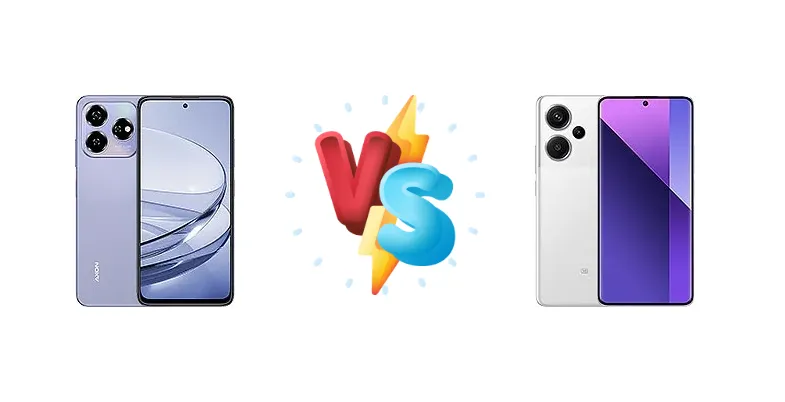
The mid-range smartphone market is fiercely competitive, and the ZTE Axon 60 and Xiaomi Redmi Note 13 Pro+ represent compelling options at different ends of the spectrum. The Axon 60 prioritizes efficiency with its Unisoc chipset, while the Redmi Note 13 Pro+ aggressively targets performance and convenience with its Dimensity 7200 Ultra and ultra-fast charging. This comparison dissects their key differences to help you choose the right phone for your needs.
🏆 Quick Verdict
For the average user prioritizing speed and convenience, the Xiaomi Redmi Note 13 Pro+ is the clear winner. Its Dimensity 7200 Ultra chipset delivers significantly better performance, and the 120W charging is a game-changer. However, the ZTE Axon 60 remains a viable option for those seeking a more power-efficient device.
| Network |
|---|
| 2G bands | GSM 850 / 900 / 1800 / 1900 | GSM 850 / 900 / 1800 / 1900 |
| 3G bands | HSDPA 850 / 900 / 1900 / 2100 | HSDPA 800 / 850 / 900 / 1700(AWS) / 1900 / 2100 - International |
| 4G bands | 1, 3, 5, 7, 8, 20, 28, 38, 40, 41 | 1, 2, 3, 4, 5, 7, 8, 12, 13, 17, 18, 19, 20, 26, 28, 32, 38, 40, 41, 66 - International |
| 5G bands | - | 1, 3, 5, 7, 8, 20, 28, 38, 40, 41, 66, 77, 78 SA/NSA- International |
| Speed | HSPA, LTE | HSPA, LTE, 5G |
| Technology | GSM / HSPA / LTE | GSM / CDMA / HSPA / EVDO / LTE / 5G |
| Launch |
|---|
| Announced | 2024, May 07 | 2023, September 21 |
| Status | Available. Released 2024, May | Available. Released 2023, September 21 |
| Body |
|---|
| Build | - | Glass front (Gorilla Glass Victus), glass back or silicone polymer back (eco leather) |
| Dimensions | 166.3 x 77.2 x 8.2 mm (6.55 x 3.04 x 0.32 in) | 161.4 x 74.2 x 8.9 mm (6.35 x 2.92 x 0.35 in) |
| SIM | Nano-SIM + Nano-SIM | · Nano-SIM + eSIM· Nano-SIM + Nano-SIM |
| Weight | - | 199 g or 204.5 g (7.02 oz) |
| Display |
|---|
| Protection | - | Corning Gorilla Glass Victus |
| Resolution | 1080 x 2400 pixels, 20:9 ratio (~392 ppi density) | 1220 x 2712 pixels, 20:9 ratio (~446 ppi density) |
| Size | 6.72 inches, 109.0 cm2 (~84.9% screen-to-body ratio) | 6.67 inches, 107.4 cm2 (~89.7% screen-to-body ratio) |
| Type | IPS LCD | AMOLED, 68B colors, 120Hz, 1920Hz PWM, Dolby Vision, HDR10+, 1800 nits (peak) |
| Platform |
|---|
| CPU | Octa-core (2x2.0 GHz Cortex-A75 & 6x1.8 GHz Cortex-A55) | Octa-core (2x2.8 GHz Cortex-A715 & 6x2.0 GHz Cortex-A510) |
| Chipset | Unisoc Tiger T616 (12 nm) | Mediatek Dimensity 7200 Ultra (4 nm) |
| GPU | Mali-G57 MP1 | Mali-G610 MC4 |
| OS | Android 13 | Android 13, up to 3 major Android upgrades, HyperOS |
| Memory |
|---|
| Card slot | microSDXC (dedicated slot) | No |
| Internal | 256GB 6GB RAM, 256GB 8GB RAM | 256GB 8GB RAM, 256GB 12GB RAM, 512GB 8GB RAM, 512GB 12GB RAM, 512GB 16GB RAM |
| Main Camera |
|---|
| Features | LED flash, HDR, panorama | Dual-LED dual-tone flash, HDR, panorama |
| Triple | 50 MP, f/1.8, (wide), PDAF
2 MP (macro)
Auxiliary lens | 200 MP, f/1.7, 23mm (wide), 1/1.4", 0.56µm, multi-directional PDAF, OIS
8 MP, f/2.2, 16mm, 120˚ (ultrawide), 1/4.0", 1.12µm
2 MP (macro) |
| Video | 1080p@30fps | 4K@24/30fps, 1080p@30/60/120fps, gyro-EIS |
| Selfie camera |
|---|
| Features | - | HDR, panorama |
| Single | 32 MP, f/2.0, (wide) | 16 MP, f/2.4, (wide) |
| Video | 1080p@30fps | 1080p@30/60fps |
| Sound |
|---|
| 35mm jack | Yes | No |
| Loudspeaker | Yes | Yes, with stereo speakers |
| Comms |
|---|
| Bluetooth | 5.2, A2DP, LE | 5.3, A2DP, LE |
| Infrared port | - | Yes |
| NFC | Yes (market/region dependent) | Yes (market/region dependent) |
| Positioning | GPS, GALILEO, GLONASS | GPS, GLONASS, BDS, GALILEO, QZSS |
| Radio | FM radio | No |
| USB | USB Type-C 2.0, OTG | USB Type-C 2.0, OTG |
| WLAN | Wi-Fi 802.11 a/b/g/n/ac, dual-band | Wi-Fi 802.11 a/b/g/n/ac/6, dual-band, Wi-Fi Direct |
| Features |
|---|
| Sensors | Fingerprint (side-mounted), accelerometer, proximity, compass | Fingerprint (under display, optical), accelerometer, gyro, proximity, compass |
| Battery |
|---|
| Charging | 22.5W wired | 120W wired, PD3.0, 100% in 19 min |
| Type | 5000 mAh | Li-Po 5000 mAh |
| Misc |
|---|
| Colors | Gold, Black, Purple | Midnight Black (Fushion Black), Moonlight White (Fushion White), Aurora Purple, Fushion Purple, Camo Green |
| Models | Z2356 | 23090RA98C, 23090RA98G, 23090RA98I |
| Price | About 200 EUR | $ 299.98 / £ 299.00 / € 208.98 / ₹ 24,999 |
| SAR | - | 1.09 W/kg (head) 0.85 W/kg (body) |
| SAR EU | - | 0.98 W/kg (head) 1.00 W/kg (body) |
ZTE Axon 60
- Potentially better power efficiency due to Unisoc T616
- More affordable price point (likely)
- Simpler software experience (potentially)
- Significantly slower charging speed
- Lower performance compared to Dimensity 7200 Ultra
- Likely less capable camera system
Xiaomi Redmi Note 13 Pro+
- Blazing-fast 120W charging
- Powerful Dimensity 7200 Ultra processor
- Brighter and potentially more accurate display
- Potentially lower battery life under heavy load
- Higher price compared to Axon 60
- More complex software (Xiaomi's MIUI)
Display Comparison
The Redmi Note 13 Pro+ boasts a significantly brighter display, reaching a measured peak of 1283 nits, making it far more usable outdoors in direct sunlight. While the Axon 60’s display specifications are not provided, it’s likely to fall considerably short of this brightness level. The Redmi Note 13 Pro+'s higher brightness also suggests a more modern panel technology, potentially with better color accuracy and viewing angles. The absence of LTPO information for either device suggests neither offers adaptive refresh rate technology for optimal power saving.
Camera Comparison
Without detailed camera specifications for the ZTE Axon 60, a direct comparison is limited. However, the Redmi Note 13 Pro+ likely benefits from a more advanced image signal processor (ISP) integrated within the Dimensity 7200 Ultra. While both phones may include multiple rear cameras, the Redmi Note 13 Pro+’s processing power will likely result in superior image quality, particularly in low-light conditions. The focus should be on the main sensor performance, as the inclusion of 2MP macro lenses on either device offers minimal practical benefit.
Performance
The performance gap between these two devices is substantial. The Xiaomi Redmi Note 13 Pro+ utilizes the Mediatek Dimensity 7200 Ultra, built on a 4nm process, featuring a Cortex-A715 prime core clocked at 2.8 GHz. This contrasts sharply with the ZTE Axon 60’s Unisoc Tiger T616 (12nm) and its Cortex-A75 cores at 2.0 GHz. The 4nm node of the Dimensity chip translates to significantly improved power efficiency and thermal performance, allowing for sustained peak performance during demanding tasks. The Redmi Note 13 Pro+ will demonstrably outperform the Axon 60 in gaming, video editing, and other processor-intensive applications.
Battery Life
The Redmi Note 13 Pro+’s 120W wired charging is its standout feature, capable of fully charging the device in just 19 minutes. This is a massive advantage over the Axon 60’s 22.5W charging. While the Redmi Note 13 Pro+'s battery capacity isn't specified, the active use score of 10:38h indicates strong battery life. The Axon 60, with its more efficient Unisoc chip, may offer comparable or slightly better battery endurance under light usage, but the Redmi Note 13 Pro+'s rapid charging mitigates any potential concerns about battery drain.
Buying Guide
Buy the ZTE Axon 60 if you prioritize long-term battery life and a more efficient processor for everyday tasks, and are less concerned with demanding gaming or rapid charging. Buy the Xiaomi Redmi Note 13 Pro+ if you demand faster performance for gaming and multitasking, and value the convenience of incredibly fast 120W charging, even if it comes at the cost of slightly reduced efficiency.
Frequently Asked Questions
❓ Is the 120W charging on the Redmi Note 13 Pro+ safe for the battery's long-term health?
Xiaomi employs multiple layers of safety protocols, including temperature monitoring and optimized charging algorithms, to mitigate the potential impact of fast charging on battery longevity. While all batteries degrade over time, the Redmi Note 13 Pro+'s charging system is designed to minimize this effect.
❓ How does the Unisoc Tiger T616 in the Axon 60 handle graphically intensive games like PUBG Mobile?
The Unisoc Tiger T616 is capable of running PUBG Mobile, but you'll likely need to lower the graphics settings to medium or low to achieve a consistently smooth frame rate. The Dimensity 7200 Ultra in the Redmi Note 13 Pro+ offers a significantly better gaming experience, allowing for higher settings and more stable performance.
❓ Does the Redmi Note 13 Pro+ support video recording at 4K resolution?
While not explicitly stated in the provided data, Xiaomi Redmi Note series phones typically support 4K video recording. It's highly probable the Redmi Note 13 Pro+ offers 4K recording capabilities, leveraging the processing power of the Dimensity 7200 Ultra for improved video stabilization and quality.