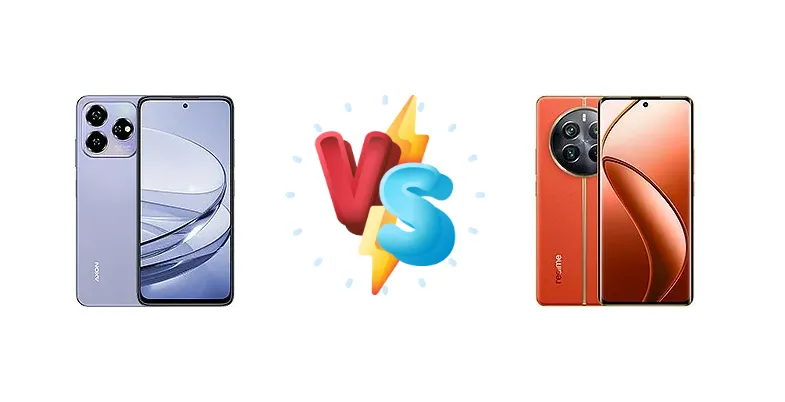
The mid-range smartphone market is fiercely competitive, and the ZTE Axon 60 and Realme 12 Pro+ represent distinct approaches. The Axon 60 aims for affordability, while the Realme 12 Pro+ prioritizes faster charging and a more modern chipset. This comparison dissects their key differences to help you choose the best fit.
🏆 Quick Verdict
For most users, the Realme 12 Pro+ is the superior choice. Its Snapdragon 7s Gen 2 chipset provides a noticeable performance boost, and the 67W charging is a game-changer. However, the ZTE Axon 60 remains a strong contender for budget-conscious buyers who prioritize value over raw power.
| Network |
|---|
| 2G bands | GSM 850 / 900 / 1800 / 1900 | GSM 850 / 900 / 1800 / 1900 |
| 3G bands | HSDPA 850 / 900 / 1900 / 2100 | HSDPA 850 / 900 / 2100 |
| 4G bands | 1, 3, 5, 7, 8, 20, 28, 38, 40, 41 | 1, 3, 5, 8, 28, 40, 41 |
| 5G bands | - | 1, 3, 5, 8, 28, 40, 41, 77, 78 SA/NSA |
| Speed | HSPA, LTE | HSPA, LTE, 5G |
| Technology | GSM / HSPA / LTE | GSM / HSPA / LTE / 5G |
| Launch |
|---|
| Announced | 2024, May 07 | 2024, January 29 |
| Status | Available. Released 2024, May | Available. Released 2024, January 29 |
| Body |
|---|
| Dimensions | 166.3 x 77.2 x 8.2 mm (6.55 x 3.04 x 0.32 in) | 161.5 x 74 x 8.8 mm (6.36 x 2.91 x 0.35 in) |
| SIM | Nano-SIM + Nano-SIM | Nano-SIM + Nano-SIM |
| Weight | - | 196 g (6.91 oz) |
| Display |
|---|
| Resolution | 1080 x 2400 pixels, 20:9 ratio (~392 ppi density) | 1080 x 2412 pixels, 20:9 ratio (~394 ppi density) |
| Size | 6.72 inches, 109.0 cm2 (~84.9% screen-to-body ratio) | 6.7 inches, 108.0 cm2 (~90.4% screen-to-body ratio) |
| Type | IPS LCD | AMOLED, 1B colors, 120Hz, 800 nits (HBM), 950 nits (peak) |
| Platform |
|---|
| CPU | Octa-core (2x2.0 GHz Cortex-A75 & 6x1.8 GHz Cortex-A55) | Octa-core (4x2.40 GHz Cortex-A78 & 4x1.95 GHz Cortex-A55) |
| Chipset | Unisoc Tiger T616 (12 nm) | Qualcomm SM7435-AB Snapdragon 7s Gen 2 (4 nm) |
| GPU | Mali-G57 MP1 | Adreno 710 |
| OS | Android 13 | Android 14, Realme UI 5.0 |
| Memory |
|---|
| Card slot | microSDXC (dedicated slot) | No |
| Internal | 256GB 6GB RAM, 256GB 8GB RAM | 128GB 8GB RAM, 256GB 8GB RAM, 256GB 12GB RAM, 512GB 12GB RAM |
| Main Camera |
|---|
| Features | LED flash, HDR, panorama | LED flash, HDR, panorama |
| Triple | 50 MP, f/1.8, (wide), PDAF
2 MP (macro)
Auxiliary lens | 50 MP, f/1.8, 24mm (wide), 1/1.56", 1.0µm, multi-directional PDAF, OIS
64 MP, f/2.8, 71mm, (periscope telephoto), 1/2.0", 0.7µm, PDAF, OIS, 3x optical zoom
8 MP, f/2.2, 16mm, 112˚ (ultrawide), 1/4.0", 1.12µm |
| Video | 1080p@30fps | 4K@30fps, 1080p@30/60/120fps, gyro-EIS |
| Selfie camera |
|---|
| Single | 32 MP, f/2.0, (wide) | 32 MP, f/2.4, 22mm (wide) |
| Video | 1080p@30fps | 1080p@30fps |
| Sound |
|---|
| 35mm jack | Yes | No |
| Loudspeaker | Yes | Yes, with stereo speakers |
| Comms |
|---|
| Bluetooth | 5.2, A2DP, LE | 5.2, A2DP, LE |
| NFC | Yes (market/region dependent) | Yes (market/region dependent) |
| Positioning | GPS, GALILEO, GLONASS | GPS, GLONASS, GALILEO, BDS, QZSS |
| Radio | FM radio | No |
| USB | USB Type-C 2.0, OTG | USB Type-C 2.0 |
| WLAN | Wi-Fi 802.11 a/b/g/n/ac, dual-band | Wi-Fi 802.11 a/b/g/n/ac/6, dual-band |
| Features |
|---|
| Sensors | Fingerprint (side-mounted), accelerometer, proximity, compass | Fingerprint (under display, optical), accelerometer, gyro, proximity, compass |
| Battery |
|---|
| Charging | 22.5W wired | 67W wired, 50% in 19 min |
| Type | 5000 mAh | 5000 mAh |
| Misc |
|---|
| Colors | Gold, Black, Purple | Submarine Blue, Navigator Beige, Explorer Red |
| Models | Z2356 | RMX3840, RMX3841 |
| Price | About 200 EUR | $ 465.00 / £ 299.00 / € 344.26 / ₹ 28,400 |
ZTE Axon 60
- Excellent value for money
- Functional for everyday tasks
- Potentially longer software support (ZTE's history)
- Significantly slower processor
- Slow charging speed
- Likely inferior display quality
Realme 12 Pro+
- Faster Snapdragon 7s Gen 2 processor
- Ultra-fast 67W charging
- Brighter and potentially smoother display
- Long battery life (13:24h active use)
- Higher price point
- Realme's software can be bloated
- Potential for more aggressive background app management
Display Comparison
The Realme 12 Pro+ boasts a brighter display, reaching a measured peak of 802 nits, which translates to better visibility outdoors compared to the ZTE Axon 60 (brightness data unavailable). While both likely utilize LCD panels given their price points, the Realme’s higher brightness is a tangible advantage. The absence of refresh rate data for the Axon 60 suggests a standard 60Hz panel, while the 12 Pro+ is expected to have a 120Hz panel, offering a smoother scrolling experience. Bezels are likely comparable, but the Realme’s overall display quality is expected to be superior.
Camera Comparison
Without detailed camera specs for the ZTE Axon 60, a direct comparison is limited. However, the Realme 12 Pro+ is expected to feature a more sophisticated camera system, likely with a larger main sensor and optical image stabilization (OIS). The Realme’s image processing algorithms are also likely more refined, resulting in better dynamic range and low-light performance. While the Axon 60 may offer acceptable image quality in good lighting conditions, the 12 Pro+ is expected to deliver consistently better results across various scenarios. The presence of a 2MP macro camera on either device is largely inconsequential.
Performance
The core difference lies in the chipsets. The Realme 12 Pro+’s Qualcomm Snapdragon 7s Gen 2 (4nm) is a significant upgrade over the ZTE Axon 60’s Unisoc Tiger T616 (12nm). The 4nm process node of the Snapdragon offers superior power efficiency and thermal performance, meaning less throttling during sustained workloads. The Snapdragon’s CPU configuration – 4x2.40 GHz Cortex-A78 & 4x1.95 GHz Cortex-A55 – is also more powerful than the Axon 60’s 2x2.0 GHz Cortex-A75 & 6x1.8 GHz Cortex-A55. This translates to faster app launches, smoother multitasking, and improved gaming performance on the Realme. The Axon 60 will handle everyday tasks, but the 12 Pro+ provides headroom for more demanding applications.
Battery Life
The Realme 12 Pro+ shines in the battery and charging department. Its 67W wired charging can replenish 50% of the battery in just 19 minutes, a massive advantage over the ZTE Axon 60’s 22.5W charging. While the Axon 60’s battery capacity is unknown, the Realme 12 Pro+ achieves an impressive 13:24h of active use, suggesting excellent battery life despite the faster charging. The faster charging speed of the Realme mitigates any potential concerns about battery capacity, making it the more convenient option for users who need to quickly top up their device.
Buying Guide
Buy the ZTE Axon 60 if you need a functional, everyday smartphone with acceptable performance for basic tasks and prioritize maximizing value for your money. Buy the Realme 12 Pro+ if you prefer a smoother user experience, faster app loading times, and significantly quicker charging, even if it means spending a bit more.
Frequently Asked Questions
❓ Is the Unisoc Tiger T616 in the ZTE Axon 60 capable of running demanding games like Genshin Impact?
While the Axon 60 can *launch* Genshin Impact, expect significant compromises in graphics settings and frame rates. The Unisoc T616 lacks the graphical horsepower of the Snapdragon 7s Gen 2, resulting in a less enjoyable gaming experience. It's better suited for less demanding titles.
❓ How does the 67W charging on the Realme 12 Pro+ compare to other fast charging standards?
67W is considerably faster than the 22.5W charging on the ZTE Axon 60 and is competitive with many other mid-range phones. It's not the absolute fastest charging available (some phones reach 120W or higher), but it's more than sufficient for quickly topping up the battery during short breaks.
❓ Does the Realme 12 Pro+ experience significant throttling during prolonged gaming sessions?
The Snapdragon 7s Gen 2's 4nm process node and the Realme 12 Pro+'s cooling system are designed to mitigate throttling. While some performance degradation is inevitable during extended gaming, it should be less pronounced than on devices with less efficient chipsets like the Unisoc T616.